The Gravesite of Myles Standish
After visiting the site of Myles Standish’s homestead, we continued following his story in Duxbury to the place where he was laid to rest. Standish died here on October 3, 1656, more than three decades after arriving aboard the Mayflower and after spending much of his later life helping establish the community of Duxbury.
There is a particularly personal detail behind his burial place. In his will, Standish requested that he be buried as close as possible to his “two dear daughters”. One was his daughter Lora Standish. The other was Mary Dingley Standish, the wife of his son Josiah and therefore his daughter-in-law. Both women had died before him. His choice to be buried beside them adds a very different dimension to the familiar image of Standish as the forceful military leader of Plymouth Colony.
Over the generations, the precise location of Standish’s grave was lost. More than two centuries later, local tradition and historical research led to efforts to find it. Two distinctive triangular or pyramid-shaped fieldstones were associated with the location, and excavations were undertaken in 1889 and again in 1891. The arrangement of the graves, Standish’s instructions in his will and other evidence led investigators to identify this as the Standish family burial site.
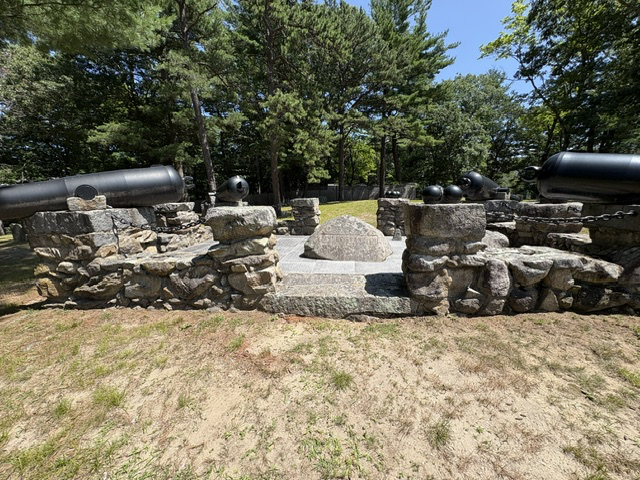
The memorial we see today was created in the late nineteenth century to permanently mark the location. The large stones identify the graves, while the low stone enclosure, chains, cannons and cannonballs surrounding them immediately recall Standish’s role as the military leader of Plymouth Colony. The military imagery is dramatic, but it was added centuries after his death; it commemorates the man rather than representing what his original seventeenth-century grave would have looked like.
Standish had come aboard the Mayflower not as one of the religious Separatists but as a professional soldier. His military experience proved important during the uncertain early years of Plymouth Colony, when he organized its defenses and participated in expeditions throughout the region. Eventually, however, his life became centered in Duxbury, where he established his homestead and remained until his death.
The gravesite itself is striking. The large fieldstones marking the burials are surrounded by a low stone enclosure, heavy chains, four cannons and stacks of cannonballs. These military elements were added long after Standish’s death, creating a memorial that immediately identifies the importance of his role as the military leader of Plymouth Colony.
At the center, however, are the much simpler stones marking the graves of Standish, his daughter Lora and his daughter-in-law Mary. Standish specifically requested that he be buried near the two women, and their graves remain together within the memorial. The combination of the old burial stones and the later cannons makes this an unusual and memorable gravesite, preserving both the location of his burial and the military role for which Captain Myles Standish is remembered nearly four centuries later.
Read More From Nancy
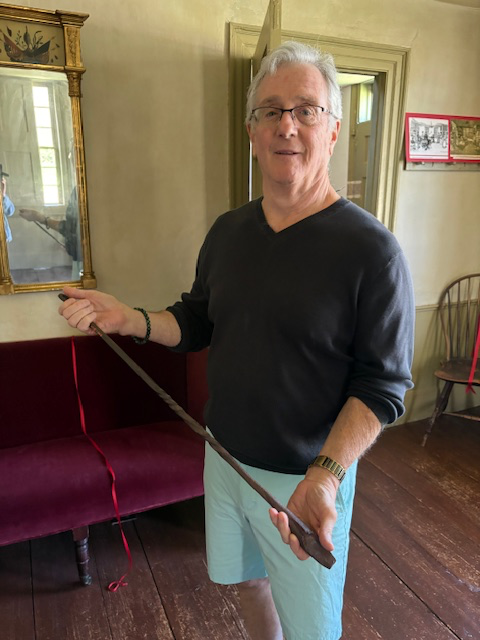
The Flip Dog
When we visited the Golden Ball Tavern in Weston, one of the objects that caught our attention was this long iron implement. At first glance, it doesn’t reveal very much about its purpose. But once we learned how it was used, it provided a wonderful glimpse into everyday tavern life more than two centuries ago. […]
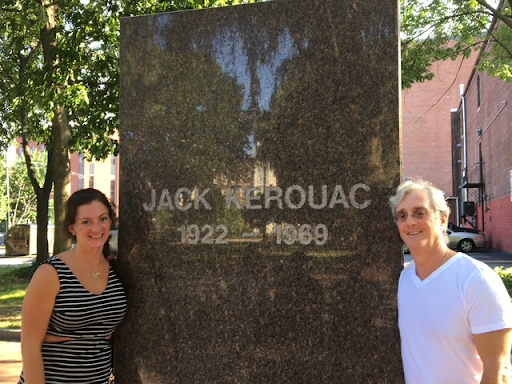
Jack Kerouac Memorial
Born in Lowell in 1922, Jean-Louis Lebris de Kérouac was the son of French-Canadian immigrants and grew up speaking French before learning English. His working-class upbringing and the close-knit ethnic neighborhoods of Lowell would later appear throughout his writings. Although he became famous for his travels across America, he never lost his During a visit to […]
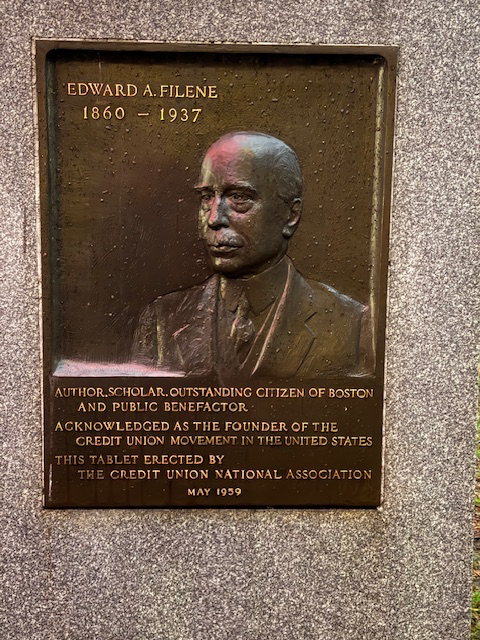
Edward A. Filene Plague
Walking along the fence surrounding the Boston Common, I came across this bronze plaque honoring Edward A. Filene. While many people recognize the Filene name from the famous Boston department store, few realize the tremendous influence he had beyond retail. Filene believed that ordinary working families deserved access to affordable credit and financial opportunity. His […]

