Saint John War Memorial
Standing among the trees of King’s Square, the Saint John War Memorial honors the men and women of the city who served and died in military conflicts. The monument was originally created to remember those lost during the First World War, but later inscriptions expanded its meaning to include the Second World War, the Korean War, and Canada’s involvement in Afghanistan.
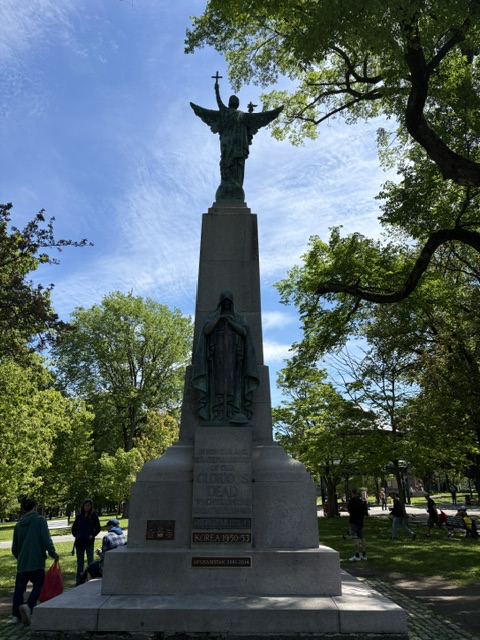
The movement to create the memorial began in 1922, when the Saint John chapter of the Imperial Order Daughters of the Empire called a public meeting to discuss how the city should commemorate its war dead. The proposal received support from veterans and other community organizations, and a public fundraising campaign was organized. A design competition was held, and the submission by Canadian sculptor Alfred Howell was selected.
Howell created a memorial that expresses both victory and mourning. At the top of the granite column is a winged bronze figure holding a victory flag in one hand and a cross in the other. Below her is a second female figure representing grief. She stands with her head bowed and her hands resting upon a sword. A soldier’s helmet and laurel leaves appear at her feet, symbols of military service, sacrifice, and honor.
The two figures present very different emotions. The figure above looks outward and upward, suggesting victory, faith, and hope. The mourning figure below is quiet and solemn, representing the families and community left behind. Together, they convey the memorial’s central message: military victory came at an enormous human cost.
Choosing where to place the monument created considerable disagreement within Saint John. The memorial committee wanted it positioned at the head of King Street, one of the most prominent locations in the city. That space, however, was occupied by a drinking fountain erected by the Women’s Christian Temperance Union in memory of the Loyalist women who helped establish Saint John. Some residents believed that removing the fountain would honor one generation by erasing the memory of another. The war memorial was ultimately placed nearby without displacing the earlier monument.
The completed memorial was unveiled on June 10, 1925. Its original dedication honored Saint John’s dead from the First World War, whose names and losses were still very much part of the lives of local families. After later conflicts, additional inscriptions were placed upon the monument so that it would continue to represent the sacrifices made by succeeding generations.
The setting within King’s Square gives the monument a particularly important place in the life of the city. People pass it while walking to the market, attending events, resting beneath the trees, or crossing the square during an ordinary day. It brings the memory of military service and loss into a public space that has been used by the people of Saint John since 1785.

Read More From Nancy
Inside the Saint John City Market
While visiting Saint John, we stopped at the City Market for lunch. What began as a place to find something to eat also allowed us to participate in a tradition that reaches back to the city’s founding. Saint John’s 1785 royal charter authorized the operation of public markets, and vendors have gathered inside the present […]
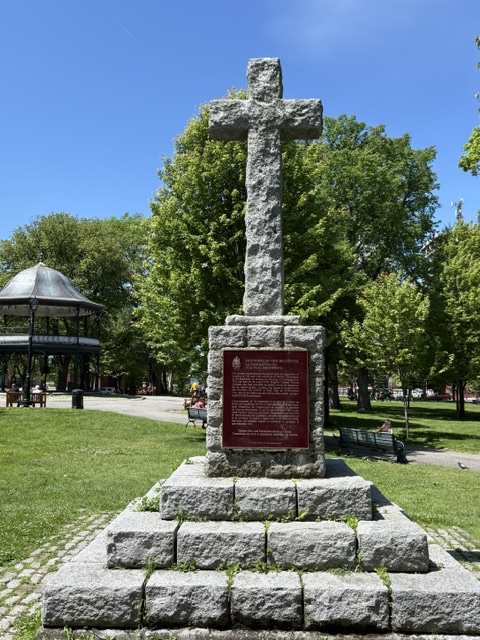
Founding of New Brunswick Monument
A tall granite cross in Saint John’s King’s Square marks the political events that created the Province of New Brunswick. Its story begins with the conclusion of the American Revolution, when thousands of people who had remained loyal to the British Crown left the newly independent United States and traveled north. In 1783, approximately 14,000 […]
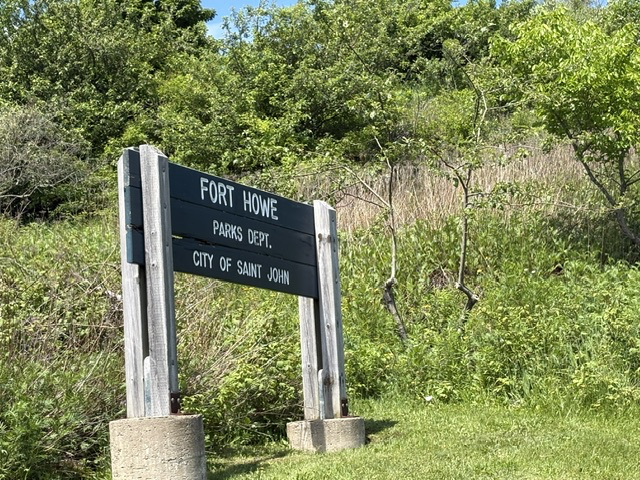
Fort Howe
From its position high above Saint John, Fort Howe once guarded the entrance to the Saint John River and the harbor below. The location offered British soldiers an expansive view of approaching ships and made the ridge a natural place from which to defend the settlement. The fort was constructed in 1777 during the American […]

