Puffer’s Building
Walking through the streets around Massachusetts General Hospital, Marty and I kept coming across buildings that made us stop and look. This one immediately caught my attention. Rising above Cambridge Street, its red-brick façade is interrupted by an extraordinary three-story projecting bay covered in green-patinated metal. Across the front, worked into the metal itself, are the words “Puffer’s Building”.
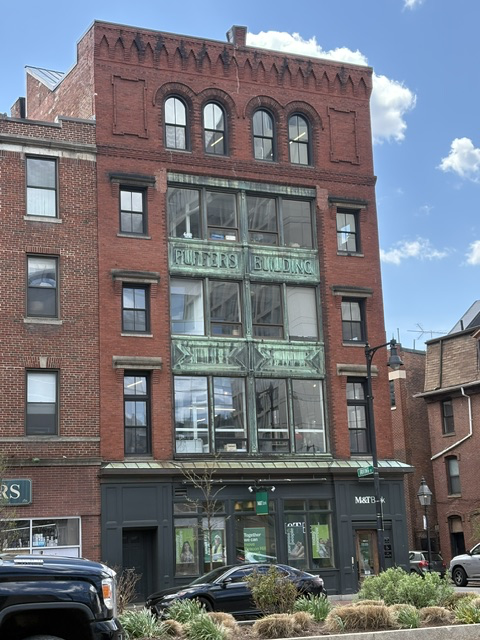
The Puffer’s Building stands at 214–218 Cambridge Street and dates to 1899. It was constructed during a period when this part of Boston was very different from the neighborhood we see today. Cambridge Street ran through the heart of the old West End, a densely populated neighborhood filled with tenements, shops, workshops, small factories, churches and gathering places.
By the turn of the twentieth century, the West End had become one of Boston’s great immigrant neighborhoods. Irish immigrants had established themselves here earlier in the nineteenth century, and they were followed by Jewish families from Eastern Europe as well as Italians and people from many other backgrounds. Families often lived within walking distance of their work, and buildings like Puffer’s combined the commercial and manufacturing activity that helped sustain the neighborhood.
The Puffer’s Building was associated with small manufacturing enterprises, including cigar making and garment work. These were important trades in the West End, providing employment for immigrant men and women who were building new lives in Boston. Historic recollections of the neighborhood even include memories of people whose family members worked in cigar shops within the Puffer’s Building.
Beginning in the late 1950s, Boston undertook one of the most consequential urban-renewal projects in the city’s history. Large portions of the old West End were declared blighted, properties were taken by eminent domain, and hundreds of buildings were demolished. Thousands of residents were displaced as entire streets and blocks disappeared. In their place came large residential complexes, government buildings, roads and an expanding Massachusetts General Hospital.
The destruction of the West End later became a nationally important example of the consequences of mid-twentieth-century urban renewal. What planners saw as deteriorated buildings had also been a functioning neighborhood of families, businesses, friendships and community institutions.
Yet here on Cambridge Street, the Puffer’s Building remained.
Its survival allows us to see a small piece of the streetscape that existed before so much of the surrounding West End disappeared. The building has since been rehabilitated and adapted for modern use, but its red brick, tall windows and especially that distinctive green metal bay continue to announce its nineteenth-century origins. The Puffer’s Building is not simply an architectural survivor. It is a remaining fragment of Boston’s old West End and of the immigrants, workers, small businesses and families who once filled the streets surrounding it.
Read More From Nancy
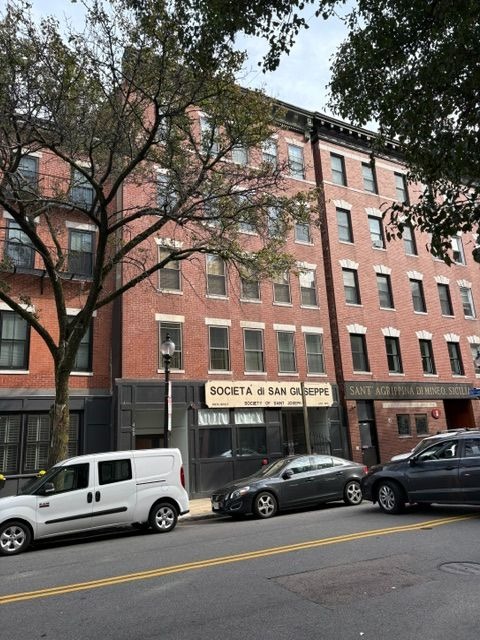
Italian Societies
Walking along Hanover Street, we passed the neighboring entrances of the Saint Joseph Society and the Sant’Agrippina di Mineo Society. Their Italian names preserve connections to particular towns in Sicily and to traditions that immigrants brought with them to Boston. The Saint Joseph Society was founded in 1915 by immigrants from Riesi, Sicily, and formally […]
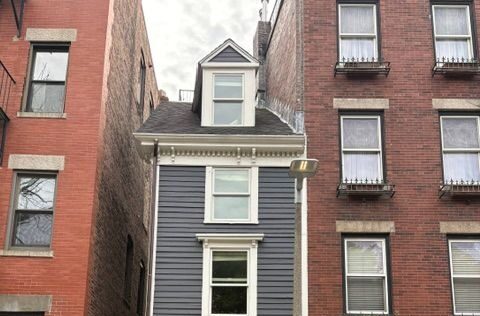
The Skinny House
Across from Copp’s Hill Burying Ground, a remarkably narrow wooden house stands among the larger brick buildings of Boston’s North End. At 44 Hull Street, the Skinny House rises four stories while measuring only about ten feet across its street-facing exterior. Its entrance is tucked into the alley beside it, allowing the slender front to […]
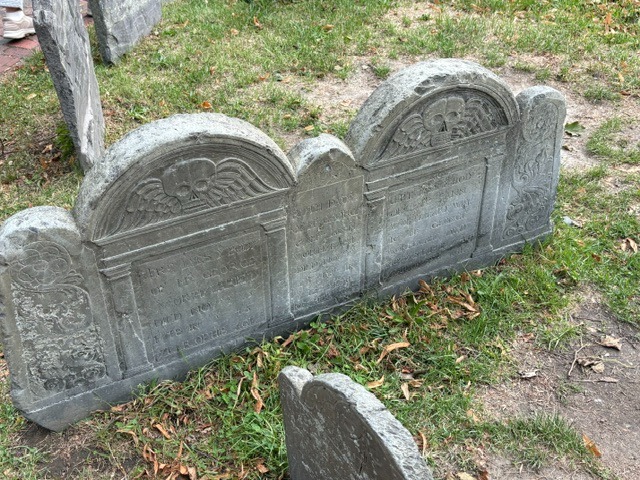
Carved Remembrance at Copp’s Hill Burying Ground
At Copp’s Hill Burying Ground, the carved gravestones preserve more than names and dates. Their shapes, lettering, and symbols reveal how earlier generations commemorated the dead and reminded the living of their own mortality. Looking closely at these markers introduces another part of Boston’s history: the work of stone carvers and the visual language their […]

