New Synagogue
With its gilded dome rising above Oranienburger Straße, Berlin’s New Synagogue was a prominent expression of Jewish communal life when it opened in 1866. Its scale and elaborate architecture reflected a community establishing a visible place within the growing capital.
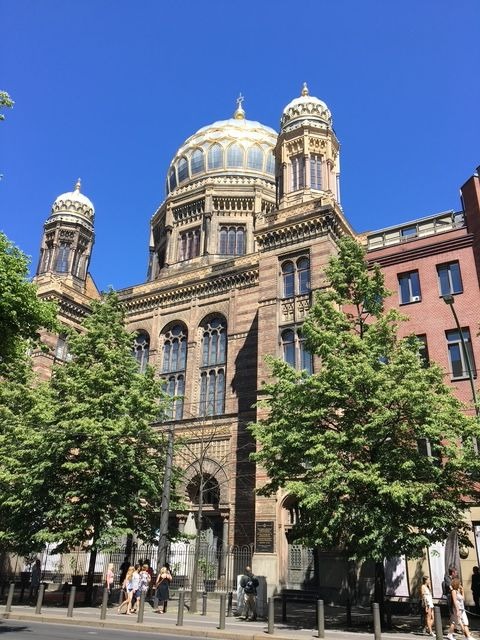
Built to designs by Eduard Knoblauch, the synagogue drew on Moorish architectural forms. Its richly ornamented façade and dome distinguished it from surrounding buildings, making the entrance a recognizable landmark in the neighborhood.
During the Nazi pogrom of November 9–10, 1938, members of the SA set fire to the building. Police officers led by local precinct head Wilhelm Krützfeld intervened, preventing greater destruction. Their actions preserved the synagogue that night, while Jewish communities across Germany endured coordinated violence.
The building nevertheless suffered devastating damage during the Second World War. In 1958, the ruined main sanctuary was demolished. The façade and surviving front sections remained, fragments of a much larger place of worship.
Partial reconstruction began in 1988, and the restored building opened in 1995 as the home of Centrum Judaicum. Its exhibitions, archives, and educational work preserve the history of the synagogue and the people whose lives were connected with it. The reconstruction restored the dome and street frontage without recreating the lost main sanctuary.
The New Synagogue therefore preserves both a landmark and evidence of an absence. Its restored exterior recalls the confidence of nineteenth-century Jewish Berlin, while its incomplete form bears witness to persecution, war, and the destruction of a community’s world. Its continuing work makes that history accessible through documents, objects, and individual lives.
Read More

Read More From Nancy
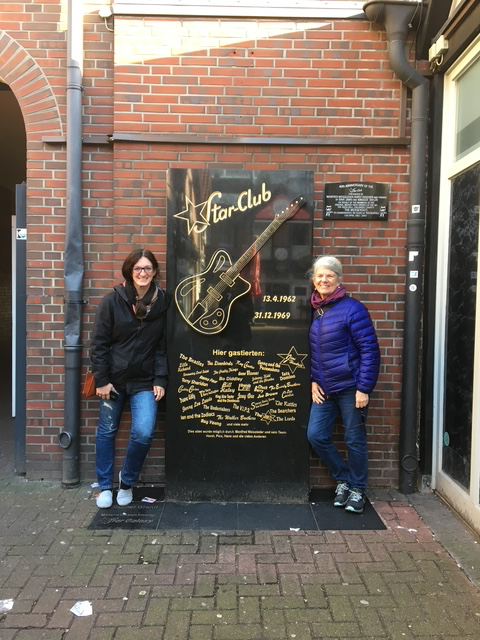
The Star Club
While traveling through Hamburg, Germany, Erin and I made a point of visiting one of the most famous addresses in rock-and-roll history. Today, there is little to suggest what once stood here, but this plaque marks the location of the legendary Star-Club, one of the most influential music venues of the twentieth century. The Star-Club […]
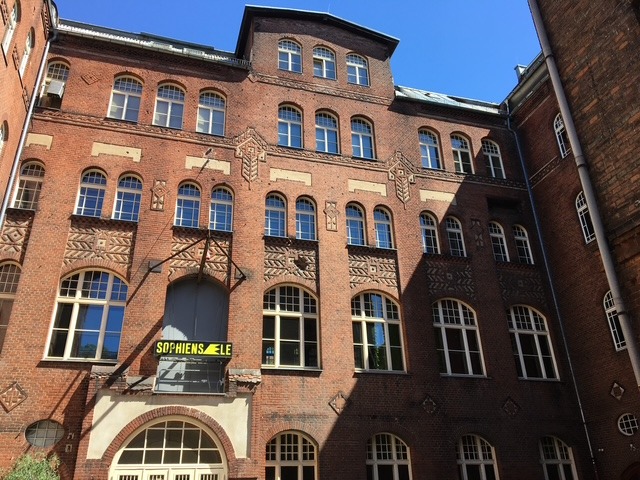
Sophiensæle
Behind the street frontage on Sophienstraße, the brick building now known as Sophiensæle began as a clubhouse for Berlin’s craftsmen’s association. Built in 1904–1905, it provided a setting for workers’ education and collective activity. The clubhouse also became a meeting place for the political left. Rosa Luxemburg, Karl Liebknecht, Clara Zetkin, and Erich Mühsam spoke […]
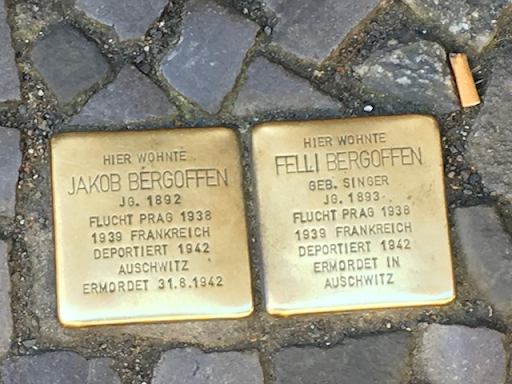
The Names Beneath Our Feet
One of the most moving experiences while walking through Berlin is discovering the small brass plaques embedded in the sidewalks. It would be easy to miss them if you weren’t looking down, but that is exactly the point. These Stolpersteine, or “stumbling stones,” ask us to pause, not because we physically stumble over them, but because […]

