The Names Beneath Our Feet
One of the most moving experiences while walking through Berlin is discovering the small brass plaques embedded in the sidewalks. It would be easy to miss them if you weren’t looking down, but that is exactly the point. These Stolpersteine, or “stumbling stones,” ask us to pause, not because we physically stumble over them, but because we stumble upon a life that once existed there
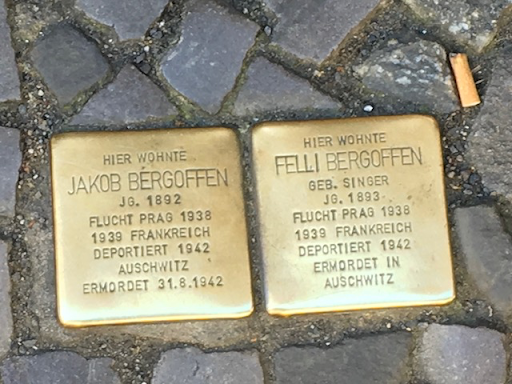
The stones in this photograph remember Jakob Bergoffen and his wife, Felli Bergoffen. The inscriptions tell their story in only a few lines. Jakob was born in 1892, and Felli in 1893. After fleeing to Prague in 1938 and then to France in 1939 to escape Nazi persecution, both were deported to Auschwitz in 1942, where they were murdered.
There are no lengthy biographies, no statues, and no grand memorials here. Instead, these simple brass stones are placed in front of the last home the family chose for themselves before their lives were torn apart. They quietly restore an identity that the Nazi regime sought to erase. Each passerby is invited to stop, read a name, and remember that these were not statistics—they were husbands and wives, parents and children, neighbors and friends.
Today, more than 100,000 Stolpersteine have been installed across Europe, making this the world’s largest decentralized memorial. Each one represents a single person whose story deserves to be remembered. Together, they transform ordinary streets into places of remembrance, ensuring that history is not confined to museums but woven into the everyday places where life once unfolded.
As I walked through Berlin, I found myself looking down almost as often as I looked up. Behind every brass plaque was a home, a family, and a future that never had the chance to unfold. These small memorials remind us that history is not only found in great monuments but also beneath our feet, inviting us to pause, remember, and honor lives that should never be forgotten.