Frances Perkins National Monument
The exhibits at the Frances Perkins homestead helped me understand the woman behind the accomplishments. Long before she became the first woman to serve in a presidential cabinet, Perkins had been shaped by education, social reform, personal hardship and a growing conviction that the government had a responsibility to protect people who could not always protect themselves.
Born in Boston in 1880 and raised in Worcester, Massachusetts, Frances attended Worcester Classical High School and then Mount Holyoke College. After graduating in 1902, she taught for several years, but her interests increasingly drew her toward the emerging world of social reform. She became involved with settlement-house work and eventually spent time at Hull House in Chicago, founded by Jane Addams. There she encountered firsthand the problems faced by poor and immigrant families living in rapidly industrializing American cities.
Her education continued at the University of Pennsylvania’s Wharton School and later at Columbia University, where she earned a master’s degree in economics and sociology in 1910. She became executive secretary of the New York Consumers’ League, investigating working conditions and advocating for protections for women and children employed in factories.
Then came the event that profoundly changed her life. On March 25, 1911, Perkins witnessed the Triangle Shirtwaist Factory fire in New York City. She watched as workers, many of them young immigrant women, became trapped in the burning building. One hundred forty-six people died. Perkins later regarded the tragedy as a defining moment in her life and became increasingly committed to workplace safety and labor reform.
In 1913, at age 33, she married Paul Caldwell Wilson, an economist who later worked in the administration of New York City Mayor John Purroy Mitchel. Perkins made the unusual decision to retain her own name. She had already established a professional identity as Frances Perkins and refused to surrender it simply because she had married.
Her family life was not easy. In 1915 she suffered a miscarriage and then the stillbirth of a son. The experience strengthened her interest in maternal and infant welfare. Her daughter Susanna was born in 1916. Perkins also carried substantial family responsibilities as her husband’s mental health deteriorated and required repeated hospitalizations, while continuing to pursue an increasingly demanding public career.
Her work brought her into the New York State government, where she worked with figures including Al Smith and Franklin Roosevelt. She became a member of the New York State Industrial Commission and eventually its chair, gaining practical experience with workplace regulation, unemployment, wages and industrial safety.
Then, in 1933, President Franklin D. Roosevelt offered her the position of Secretary of Labor.
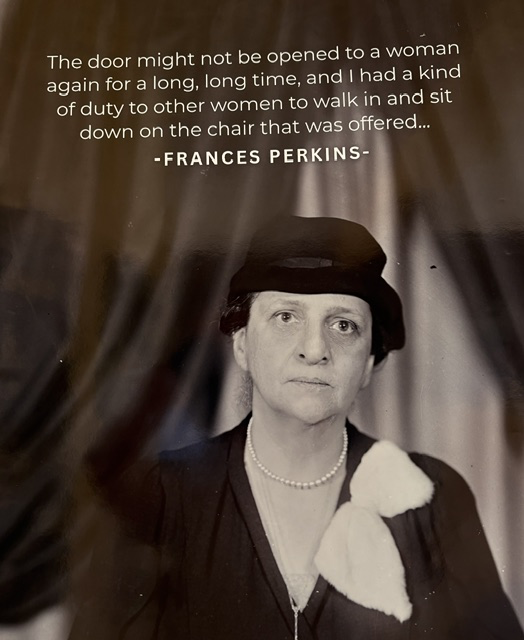
The quotation in this photograph explains how Perkins viewed that moment. She understood that the opportunity extended beyond herself: “The door might not be opened to a woman again for a long, long time, and I had a kind of duty to other women to walk in and sit down on the chair that was offered…”
She did walk through that door. And once she was inside, Frances Perkins did far more than simply occupy a chair previously reserved for men. She used that position for twelve years to help shape Social Security, unemployment insurance, minimum-wage and overtime protections, restrictions on child labor and many of the labor standards that became part of modern American life. By the time Roosevelt opened that door in 1933, Frances Perkins had spent more than thirty years preparing herself to walk through it.

Read More From Nancy
Women’s Rights National Historical Park
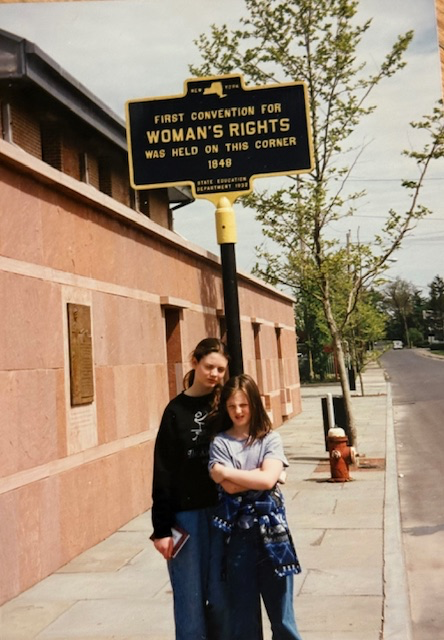
Driving across upstate New York is full of history, landmarks, and monuments. A brown National Park sign in Seneca Falls led me to the Women’s Rights Museum, and like any new place, that first visit left me with a lot to take in. I did not know then about the convention that had taken place here. […]
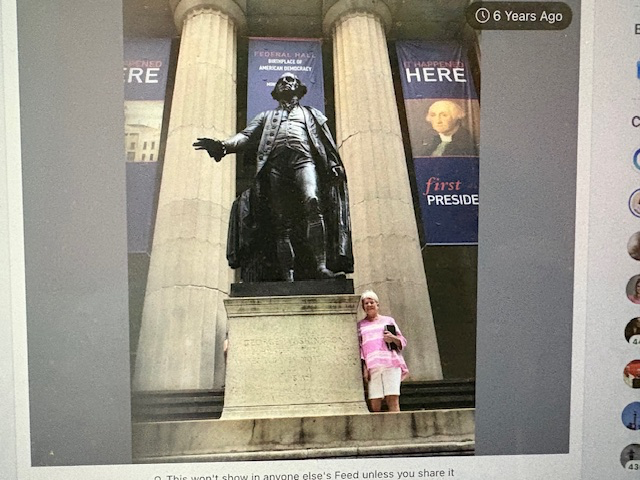
Federal Hall National Memorial
Federal Hall is one of the most historically significant sites in New York, marking the birthplace of the American government. From Washington’s inauguration to the adoption of the Bill of Rights, it embodies the early struggles and triumphs that shaped the nation. Standing on the steps where George Washington took the oath of office on April […]
Adams National Historical Park
The Adams National Historical Park is a very special park here in Massachusetts, and that truly deserves a full day of exploration. Located in Quincy, it offers a rare opportunity to step directly into the lives of one of America’s most influential families. Your visit begins at the visitor center, where you board a trolley that […]

