Edward Everett
Standing on Boston Common is a statue of a man whose name is no longer familiar to many Americans, yet during the nineteenth century he was one of the nation’s most admired public figures. This monument honors Edward Everett, a Massachusetts scholar, educator, diplomat, governor, U.S. senator, Secretary of State, and one of the greatest orators of his generation.
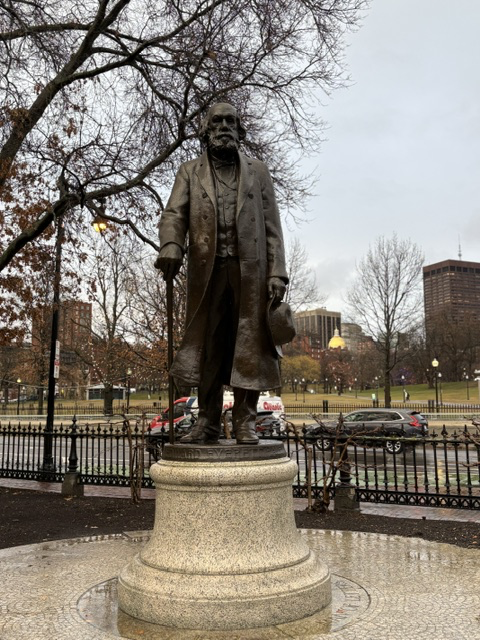
Born in Dorchester in 1794, Everett graduated from Harvard at the age of seventeen and went on to become a minister, professor of Greek literature, and eventually president of Harvard University. His career in public service was equally remarkable. He served in Congress, as Governor of Massachusetts, as Minister to Great Britain, as President Millard Fillmore’s Secretary of State, and later as a United States senator. Few Americans have held such a wide range of distinguished positions.
Today, however, Edward Everett is remembered most often for an event in which he was not the principal speaker. On November 19, 1863, at the dedication of the Soldiers’ National Cemetery in Gettysburg, Everett delivered the featured address. His speech lasted nearly two hours and was considered a masterpiece of public oratory. When he finished, President Abraham Lincoln rose to offer what was intended to be only a few remarks. Those 272 words became the Gettysburg Address, one of the most famous speeches in American history.
Everett himself immediately recognized Lincoln’s achievement. Writing to the President the following day, he graciously observed, “I should be glad if I could flatter myself that I came as near to the central idea of the occasion in two hours as you did in two minutes.” His generous acknowledgment reflects the character of a man who valued the power of ideas more than personal recognition.
The City of Boston recognized Edward Everett’s extraordinary contributions soon after his death. Sculpted by William Wetmore Story, the bronze statue was dedicated in 1867, only two years after Everett passed away. Originally placed in the Boston Public Garden, it was later moved several times before finding its present home near Boston Common. It was one of the earliest public monuments in Boston dedicated to honoring a civilian rather than a military hero, reflecting the city’s deep respect for scholarship, education, and public service.
As I stood before this monument, I found myself thinking less about Gettysburg and more about the remarkable breadth of Edward Everett’s life. Professor, university president, governor, congressman, diplomat, senator, Secretary of State, and one of the greatest orators of his generation. Few Americans have served their country in so many ways.
Read More From Nancy
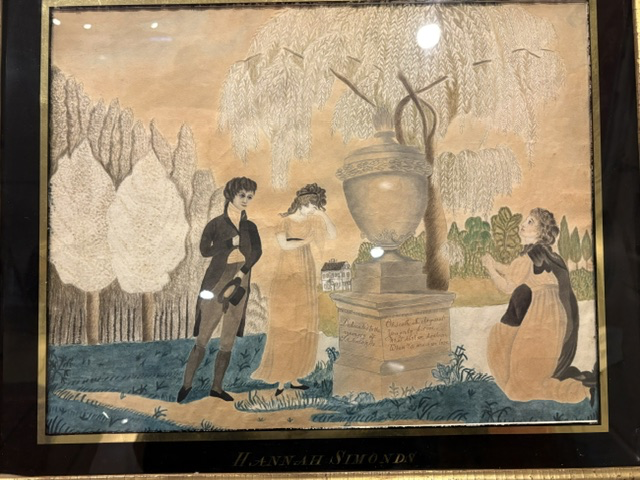
Hannah Simonds’ Mourning Portrait
One of the most moving pieces we discovered at the Buckman Tavern in Lexington was this delicate watercolor painted by Hannah Simonds in 1805. At first glance, it appears to be a simple family memorial, but it tells a much larger story about remembrance, family, and the quiet ways ordinary Americans preserved the legacy of […]
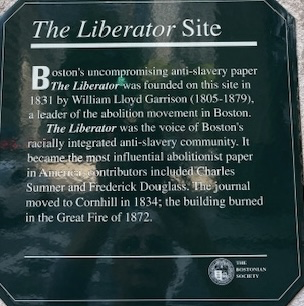
The Liberator Site
I had just stepped away from the busy Freedom Trail, when I came across the bronze plaque on a quiet Boston street. It read: “The Liberator Site – Boston uncompromising anti-slavery paper. The Liberator was founded on this site in 1831 by William Lloyd Garrison…..“ Standing at this spot, I realized that this was the birthplace […]
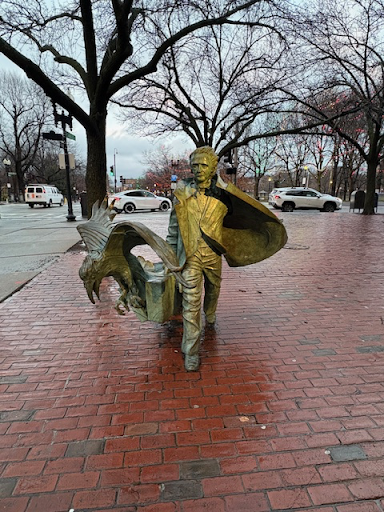
Edgar Allen Poe Statue
This is a statue of Edgar Allan Poe on the sidewalk along Boylston Street in Boston. He is caught in mid-stride, coat swirling with a raven perched atop a stack of books at his feet. The placement of this statue is intentional and rooted in Poe’s relationship with the city where his life began. Poe […]

