Cases Rocamora
Walking along Passeig de Gràcia, we noticed a building whose slender turrets and reddish roofs gave it an almost castle-like appearance. Rows of balconies stretched along the stone façade, while projecting windows and carved ornament added detail above the busy sidewalk. These were the Cases Rocamora, a group of residences that reflect the ambitions of the families who helped shape this celebrated Barcelona boulevard.
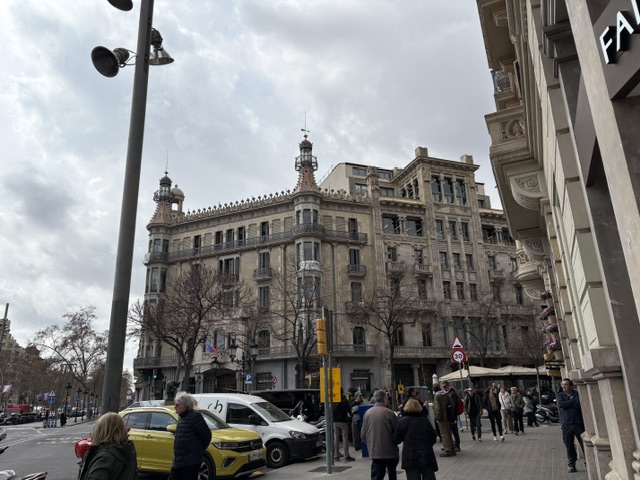
Designed by brothers Joaquim and Bonaventura Bassegoda i Amigó, the buildings were constructed during the 1910s. They occupy numbers 6–14 Passeig de Gràcia, extending from the corner of Carrer de Casp along much of the block. Although their coordinated exterior suggests one immense residence, the development comprises three adjoining buildings.
The architects combined Gothic references with a distinctly French influence. Turrets, steep roofs, and an elaborate roofline give the complex its picturesque silhouette. Below them, the repeated windows and balconies bring order to the long façade. It is an example of how Barcelona’s architects adapted historical styles to the needs of a modern residential city.
What makes the building especially engaging is the way its appearance changes as you look upward. At street level, shops and entrances belong to the everyday activity of the boulevard. Above them, enclosed projecting bays, decorative stonework, and balconies reveal the care given to the residential floors. At the roofline, the turrets introduce another layer of ornament, making the corner visible from a considerable distance.
The buildings were developed for the Rocamora family, whose name remains attached to several properties in Barcelona. Their investment here formed part of the growth of Passeig de Gràcia as an address where prosperous families could establish themselves and commission architecture that expressed their standing. The scale of the development allowed that expression to extend across several adjoining properties rather than a single house.
The ground floor also has its own history. Number 6 once housed Prats-Fatjó, a distinguished pastry shop whose premises received the city’s annual award for commercial establishments in 1917. That detail adds a more personal dimension to the grand architecture: beneath the residences, people came to purchase pastries and take part in the social life of the boulevard.
Read More From Nancy
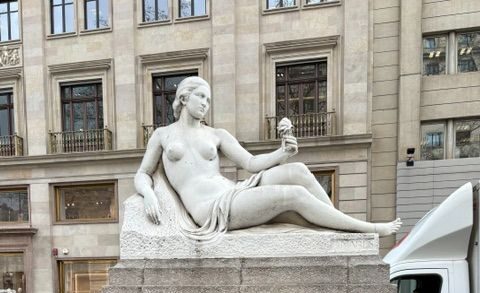
The Monument to Francesc Soler i Rovirosa
Along Barcelona’s Gran Via, we came across a reclining marble woman holding a rose. Her relaxed pose and quiet expression contrasted with the traffic moving past the surrounding gardens. On the pedestal beneath her was a portrait medallion and a name: Francesc Soler i Rovirosa. The monument honors an artist whose work helped audiences enter […]
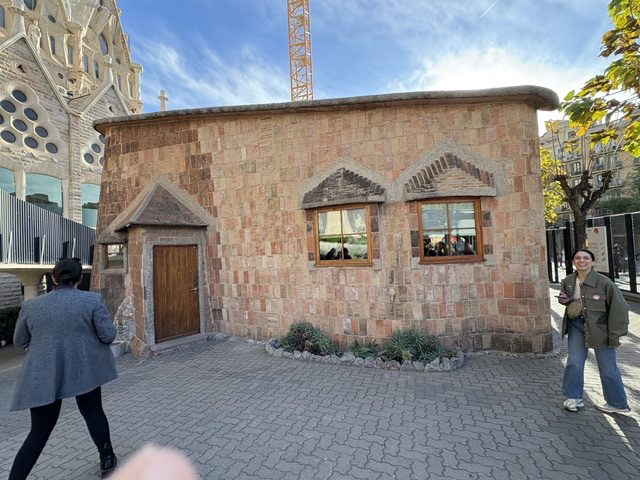
Gaudi’s Workshop
Standing beside the magnificent Sagrada Família is a building that many visitors walk past without realizing its significance. This modest stone structure is Gaudí’s workshop, where one of the world’s greatest architectural masterpieces has taken shape for more than a century. When Antoni Gaudí devoted himself entirely to the Sagrada Família in 1914, this workshop […]
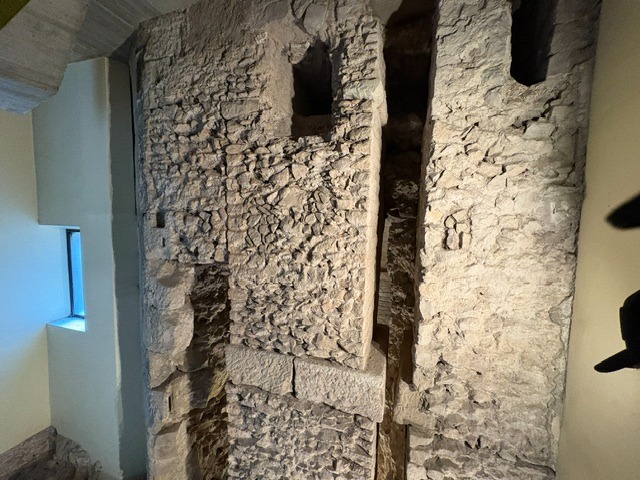
The Roman Aqueduct
Inside Casa de l’Ardiaca, near Barcelona’s cathedral, surviving water channels reveal part of the engineering that supported the ancient Roman city of Barcino. Built into a site later occupied by a medieval residence, these remains preserve evidence of an essential urban service: bringing fresh water from beyond the city walls. The Romans established Barcino near […]

