Battle Monument at North Bridge
The granite obelisk beside Concord’s North Bridge has a history of its own. Known as the 1836 Battle Monument, it was the first monument erected at the battlefield. Its creation involved years of disagreement over where it should stand and what it should say—questions that reveal how carefully Concord’s residents considered their town’s place in the nation’s founding story.
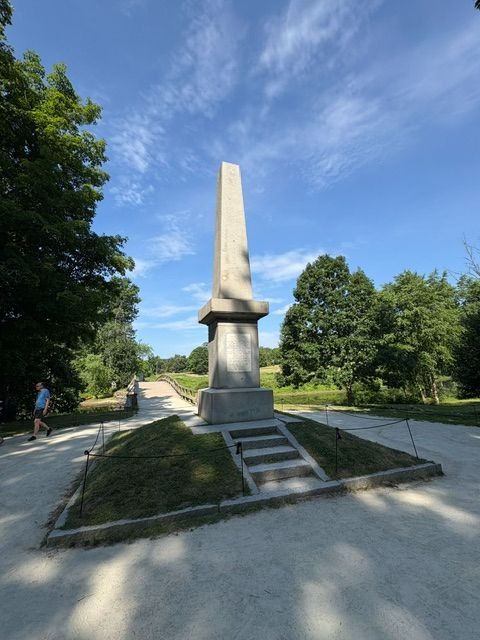
Planning began in 1825, fifty years after the fighting. A proposed location in Concord’s town center drew objections from residents who wanted the memorial at the battlefield itself. The project stalled until Reverend Ezra Ripley donated land near the former bridge, allowing the town to commemorate the encounter where it had occurred.
Solomon Willard, associated with the Bunker Hill Monument, helped design the twenty-five-foot obelisk, and James Wilkins constructed it. Four pieces of white granite were cut from a single boulder. A marble tablet set into its face carried an account of the battle. The monument’s restrained appearance gives little indication of the discussion that surrounded its construction.
Its inscription proved especially contentious. Concord’s claim to the first forcible resistance against British aggression provoked objections from Lexington, where bloodshed had occurred earlier that morning. The disagreement concerned how the two encounters should be understood and remembered. Even decades after the Revolution, the language used to describe its beginning carried considerable local importance.
The dedication took place on July 4, 1837, explaining why a monument bearing the date 1836 is associated with a ceremony the following year. Townspeople gathered for prayers, an address by Samuel Hoar, and the singing of a new hymn written for the occasion by Ralph Waldo Emerson. Sung to the familiar tune “Old Hundred,” his “Concord Hymn” introduced the phrase “the shot heard round the world.” Those words would become inseparable from the memory of the North Bridge.
Hoar’s dedication address also looked beyond the stone itself. He urged younger generations to study the Revolution’s participants and follow their principles, suggesting that responsible conduct would honor them more fully than a monument alone. The ceremony therefore asked something of the living as well as commemorating the dead.
That connection between remembrance and responsibility gives the obelisk a significance beyond its size. It records an early effort to preserve the battlefield’s meaning for people who had not witnessed the fighting. Emerson’s hymn extended that effort through words that could be printed, sung, taught, and carried far beyond Concord.
The obelisk preserves two chapters of Concord’s history: the fighting of April 1775 and the later effort to give those events a lasting place in public memory. Its story includes the townspeople who debated its location, the craftsmen who built it, and the gathering that first sang Emerson’s hymn. Together, the monument and the poem helped shape how generations would remember the North Bridge.
Read More From Nancy
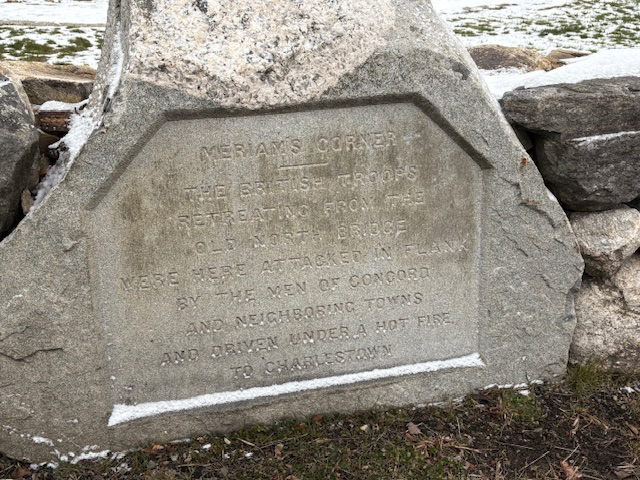
Meriam’s Corner
Meriam’s Corner is an important Revolutionary War sites in Concord, located near the Nathan Meriam House along Lexington Road within the Minute Man National Historical Park. On April 19, 1775, after the British regulars had searched Concord and begun their march back toward Boston, they passed this junction near the Meriam family homestead. It was here that […]
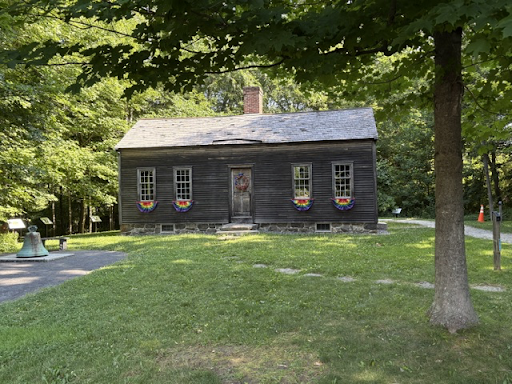
The Robbins House
When most people visit Concord, Massachusetts, they come to walk across the Old North Bridge, stand where the American Revolution began, and visit the homes of Emerson, Thoreau, Hawthorne, and Alcott. I have made that journey many times over the years and thought I knew Concord’s history well. On one of my more recent visits, […]
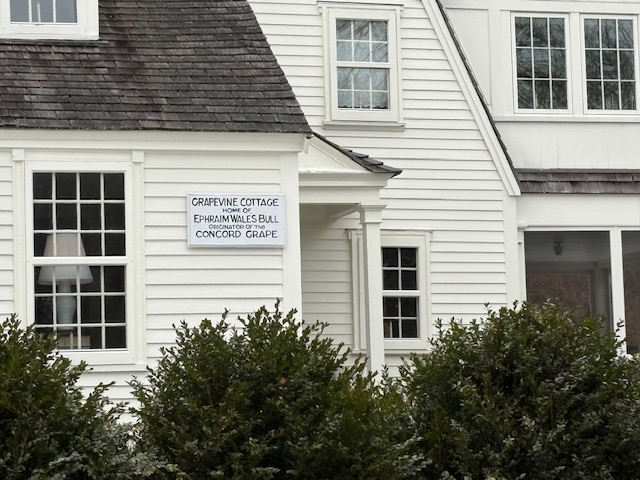
Grapevine Cottage
I grew up enjoying grape jelly on my toast. Like many children, I never thought about where the familiar flavor came from. It wasn’t until much later that I learned the grape behind the jelly: the Concord grape, originated from vines grown by a man named Ephraim Wales Bull in Concord. While exploring Concord, this […]

