The Salt Storehouses
Standing along the Trave River near Lübeck’s Holsten Gate, the six buildings known as the Salzspeicher, or Salt Storehouses, preserve the story of a commodity that helped make this northern German city wealthy and powerful. Their rows of windows, steep red roofs, and distinctive stepped gables reflect in the water, creating one of Lübeck’s most recognizable scenes.
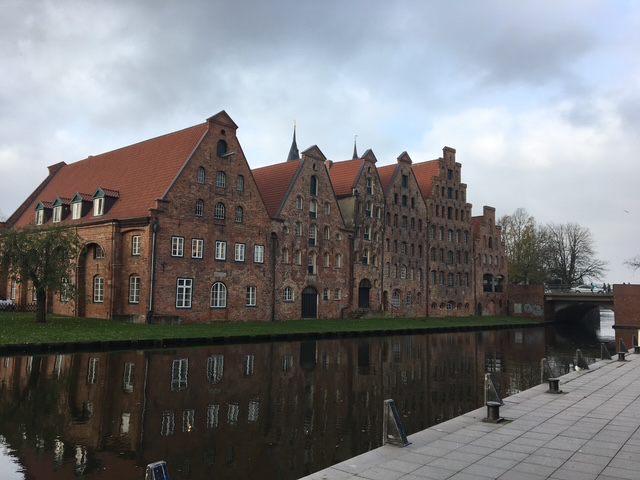
The warehouses were constructed between 1579 and 1745, although Lübeck’s salt trade began centuries earlier. Salt mined near Lüneburg was transported north along the Old Salt Route and later carried by boat through the Stecknitz Canal, completed in 1398. Upon reaching Lübeck, it was stored in these warehouses before being loaded onto ships bound for ports throughout the Baltic region.
Before refrigeration, salt was essential for preserving food. It was especially valuable to the Scandinavian herring fisheries, where large quantities were needed to cure the catch so that it could be transported and sold throughout Europe. Lübeck’s merchants occupied a profitable position between the salt producers of northern Germany and the fishing communities of the Baltic. Sometimes called “white gold”, salt helped build the prosperity that made Lübeck one of the leading cities of the Hanseatic League.
The location of the warehouses beside the river was practical. Barges could deliver their cargo directly to the storehouses, and merchant vessels could then carry the salt toward Scandinavia. Their size and sturdy brick construction reveal the enormous scale and value of the trade they once supported. In later years, the buildings were adapted to store other goods as Lübeck’s economy changed.
When we stopped beside the Trave, the quiet water and handsome buildings offered little indication of the busy commercial activity that once filled this waterfront. Barges, barrels, sailors, and merchants have disappeared, but the Salt Storehouses remain. They are a reminder that the growth of great cities was often shaped by ordinary necessities—and that something as simple as salt could support an international network of trade and help build the power of a city.
Read More From Nancy
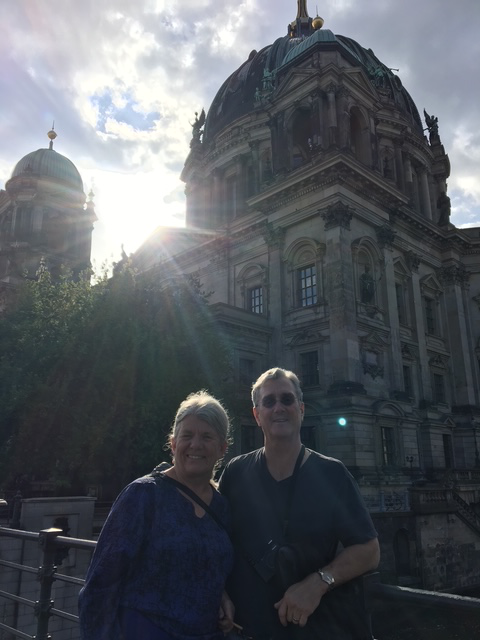
Berliner Dom
When Marty and I visited Berlin, our timing happened to coincide with a celebration of Martin Luther. It was the 500th anniversary of the Protestant Reformation in 2017, commemorating Luther’s posting of the Ninety-Five Theses in Wittenberg on October 31, 1517. Throughout Germany, churches were filled with visitors who had traveled to take part in […]
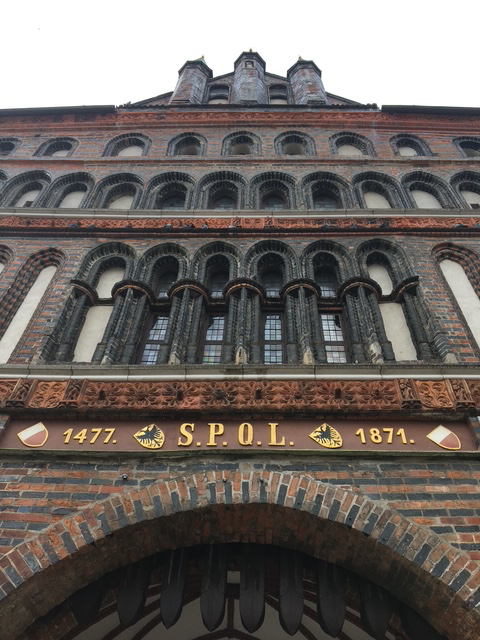
S.P.Q.L. – The Senate and People of Lübeck
While standing beneath the Holstentor in Lübeck, one detail caught my attention. Above the entrance are the letters S.P.Q.L., an inscription modeled after the famous Roman initials S.P.Q.R., meaning “The Senate and People of Rome.” In Lübeck, the letters stand for Senatus Populusque Lubecensis—”The Senate and People of Lübeck.” The inscription reflects the city’s pride in its long […]
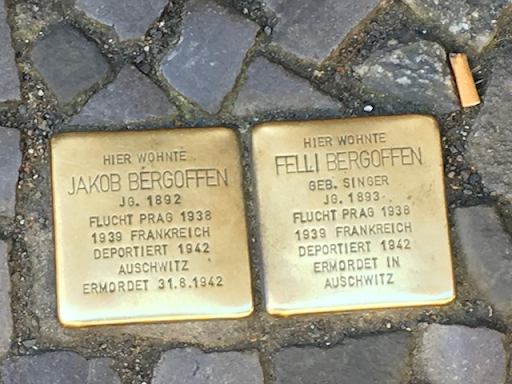
The Names Beneath Our Feet
One of the most moving experiences while walking through Berlin is discovering the small brass plaques embedded in the sidewalks. It would be easy to miss them if you weren’t looking down, but that is exactly the point. These Stolpersteine, or “stumbling stones,” ask us to pause, not because we physically stumble over them, but because […]

