Berliner Dom
When Marty and I visited Berlin, our timing happened to coincide with a celebration of Martin Luther. It was the 500th anniversary of the Protestant Reformation in 2017, commemorating Luther’s posting of the Ninety-Five Theses in Wittenberg on October 31, 1517. Throughout Germany, churches were filled with visitors who had traveled to take part in the anniversary events.
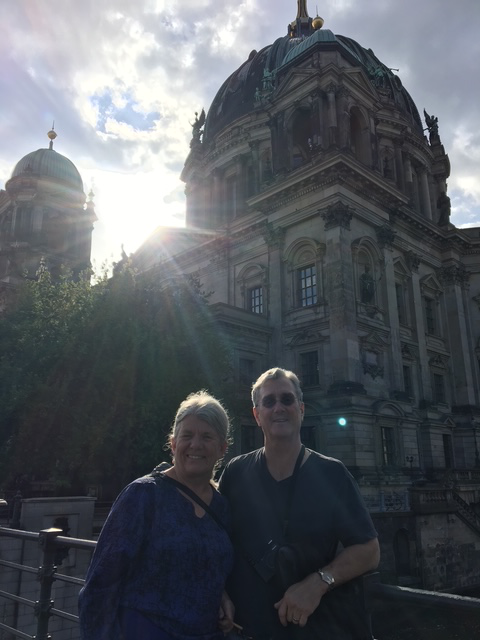
Here we are outside the Berliner Dom, Berlin’s great Protestant cathedral on Museum Island. Although its enormous dome and elaborate architecture can easily suggest one of Europe’s great Catholic cathedrals, the Berliner Dom belongs to Germany’s Protestant tradition. Its history reflects both Lutheran and Reformed influences that became intertwined in Prussia.
The present cathedral was built between 1894 and 1905 during the reign of Kaiser Wilhelm II, replacing an earlier cathedral on the site. Designed by Julius Carl Raschdorff, it was intended to be a monumental Protestant church worthy of the capital of the relatively new German Empire. It also served as the court and dynastic church of the Hohenzollerns, the family that ruled Brandenburg and Prussia and eventually provided the German emperors. Their connection remains particularly visible in the Hohenzollern Crypt beneath the cathedral, where members of the dynasty were buried over several centuries.
The building also carries the scars of modern German history. It was severely damaged during World War II, including a devastating fire in its dome following an air raid in 1944. Because it stood in East Berlin after the war, restoration took decades. The cathedral finally reopened in 1993, after the reunification of Germany.
Being there during the Reformation anniversary gave our visit another dimension. Martin Luther himself had died centuries before the present Berliner Dom was constructed, but the religious transformation he began in 1517 ultimately shaped the Protestant world to which this cathedral belongs.
Read More From Nancy
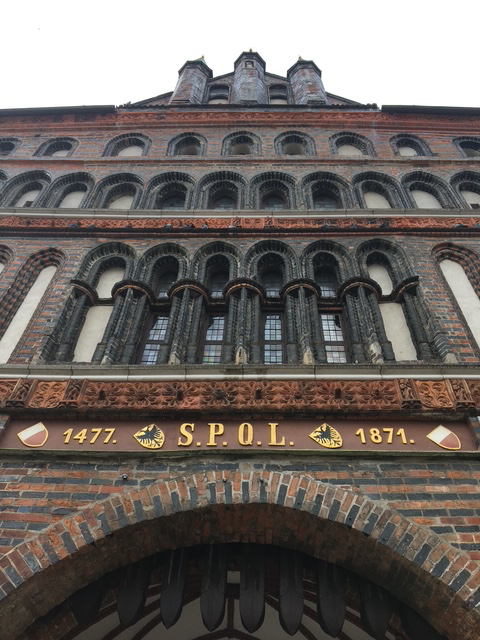
S.P.Q.L. – The Senate and People of Lübeck
While standing beneath the Holstentor in Lübeck, one detail caught my attention. Above the entrance are the letters S.P.Q.L., an inscription modeled after the famous Roman initials S.P.Q.R., meaning “The Senate and People of Rome.” In Lübeck, the letters stand for Senatus Populusque Lubecensis—”The Senate and People of Lübeck.” The inscription reflects the city’s pride in its long […]
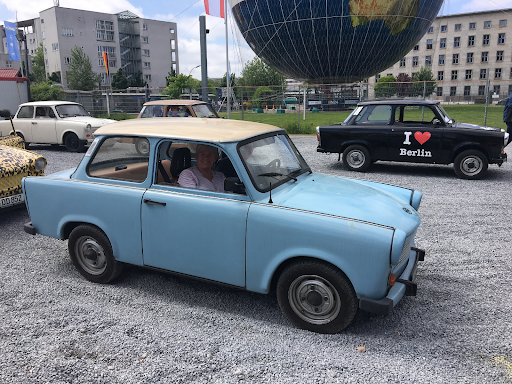
Trabi Car
When we visited Berlin in 2017, one of our fun adventures was driving a Trabant, known as a Trabi. I have to admit, I had never heard of these cars before. And when Marty suggested the tour, I was curious and so glad we did it. Marty took the wheel as we followed our guide […]
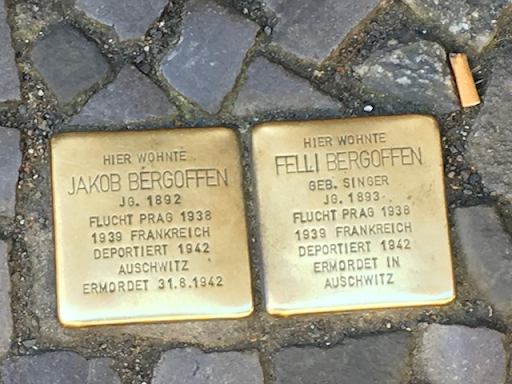
The Names Beneath Our Feet
One of the most moving experiences while walking through Berlin is discovering the small brass plaques embedded in the sidewalks. It would be easy to miss them if you weren’t looking down, but that is exactly the point. These Stolpersteine, or “stumbling stones,” ask us to pause, not because we physically stumble over them, but because […]

