Thinkers’ Lodge National Historic Site Plaque
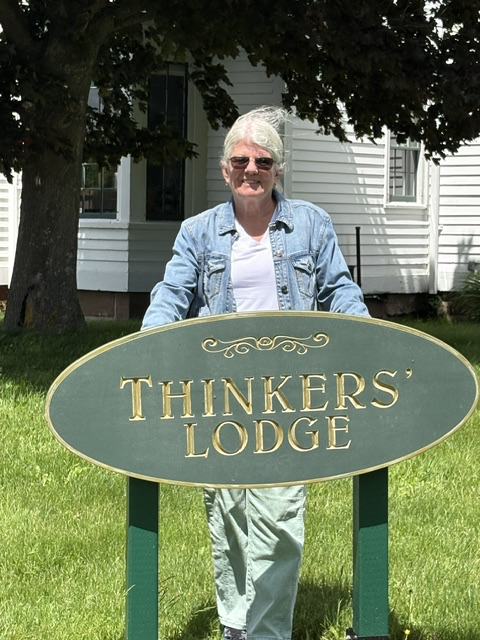
Standing in front of this plaque, I was struck by how long it took for Thinkers’ Lodge to receive formal recognition for what happened here. The first Pugwash Conference took place in 1957, when 22 scientists from ten countries gathered here at the height of the Cold War to discuss nuclear weapons and the responsibility of scientists to work toward their elimination. That meeting launched the international Pugwash movement.
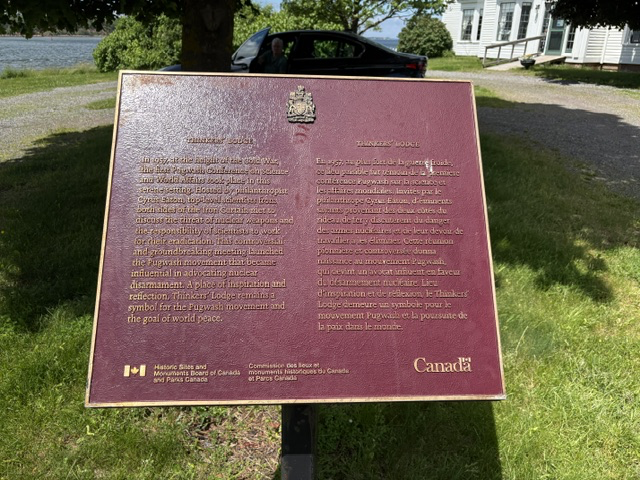
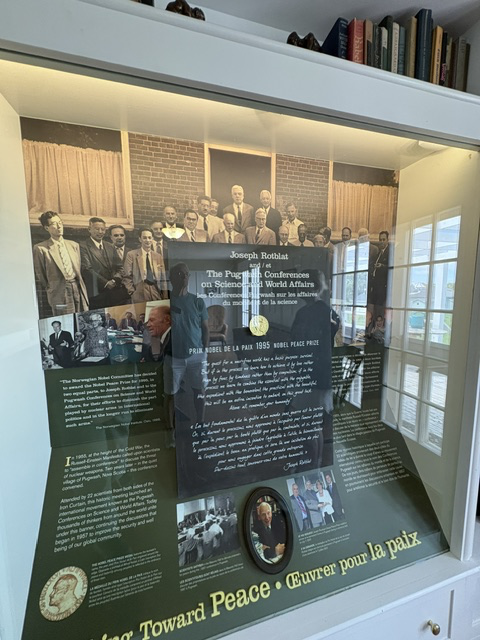
Yet decades passed before the importance of this small place in Nova Scotia was formally recognized. In 1995, 38 years after that first meeting, the Pugwash Conferences on Science and World Affairs and Joseph Rotblat jointly received the Nobel Peace Prize for their efforts toward nuclear disarmament. Suddenly, a movement that had begun around tables in Pugwash received the world’s most prestigious recognition for work toward peace.
Even then, Thinkers’ Lodge itself was not yet a National Historic Site. The property had also become increasingly vulnerable. In 1996, just a year after the Nobel Prize, an electrical fire broke out in the Lodge. Firefighters from four communities fought the blaze while residents formed a human chain, carrying furniture, books, rugs, lamps and other historic objects out of the building to safety. The Lodge survived, but the episode demonstrated just how easily the physical place connected with the Pugwash story could have disappeared.
It was not until August 26, 2008—51 years after the first conference and 13 years after the Nobel Peace Prize, that Canada designated Thinkers’ Lodge a National Historic Site. The designation recognized both the 1957 conference and the Lodge’s continuing importance as a symbol of nuclear disarmament and world peace,
By then the property needed substantial restoration. Over the following years, the Lodge underwent extensive rehabilitation, including work on its roof, chimneys, foundations, decks, windows, plaster, electrical systems and plumbing. The restoration was completed in the summer of 2011, and the restored Lodge was opened to the public at a community open house on August 9.
Then, on October 7, 2011, another important moment occurred. The Government of Canada celebrated the grand reopening of Thinkers’ Lodge and unveiled the Historic Sites and Monuments Board of Canada plaque that I am standing before here. There is something remarkable about that timeline: 1957, the conference; 1995, the Nobel Peace Prize; 1996, the fire; 2008, designation as a National Historic Site; and 2011, restoration, reopening and the unveiling of this plaque.
More than half a century passed between the conversations that made Thinkers’ Lodge internationally significant and Canada’s formal recognition of the place where they began. Perhaps that is what makes this plaque important. It doesn’t simply mark a historic site. It represents the eventual recognition and preservation of a place whose influence had reached around the world long before the building itself was officially acknowledged at home.
Read More From Nancy
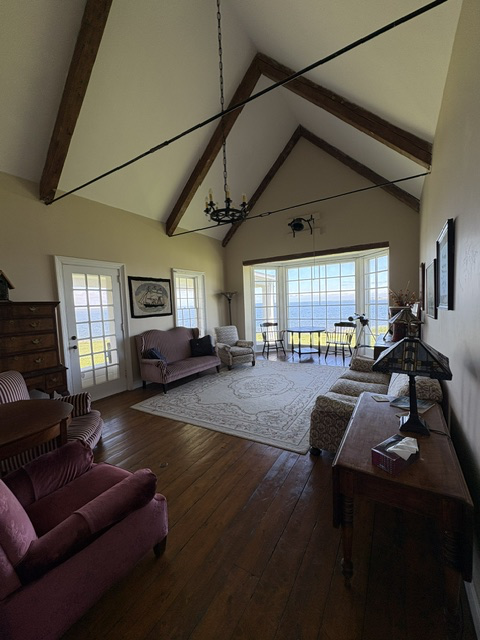
Thinkers’ Lodge
As we started our road trip home from Halifax, Marty and I decided to get off the main road and make our way to the small village of Pugwash, Nova Scotia. We had never heard of Pugwash, nor did we know anything about the remarkable events that had taken place there. What we found was […]
The 1995 Nobel Peace Prize — Pugwash and Joseph Rotblat
This display brings the story of Thinkers’ Lodge forward almost forty years from the first conference. Across the bottom are the words “Toward Peace,” while the center identifies Joseph Rotblat and the Pugwash Conferences on Science and World Affairs as recipients of the 1995 Nobel Peace Prize. The large photograph at the top shows’ participants at the […]
The Russell-Einstein Manifesto
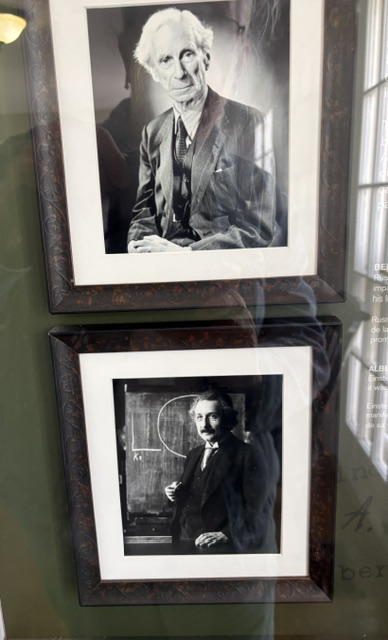
Before there was a meeting at Thinkers’ Lodge, there was a warning. In the years following World War II, scientists who had witnessed the development of nuclear weapons increasingly understood that humanity had entered a fundamentally different age. Among those most concerned were philosopher and mathematician Bertrand Russell and physicist Albert Einstein. In 1955, Russell […]

