The Grand Union Flag
While exploring Plymouth’s 1749 Courthouse, I came across this flag. At first glance it seems almost contradictory: thirteen red and white stripes like an early American flag, but with the British Union flag occupying the canton. That contradiction is exactly what makes the Grand Union Flag so important.
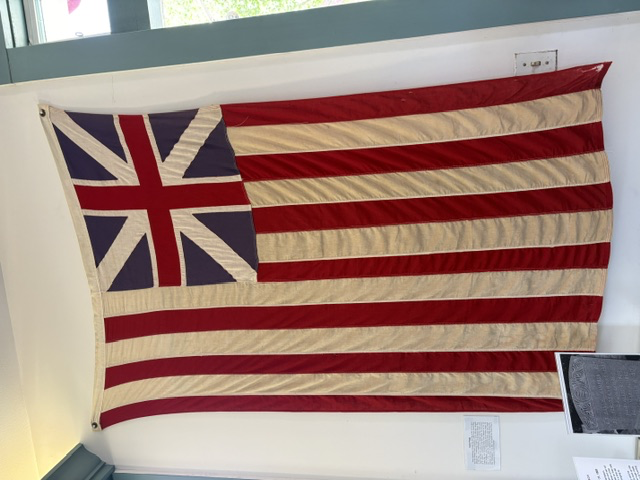
The thirteen stripes represented the thirteen American colonies, while the Union flag acknowledged that those colonies were still part of the British Empire. When this flag came into use in 1775, the Revolution had begun, but independence had not yet been declared. Many colonists were still fighting for their rights as British subjects rather than necessarily demanding the creation of an entirely separate nation.
The flag became associated with the newly organized Continental forces. On January 1, 1776, George Washington’s army raised the Grand Union Flag on Prospect Hill in what is now Somerville, Massachusetts, while the Continental Army was surrounding British-held Boston.
Only six months later, the Declaration of Independence fundamentally changed what an American flag needed to represent. The British Union in the corner no longer made sense for a people declaring themselves independent of Britain. In June 1777, the Continental Congress adopted a new national flag with thirteen stripes and thirteen stars.
That makes the Grand Union Flag a transitional flag. One belonging to a very narrow but enormously important moment in American history. It represents Americans who had already taken up arms against British authority but had not yet taken the final step of declaring themselves a separate nation.

Read More From Nancy
Plymouth Rock
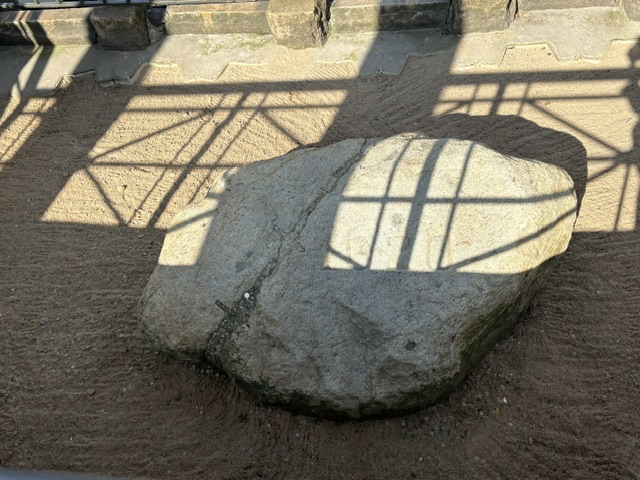
Few objects in American history are as instantly recognizable—or surrounded by as much legend—as Plymouth Rock. Sitting today beneath its granite portico on the edge of Plymouth Harbor, the rock has come to symbolize the arrival of the Mayflower passengers and the beginnings of Plymouth Colony in 1620. Yet there is no contemporary account stating […]
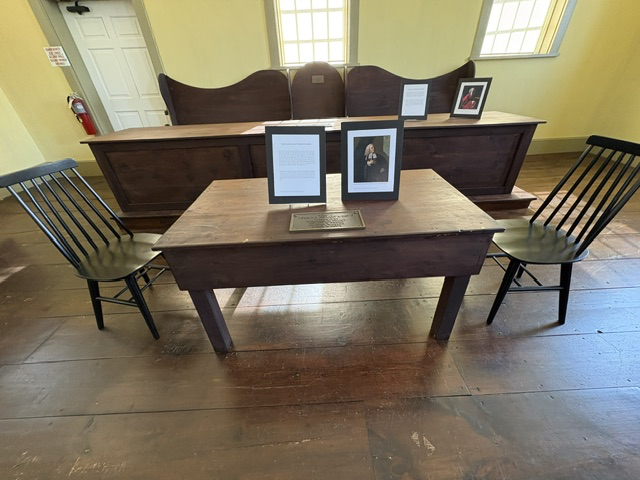
Clerk and Attorney’s Table
Directly in front of the justices’ bench in Plymouth’s 1749 Court House sits the clerk and attorneys’ table. Its position at the center of the courtroom reflects the important work that took place here as each case moved through the colonial court. The court clerk was responsible for creating the official written record of the […]

The Mayflower
Standing along the Plymouth waterfront, Mayflower II immediately connects the town to the story that has defined it for more than four centuries. The ship behind us is not the original Mayflower, but a full-scale reproduction built in England and sailed across the Atlantic in 1957 as a symbol of friendship between the United States […]

