A Sword from “Bleeding Kansas”
This sword connects John Brown’s raid at Harpers Ferry to an earlier and violent chapter in the struggle over slavery. Before Brown came to Virginia in 1859, he had already become a nationally known, and deeply controversial, figure because of his actions in the Kansas Territory.
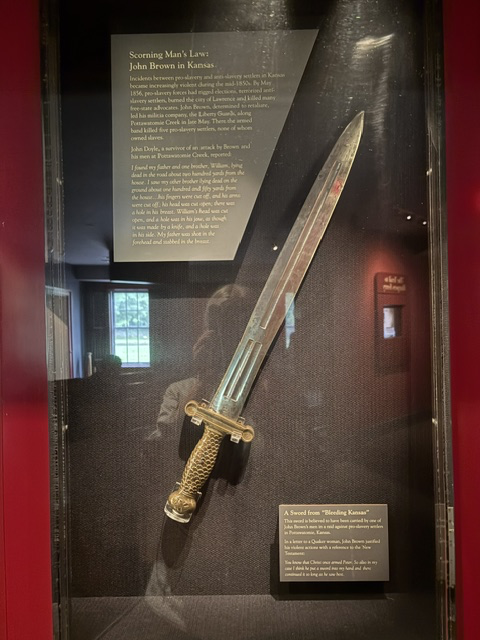
During the 1850s, Americans were fighting over whether Kansas would enter the Union as a free or slave state. The Kansas-Nebraska Act of 1854 left that decision largely to the settlers themselves, and both antislavery and proslavery supporters poured into the territory hoping to determine its future. Elections were disputed, rival governments formed, communities were attacked, and political disagreement turned into armed conflict. The period became known as “Bleeding Kansas”.
John Brown arrived in Kansas in 1855, joining several of his sons who had already settled there. Brown believed that resisting slavery required action rather than compromise. In May 1856, after proslavery forces attacked the antislavery town of Lawrence, Brown and several followers retaliated at Pottawatomie Creek. Five proslavery men were killed with broadswords.
The sword displayed here is believed to have been carried by one of Brown’s men during a raid against proslavery settlers at Pottawatomie. That makes it an especially disturbing but important artifact. It represents the point at which the national argument over slavery was already becoming an armed conflict several years before the Civil War officially began.
Brown himself connected his actions to his religious convictions. In a letter to a Quaker woman, he defended the violence by referring to the New Testament and Christ’s instruction to his followers to carry a sword. As we saw with Brown’s family Bible, his faith was not separate from his abolitionism. He interpreted Scripture as requiring him to oppose slavery, and he eventually concluded that violence was justified in doing so.
That history makes this sword particularly meaningful in Harpers Ferry. Brown did not suddenly become a militant abolitionist when he arrived here in October 1859. Harpers Ferry was part of a progression. Bleeding Kansas had already convinced him that the conflict over slavery would not be resolved through political compromise alone. Three years after Pottawatomie, Brown would attempt something far larger at Harpers Ferry: seizing the federal armory and using its weapons to help initiate an uprising against slavery.
This sword therefore connects two places separated by hundreds of miles, Kansas and Harpers Ferry, and two chapters of the same escalating national crisis. By the time Brown arrived here in 1859, the violence that would soon engulf the entire country had already begun.
Read More From Nancy
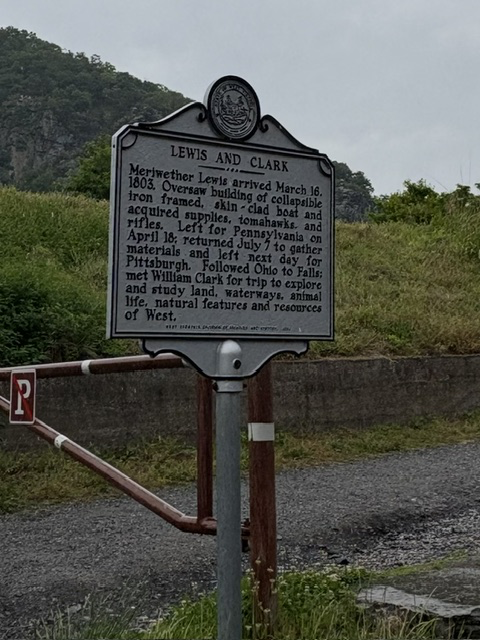
Harpers Ferry and the Lewis and Clark Expedition
This historical marker adds another piece to the Meriwether Lewis story in Harpers Ferry. Before the famous Lewis and Clark Expedition began its journey across the continent, Lewis spent several weeks here gathering equipment and working with the skilled craftsmen of the United States Armory. Meriwether Lewis arrived in Harpers Ferry on March 16, 1803. […]
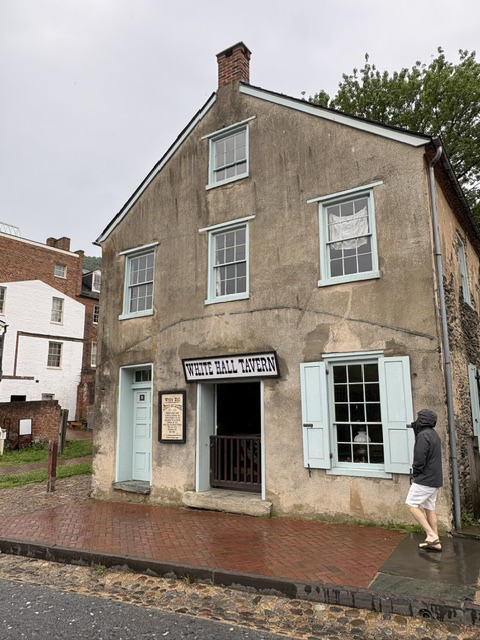
White Hall Tavern
Walking through the historic streets of Harpers Ferry, buildings like White Hall Tavern help tell another side of the town’s story. John Brown’s raid and the Civil War dominate the history here, but Harpers Ferry was also a working industrial community filled with ordinary people who needed places to eat, drink, gather and exchange news. […]
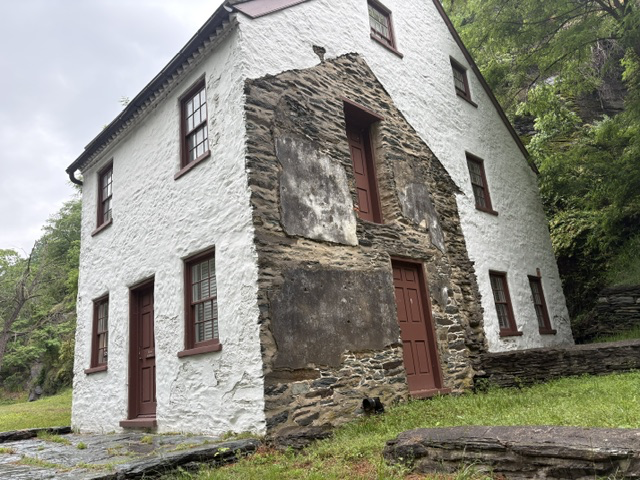
The Harper House
High above Lower Town stands the Harper House, the oldest surviving building in Harpers Ferry. Its story takes us back before the federal armory, the railroads and most of the historic events that would eventually make this little town nationally significant. Robert Harper began constructing this stone house in 1775. Harper had arrived in this […]

