The Tomb of Galileo
During our family travels through Italy, we visited the Basilica of Santa Croce in Florence. Among the extraordinary monuments lining the interior is this elaborate tomb honoring Galileo Galilei, one of the most important figures in the history of science.
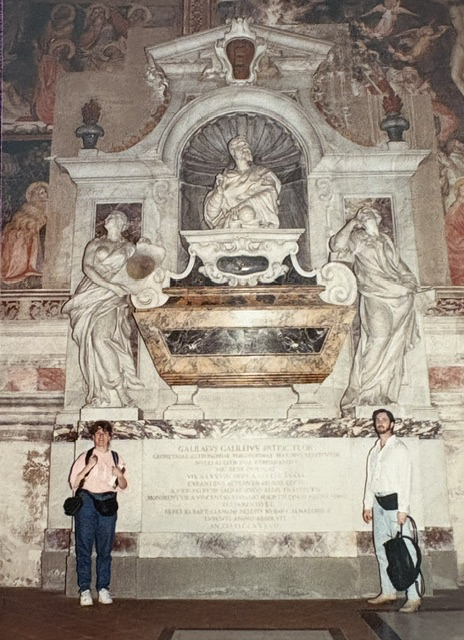
Galileo was born in Pisa in 1564 and spent important years of his life in Florence and Tuscany. Through his observations with the telescope, his studies of motion and his insistence that the natural world could be understood through observation and mathematics, he helped transform the way humanity understood the universe. His astronomical observations provided powerful evidence supporting the idea that the Earth and other planets revolved around the Sun rather than everything revolving around the Earth.
Those ideas brought him into conflict with the Catholic Church. In 1633, the Roman Inquisition found Galileo “vehemently suspected of heresy” for defending the heliocentric model associated with Copernicus. He was forced to formally recant and spent the remainder of his life under house arrest.
When Galileo died in 1642, Grand Duke Ferdinando II de’ Medici wanted him buried prominently in Santa Croce alongside members of his family. Church authorities objected to such an honor for a man who had been condemned by the Inquisition. Instead, Galileo was initially buried in a much less conspicuous location within the basilica.
Nearly a century passed before that changed. In 1737, Galileo’s remains were transferred to this monumental tomb in the main body of Santa Croce. The monument was designed by Giovanni Battista Foggini. At its center is a bust of Galileo by Giovanni Battista Foggini, while the figures beside him represent Astronomy and Geometry, two disciplines inseparable from Galileo’s life’s work.
There is another fascinating story connected with the transfer of his remains. When Galileo’s body was exhumed in 1737, several admirers removed three fingers, a tooth and a vertebra as relics. Some of these objects disappeared for generations. Galileo’s preserved middle finger is now displayed at Florence’s Museo Galileo, an unusual reminder of the almost reverential status he eventually acquired.
Standing beside Galileo’s tomb brought us directly into one of the great stories in the history of ideas. The man who had once been denied a prominent burial because of his conflict with Church authorities eventually received this enormous monument celebrating precisely what had made him controversial: his determination to observe, question and understand the universe.
Read More From Nancy
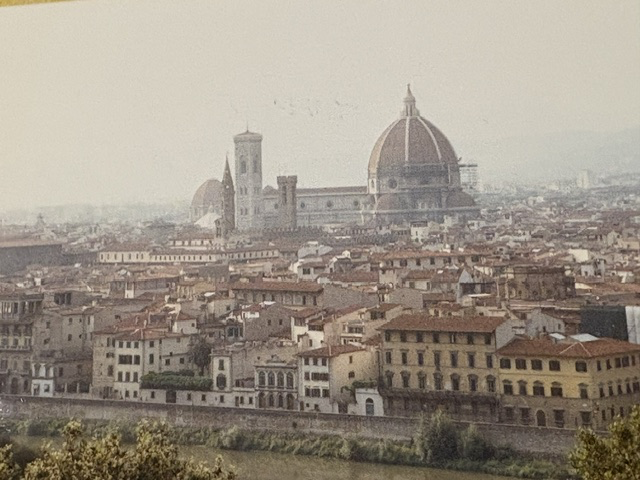
The Florence Skyline
Seen from the hills south of the Arno River, Florence reveals itself not as a collection of separate monuments but as a complete historic city. Rows of closely packed buildings spread across the valley, their warm stone walls and red-tiled roofs creating a remarkably unified landscape. Rising above them are the towers, domes and church […]
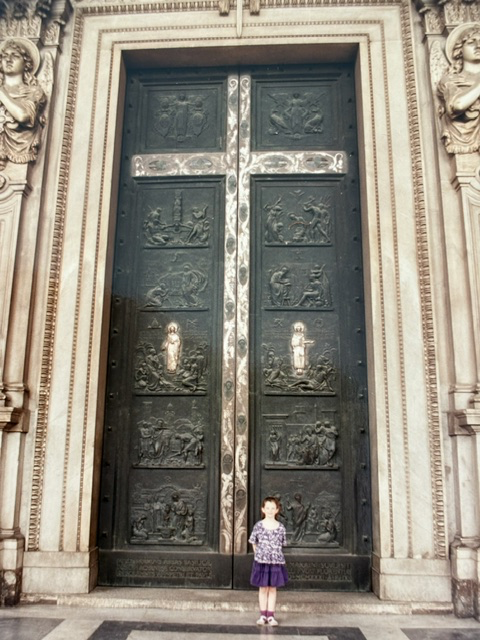
The Holy Door of St. Peter’s Basilica
On one of our family trips to Rome, we visited St. Peter’s Basilica, where this photograph of Erin was taken standing in front of the enormous bronze Holy Door. Known as the Porta Santa, it is one of the most significant entrances to St. Peter’s Basilica and has been associated with the Catholic Church’s Jubilee […]
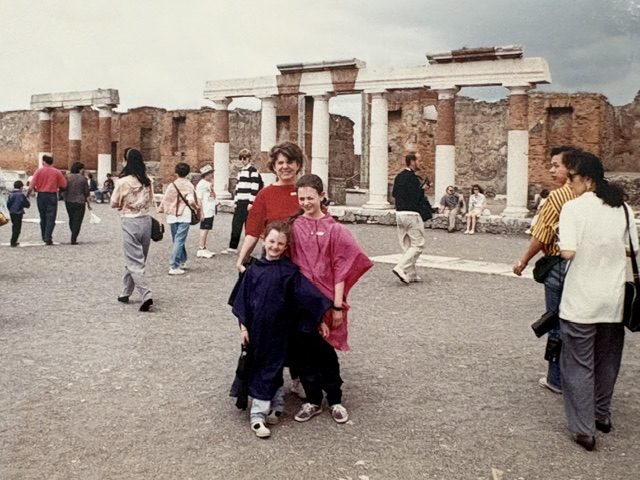
Pompeii
While traveling through Italy on a family vacation, we took a memorable tour of Pompeii. Walking through its excavated streets allowed us to experience the remains of an ancient city as more than a collection of ruins. Homes, shops, temples, public buildings, and gathering places still followed the arrangement of a community in which people […]

