Mayflower Compact
Carved into this stone is the text of the Mayflower Compact, a remarkably short agreement created at an extraordinary moment. Long before there was a permanent settlement at Plymouth, before houses had been built or fields planted, the passengers aboard the Mayflower faced a fundamental question: how would they govern themselves once they went ashore?
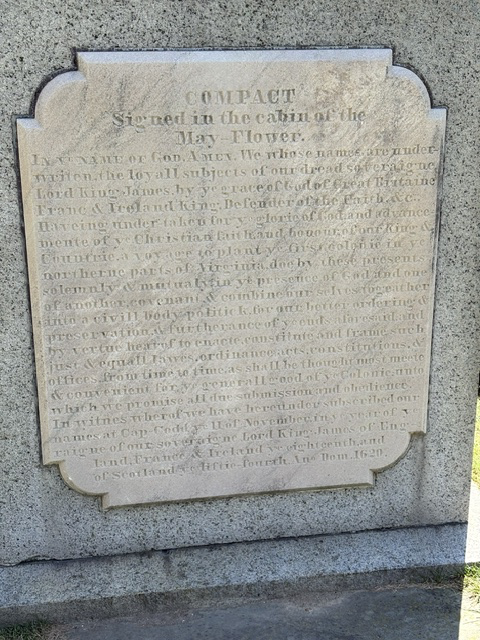
The Mayflower had left Plymouth, England, in September 1620 carrying 102 passengers. After a difficult Atlantic crossing lasting more than two months, land was finally sighted on November 9. But the ship had not arrived where its passengers expected. Their destination had been farther south, within territory associated with the Virginia Company. Instead, they found themselves off Cape Cod, well north of the area covered by the authority under which they had planned to settle.
That created an immediate problem. Among the passengers were the Separatists we commonly call the Pilgrims, but they were not the only people aboard. More than half of the passengers had joined the expedition for other reasons. William Bradford later wrote that some passengers began suggesting that once they landed, they would be free to do as they pleased because the patent under which the colony had been organized would no longer apply.
Before anyone went ashore, the colony needed some form of recognized authority. The answer was the Mayflower Compact. On November 11, 1620, while the Mayflower lay anchored in what is now Provincetown Harbor, the adult male passengers gathered aboard the ship and agreed to form what they called a “civil Body Politick”. They promised to create “just and equal Laws, Ordinances, Acts, Constitutions and Offices” as might be necessary for the general good of the colony and, importantly, agreed to submit themselves to those laws.
Forty-one men signed the agreement. Among their names were many that would become familiar in the story of Plymouth: William Bradford, William Brewster, Myles Standish, Edward Winslow, John Alden, Isaac Allerton, Stephen Hopkins, and others.
The Compact was not a constitution in the way we understand that word today, nor did it establish a modern democracy. Women did not sign it, servants had little political power, and the agreement remained firmly rooted in the political and religious world of 17th-century England. The men who signed it also declared themselves loyal subjects of King James.
But there was an important idea contained within it. Authority in this new community would depend, at least in part, upon an agreement among the people who were going to live under it. Faced with circumstances for which their original plans no longer provided an answer, they created a government through mutual consent and agreed that laws should be enacted for the “general good of the Colony”.
Another fascinating part of the story is that the original document no longer exists. We do not know what happened to the piece of paper signed aboard the Mayflower. The words survived because accounts of the Compact were preserved, including William Bradford’s transcription in Of Plymouth Plantation. The document that became one of the most famous in early American history survives through copies rather than through the original sheet bearing those 41 signatures.
And the Compact was written before the passengers knew that Plymouth would become their permanent home. They had not yet seen Plymouth Rock, climbed Cole’s Hill, walked what would become Leyden Street, or begun constructing their first houses. They were still aboard their ship at Cape Cod, looking toward an unfamiliar coastline and trying to decide what came next.
Only after further exploration did the Mayflower cross Cape Cod Bay. In December, the passengers selected the site at Patuxet where they would establish Plymouth. That sequence makes this document especially meaningful to me. We usually think of government as something created after a community exists. Here, the agreement came first. Before building the town, these passengers recognized that if they were going to survive together, they needed rules, leadership, cooperation, and some common understanding of their responsibilities to one another.
Standing before these words more than four centuries later, I find myself thinking less about the mythology that eventually grew around the Mayflower Compact and more about that moment aboard the ship. One hundred and two passengers had crossed an ocean and arrived somewhere they had not intended to be. Their future was uncertain, winter was approaching, and they had no idea what awaited them. Before stepping into that uncertainty, they stopped and made an agreement with one another. Before there was Plymouth, there was the Mayflower Compact.
Read More
Read More From Nancy
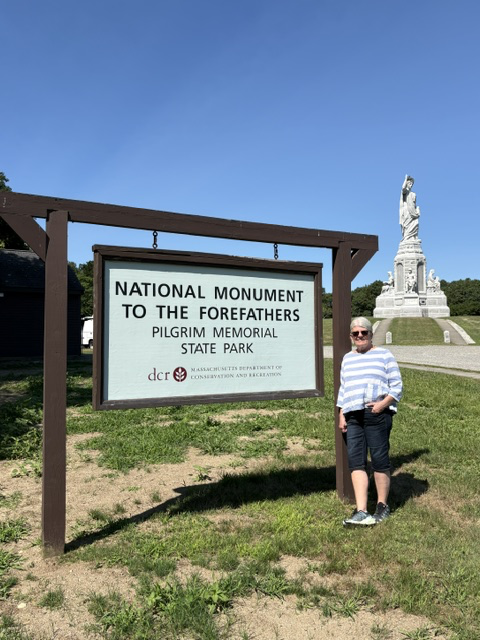
National Monument to the Forefathers
We have visited Plymouth many times over the years, so I am still amazed that it took us this long to discover the National Monument to the Forefathers. When we finally visited this year, I found it almost mind-blowing. Rising more than 80 feet above us, the monument is enormous, intricately sculpted, and filled with […]
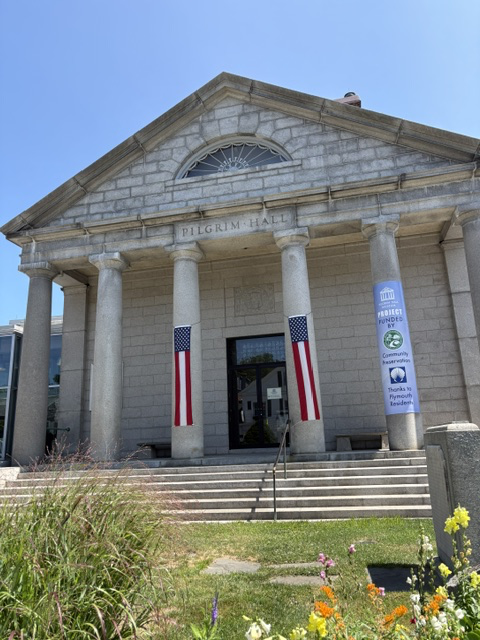
Pilgrim Hall Museum
Just a few blocks from the Plymouth waterfront stands Pilgrim Hall Museum, another place where the story of Plymouth becomes tangible. Founded by the Pilgrim Society in 1824 and opened the following year, it is the oldest continuously operating public museum in the United States. The imposing granite building was designed specifically to preserve the […]
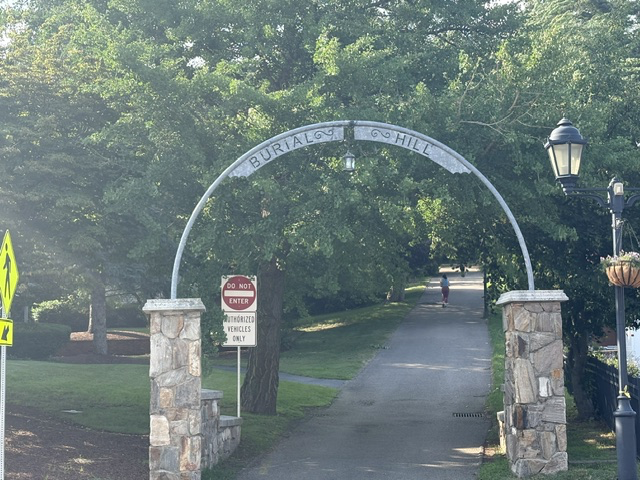
Burial Hill
Rising above Town Square at the upper end of Leyden Street, Burial Hill is one of Plymouth’s most significant historic places. Its elevation provides a commanding view of the harbor, the waterfront, and the route of the town’s first street. That view explains why the settlers initially used the hill for defense rather than burial. […]

