Massasoit Statue
Overlooking Plymouth Harbor from Cole’s Hill stands this bronze statue of Massasoit, also known as Ousamequin, the Pokanoket sachem whose leadership played an essential role in the survival of the newly established Plymouth Colony. He was not simply a figure who appeared in the Pilgrim story. He was the leader of a people who had lived in this region for generations, making decisions about how best to protect and provide for his own communities during a period of enormous change.
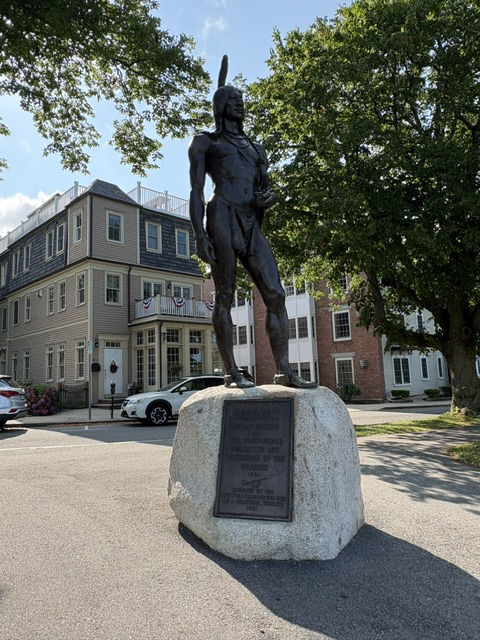
In March 1621, only months after the arrival of the Mayflower, Massasoit met with representatives of the struggling English settlement. The agreement they reached pledged that neither side would harm the other, that stolen property would be returned, and that they would come to one another’s aid if attacked. At a time when mistrust or conflict could easily have defined their first encounters, Massasoit chose diplomacy.
That decision seems particularly significant when standing before his statue today. The English settlers had barely survived their first winter. They were weakened by disease and loss and knew very little about the land on which they were attempting to build a community. Massasoit possessed something they desperately needed, not only knowledge of the region, but the ability to create a relationship that offered a measure of stability and cooperation.
The statue was created by Massachusetts sculptor Cyrus Dallin and dedicated in 1921, three hundred years after that agreement. Its inscription remembers Massasoit as the “Protector and Preserver of the Pilgrims“. Standing tall and looking out toward Plymouth Harbor, he is portrayed with the dignity and strength of a leader.
We know that the centuries following the arrival of the English would bring devastating consequences for Native peoples. But this monument asks us to remember a particular moment in 1621. At that moment stood a Native leader faced with newcomers who were vulnerable, unfamiliar with his world, and uncertain of their future. Massasoit chose negotiation and cooperation. Whatever came later, that act of leadership deserves to be remembered on its own terms.
Read More From Nancy
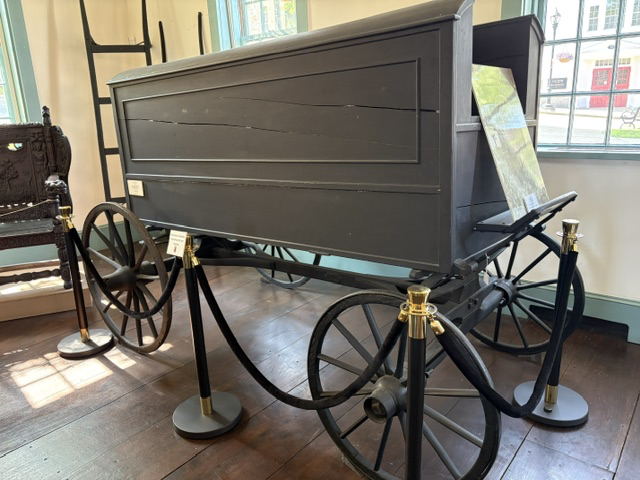
Oldest Hearse
Inside Plymouth’s historic courthouse, we came across an object that tells a very different kind of hometown story. This horse-drawn hearse dates to about 1820 and is believed to be the oldest surviving hearse in Plymouth. According to the exhibit, it was stored for many years in a small stone building behind First Church. The […]
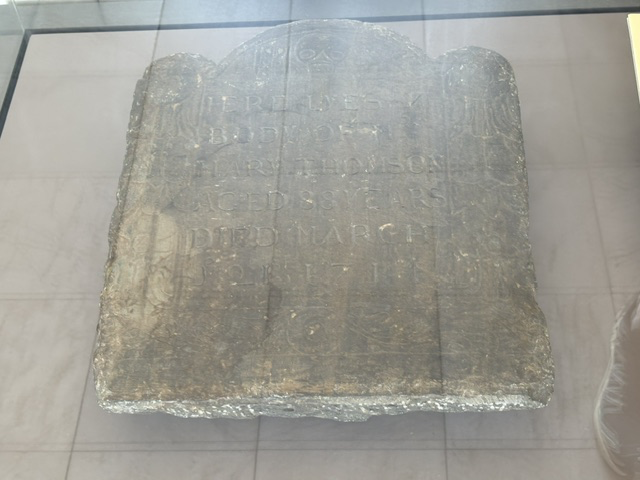
Mary Cooke Thompson Gravestone
Among the artifacts at Pilgrim Hall Museum is this early New England gravestone for Mary Cooke Thompson, a woman with a direct connection to one of the Mayflower families. Mary was the daughter of Mayflower passenger Francis Cooke and his wife, Hester Mahieu. Mary was born in Leiden in the Netherlands, where the English Separatist […]
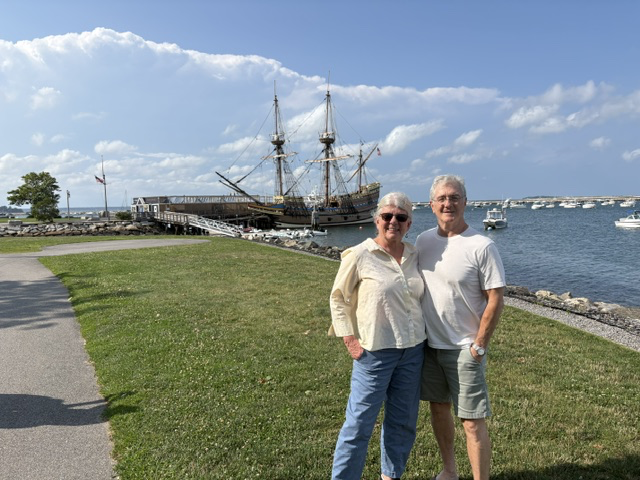
The Mayflower
Standing along the Plymouth waterfront, Mayflower II immediately connects the town to the story that has defined it for more than four centuries. The ship behind us is not the original Mayflower, but a full-scale reproduction built in England and sailed across the Atlantic in 1957 as a symbol of friendship between the United States […]

