Dr John Collins Warren
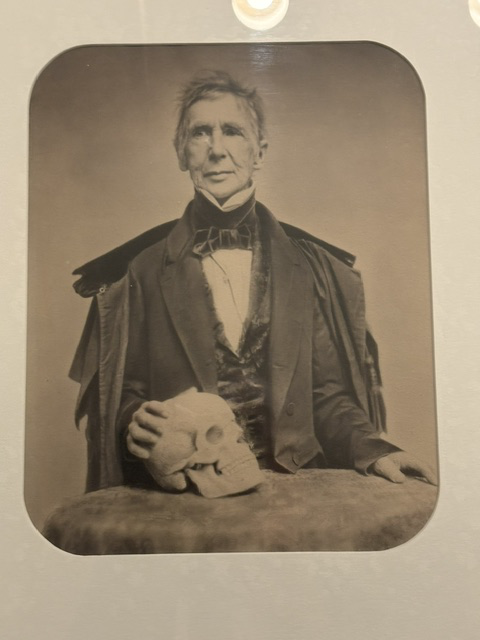
Among the photographs displayed within the historic Bulfinch Building at Massachusetts General Hospital is this remarkable portrait of Dr. John Collins Warren. Standing formally dressed with one hand resting on a human skull, Warren looks very much like a nineteenth-century physician and anatomist. Yet his connection to this building goes much deeper. He was one of the people responsible for creating Massachusetts General Hospital in the first place.
In 1810, Warren and fellow physician James Jackson issued a circular calling for the establishment of a general hospital in Boston. At the time, Boston had no institution comparable to the great hospitals already operating in some European cities. Their vision was a hospital that would care for the sick, particularly those without the means to obtain adequate medical care elsewhere, while also providing a place for physicians to teach and advance medical knowledge. Massachusetts General Hospital was incorporated in 1811, and the Bulfinch Building received its first patient in 1821.
Warren was particularly important to the development of surgery in Boston. He was a professor at Harvard Medical School and became MGH’s first surgeon. Anatomy was fundamental to surgical education, which helps explain the skull in this portrait. Long before CT scans, MRIs and the sophisticated imaging available to physicians today, learning the physical structure of the human body depended heavily upon anatomical study and dissection.
Warren’s career also connected him to one of the most important events ever to occur within the Bulfinch Building. On October 16, 1846, he performed the operation during the famous public demonstration of ether anesthesia. Dentist William T. G. Morton administered ether to Edward Gilbert Abbott, and Warren then removed a tumor while Abbott remained insensible to the pain.
The photograph itself dates from about 1855, near the end of Warren’s life. Photography was still relatively new, making this not simply a portrait of an important physician but an actual photographic image of a man who practiced medicine more than 170 years ago.
Walking through the small historical displays in the Bulfinch Building, photographs like this make the building’s history feel much more personal. Warren was not simply someone whose name appears in the story of Massachusetts General Hospital. He helped imagine the hospital, practiced and taught within it, and participated in an event that forever changed surgery.

Read More From Nancy
The Mirroscope
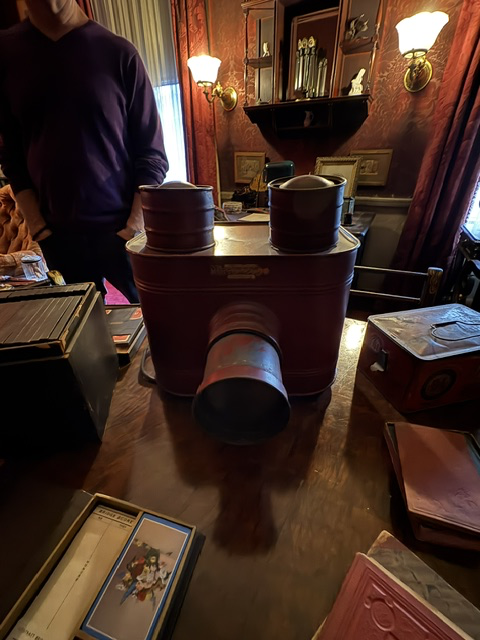
Among the objects that caught my attention while visiting the Gibson House Museum in Boston was this unusual piece of photographic equipment. At first glance, with its large projecting lens and boxlike body, I assumed it was an early camera. Looking more closely, however, I discovered that it worked in exactly the opposite direction. It […]
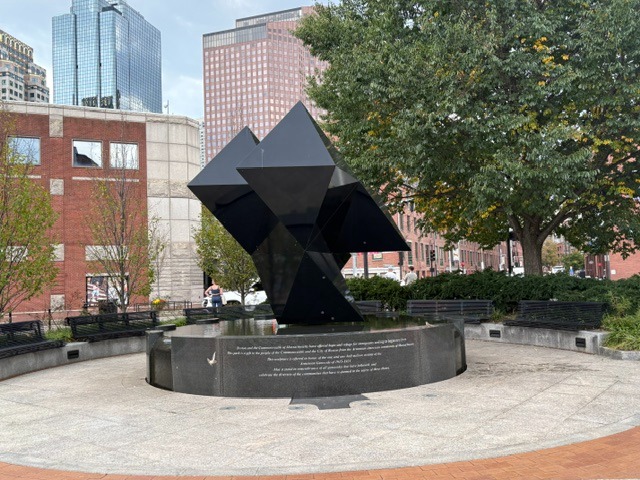
Armenian Heritage Park
During our walk around Boston, we stopped at Armenian Heritage Park on the Rose Kennedy Greenway. Its angular sculpture offers a different kind of memorial: one whose form changes while its purpose remains rooted in remembrance. The sculpture honors the lives lost during the Armenian Genocide of 1915–1923 and the genocides that followed. The park […]
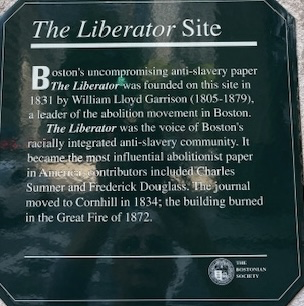
The Liberator Site
I had just stepped away from the busy Freedom Trail, when I came across the bronze plaque on a quiet Boston street. It read: “The Liberator Site – Boston uncompromising anti-slavery paper. The Liberator was founded on this site in 1831 by William Lloyd Garrison…..“ Standing at this spot, I realized that this was the birthplace […]

