Thoreau’s Night on Mount Greylock
One of the markers on the summit of Mount Greylock preserves the words of Henry David Thoreau, recalling a night he spent here in July 1844. While many visitors come simply to enjoy the view, Thoreau came seeking something more. His journey to Greylock became one of the defining experiences of his early life and found its way into his first published book, A Week on the Concord and Merrimack Rivers.
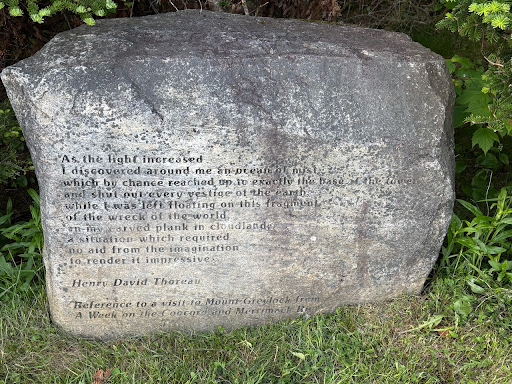
By the summer of 1844, Thoreau was at an important crossroads. Two years earlier, he had lost his beloved brother John, whose death profoundly affected him. After spending several months working in New York, he returned to Massachusetts and set out alone on a walking tour through the Berkshires. Carrying little more than a knapsack, a walking stick, a few books, and a change of clothing, he climbed Mount Greylock, then commonly known as Saddle-back Mountain, as part of a journey intended to reconnect him with the natural world. The summit in 1844 was very different from what visitors experience today. There was no Bascom Lodge and no Veterans War Memorial Tower. Instead, Thoreau spent the night near a simple observation tower that had been built by Williams College students. He later wrote that he slept between boards taken from the remains of an earlier observatory. Before dawn, he awoke to discover the mountain rising above an ocean of clouds.
It was that extraordinary morning that inspired the words engraved on the stone:
“As the light increased, I discovered around me an ocean of mist, which by chance reached up to exactly the base of the tower, and shut out every vestige of the earth, while I was left floating on this fragment of the wreck of the world.”
The passage is among the most memorable descriptions in Thoreau’s writings. Rather than simply describing a beautiful sunrise, he captured the feeling of standing above the clouds, where the familiar landscape had disappeared and the summit seemed to exist in an entirely different world.
Many literary scholars view the Greylock journey as an important turning point. Traveling alone through the mountains gave Thoreau renewed confidence in the value of solitude, self-reliance, and direct experience in nature. Less than a year later, he began his experiment at Walden Pond, where he would spend more than two years exploring many of the same ideas that first took shape during this journey through the Berkshires.
Standing beside this marker, it is easy to appreciate why Mount Greylock has inspired generations of visitors. The mountain did more than provide Thoreau with a memorable view; it became part of the intellectual and spiritual journey that shaped one of America’s most influential writers. More than 180 years later, his words continue to invite visitors to pause, look beyond the scenery, and consider how a single experience in nature can leave a lasting mark on a person’s life.
Read More

Read More From Nancy
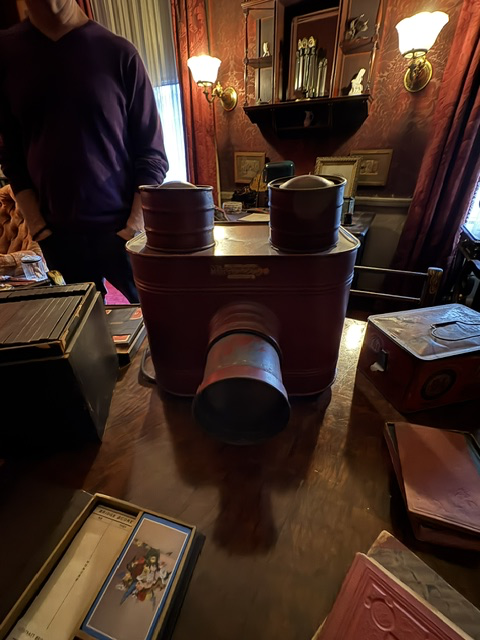
The Mirroscope
Among the objects that caught my attention while visiting the Gibson House Museum in Boston was this unusual piece of photographic equipment. At first glance, with its large projecting lens and boxlike body, I assumed it was an early camera. Looking more closely, however, I discovered that it worked in exactly the opposite direction. It […]
The 1917 Allies Flag
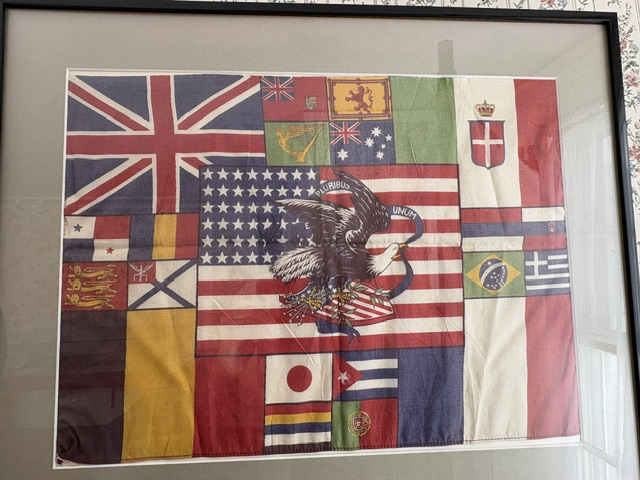
This unusual silk flag, preserved by the Needham History Center & Museum, tells a story not only about World War I, but about how Americans were encouraged to understand the nation’s entry into the conflict. By 1917, Europe had already been at war for nearly three years. The United States had remained officially neutral, but […]
Samuel Eliot Morison Memorial
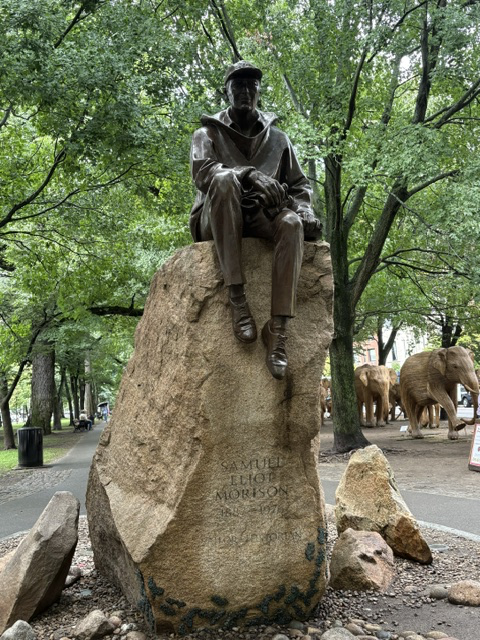
Walking along the Commonwealth Avenue Mall reveals a series of monuments honoring people connected to Boston and the wider world. Among them is a particularly distinctive sculpture of Samuel Eliot Morison. Rather than placing him formally on his feet or astride a horse, sculptor Penelope Jencks portrayed him as a sailor seated on an enormous […]

