A Piece of the Old North Bridge
While visiting the Wayland Historical Society, I was surprised to find a small fragment of wood displayed in a simple case. At first glance, it appeared to be little more than an old, weathered timber.
Yet this was no ordinary piece of wood.
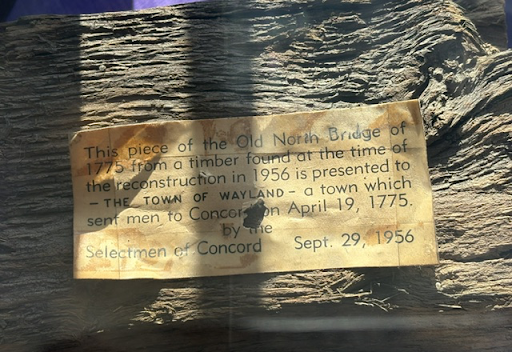
It was a remnant of the original Old North Bridge, the bridge where colonial militia and British soldiers exchanged the “shot heard round the world” on April 19, 1775, marking the beginning of the American Revolutionary War.
The original bridge had long since disappeared, but during the 1956 reconstruction of the North Bridge, one of the original timbers was recovered. Rather than preserving it in a single museum, portions of that historic wood were presented to communities that had participated in the events of April 19, 1775.
Wayland—then part of the town of Sudbury—was one of those communities. On that historic morning, six militia companies, totaling 302 men, marched from Sudbury to Concord, representing one of the largest contingents from any single town. Thirty-five of those men are buried today in Wayland’s North Cemetery, their names still familiar throughout the community: Bent, Damon, Grout, Heard, Loker, Noyes, Rice, Russell, and Sherman.
One story from Wayland’s Revolutionary past reaches even further into American history. A century after the battle, local resident Horace Heard left a bequest that helped fund The Minute Man, the iconic statue sculpted by Daniel Chester French and dedicated at the North Bridge in 1875 for the centennial of the battle.
Historical artifacts do not have to be grand to be meaningful. Sometimes the smallest objects tell the largest stories. A worn timber, an old document, a family photograph, or a simple household item can bridge centuries, reminding us that history was lived by real people in real communities.
Sometimes a single piece of wood can carry the memory of a nation’s beginning.
Read More From Nancy
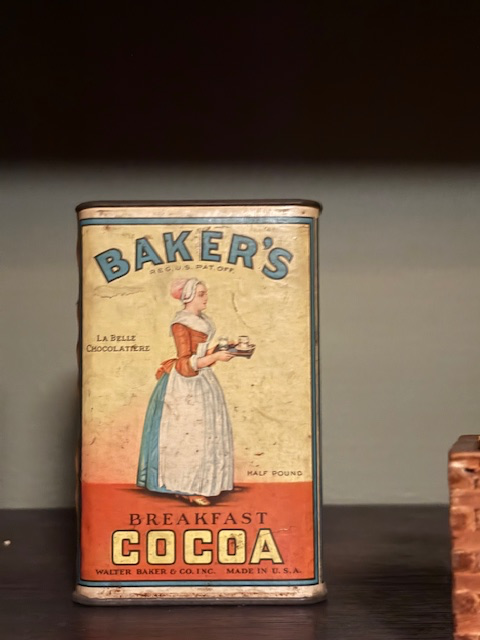
Gibson House Museum – Baker’s Breakfast Cocoa
When visiting the Gibson House Museum in Boston, this colorful tin caught my eye in the kitchen. Baker’s Breakfast Cocoa, the title sparked my curiosity. The tin was produced by Walter Baker & Co, the oldest continuously operating chocolate manufacturer in the United States. Founded in the late 1700s, in Massachusetts, Baker’s became a household […]
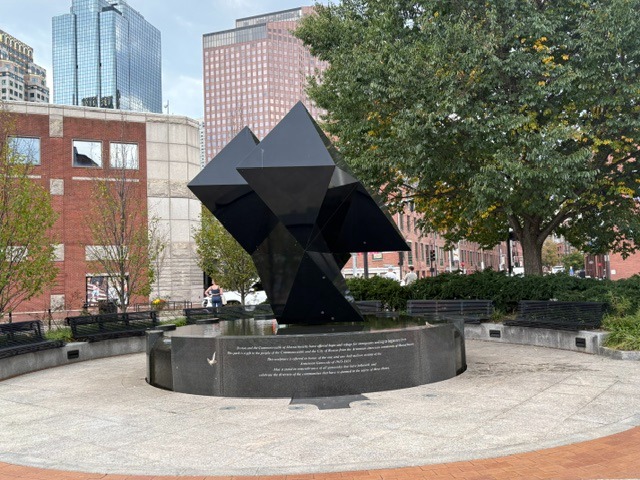
Armenian Heritage Park
During our walk around Boston, we stopped at Armenian Heritage Park on the Rose Kennedy Greenway. Its angular sculpture offers a different kind of memorial: one whose form changes while its purpose remains rooted in remembrance. The sculpture honors the lives lost during the Armenian Genocide of 1915–1923 and the genocides that followed. The park […]
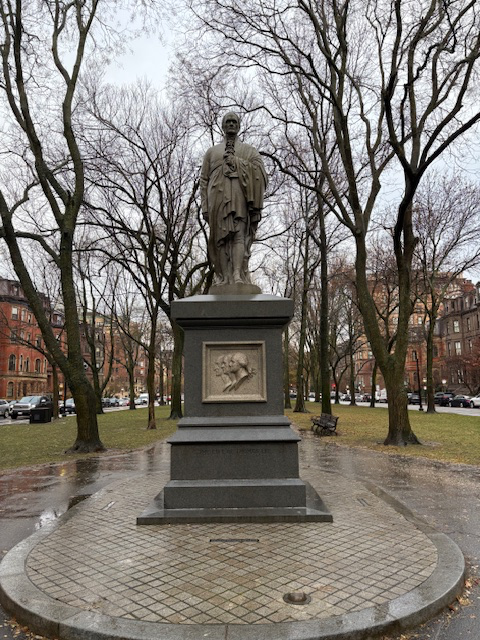
Alexander Hamilton Statue in Boston
I love walking the Commonwealth Avenue Mall and pausing to take in the sculptures that line the path. Each one is placed not just to decorate the boulevard but also to invite reflection. One of the most prominent is the statute of Alexander Hamilton. I found myself wondering why Hamilton, who never lived in Boston. […]

