The Glass that Carried the Light Fishermen’s Museum
Inside the Fishermen’s Museum, a large glass lens stands in a metal frame, its carefully shaped sections stacked around the space where a lamp would sit. It is a Fresnel lens, an invention that transformed lighthouse illumination during the nineteenth century. The museum describes this exhibit as similar to the lens used in Pemaquid Point Lighthouse.
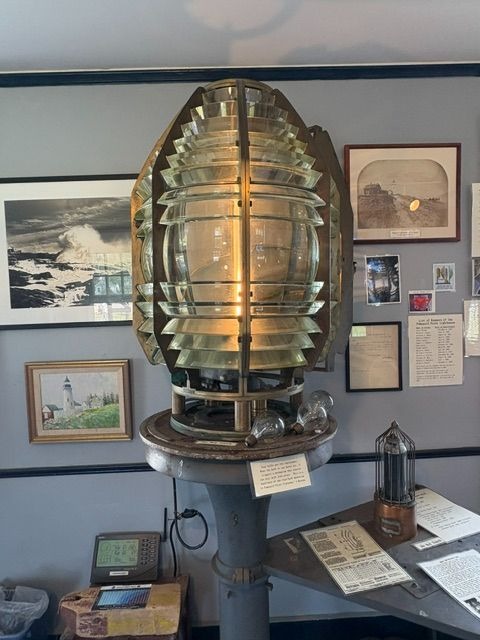
French physicist Augustin-Jean Fresnel developed the design in the early 1820s. Earlier lighthouse lenses could be thick, heavy, and inefficient. Fresnel arranged smaller sections of glass into a structure that gathered and redirected light far more effectively. His work allowed a lamp’s light to reach farther across the water.
The idea was ingenious: improve how the available light was used. A lamp sends light in many directions, but much of that light is of little help to someone looking for a beacon at sea. The lens’s precisely shaped glass bends and redirects those rays into a concentrated beam. Its ridges and prisms are working parts, each contributing to the light sent toward the horizon.
Pemaquid Point received a fourth-order Fresnel lens in 1856. “Order” refers to a lens’s size classification; different sizes were used to meet different navigational needs.
Seen up close, the museum’s lens makes the engineering easier to appreciate. What appears from offshore as a distant light depended on carefully made glass, an accurately positioned lamp, and regular attention from its keeper. The tower gave the light its height; the lens helped carry it out to sea.

Read More From Nancy
When the Light Could Not Be Seen
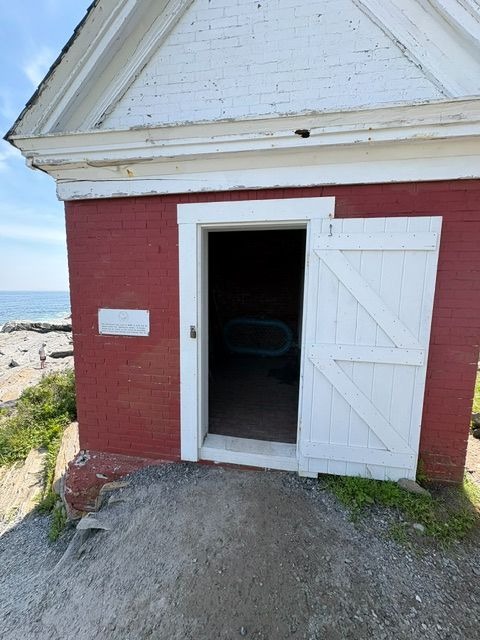
The small red brick bell house at Pemaquid Point served a purpose that the lighthouse alone could not fulfill. When fog obscured the coast and hid the light, mariners needed a warning they could hear. Built in 1897, the bell house sheltered the equipment used to operate the station’s fog bell. Early arrangements included steam-powered […]
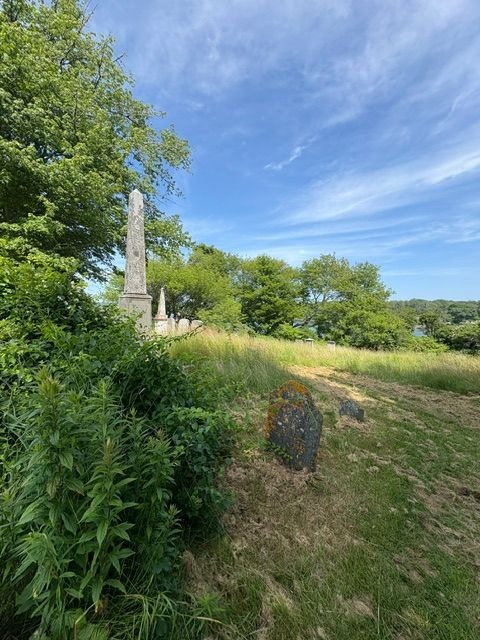
The Old Burying Ground at Pemaquid
Weathered headstones stand among the grass and trees at Pemaquid’s old burying ground. Some are modest slabs, while taller monuments rise above them. Lichen covers parts of the stone, and time has softened inscriptions that once clearly identified the people buried here. The surviving gravestones date back to the early 1700s. The burial ground itself […]
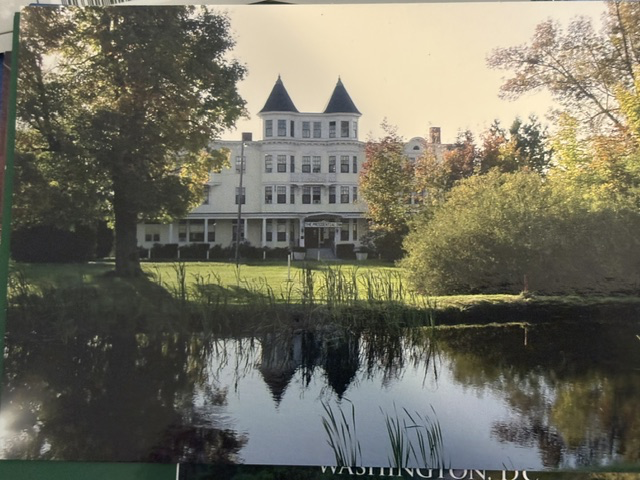
Poland Spring Resort
I made my way to Poland Spring to spend the night, and in many ways it felt like stepping back in time. This was not a modern luxury hotel experience. The room was plain, the towels were thin, and there was a small bar of soap waiting in the bathroom. The accommodations were simple and […]

