St. Matthew’s Church
On Barrington Street near Spring Garden Road, St. Matthew’s Church preserves the history of a congregation whose origins reach back to Halifax’s founding in 1749. Its tall spire, pointed windows and buttressed walls belong to a building completed in 1859, but the community that built it had already worshipped in the town for more than a century.
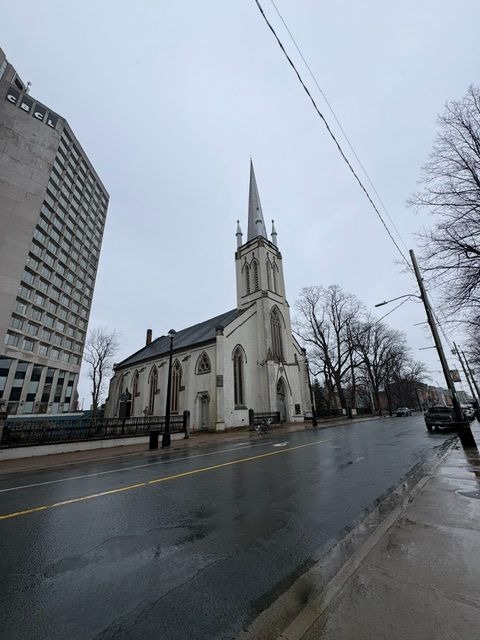
The congregation began as a gathering of Protestant dissenters, people whose worship differed from that of the established Church of England. In December 1749, they received a site at the corner of Hollis and Prince Streets. Their first church opened in 1754, following several years in which they used St. Paul’s Anglican Church for services. Originally called Mather’s Church and later the Protestant Dissenting Church, it became known as St. Matthew’s Presbyterian Church during the early nineteenth century.
A fire on New Year’s Day in 1857 destroyed that first building. Rather than rebuild on the same site, the congregation purchased land on Barrington Street from Anglican Bishop Hibbert Binney. The replacement church opened in 1859. Its Gothic Revival exterior features a prominent entrance tower, a slender spire and pointed windows along the sanctuary walls. Inside, galleries and a high pulpit reflected the congregation’s emphasis on preaching and the spoken word.
The church also had connections to the development of Confederation. Its minister in 1867, George Monro Grant, supported a united Canada. In 1872, he travelled across the country with St. Matthew’s parishioner Sandford Fleming, the railway engineer, and recorded the journey in Ocean to Ocean. Their association links this Halifax congregation with the effort to understand and connect the newly formed country.
In 1925, the congregation joined the United Church of Canada. During the Second World War, St. Matthew’s provided entertainment, ministry and comfort to Canadian troops, extending its work beyond Sunday worship. Its history combines the establishment of an early dissenting congregation, recovery from a destructive fire and generations of service within downtown Halifax.
Read More From Nancy
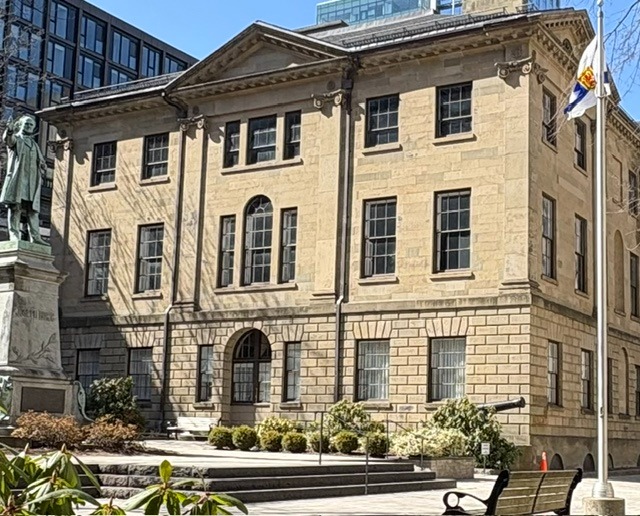
Province House
Province House has been the home of Nova Scotia’s legislature since its official opening on February 11, 1819. As Canada’s oldest legislative building, it preserves more than two centuries of parliamentary history within a structure still serving its original purpose. Its construction gave the province’s elected Assembly a permanent home after decades in temporary accommodations. […]
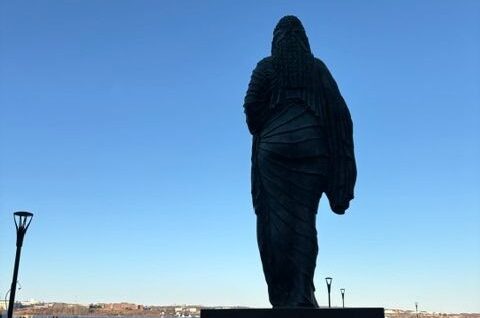
The Sirens’ Calling
At Queen’s Marque on Halifax’s waterfront, four sculpted figures stand on black granite bases, each oriented toward a different point of the compass. Created by Nova Scotia artist John Greer and installed in 2020, The Sirens’ Calling draws on ancient Greek sculpture and mythology to explore departure, return and the harbour’s role as a place […]
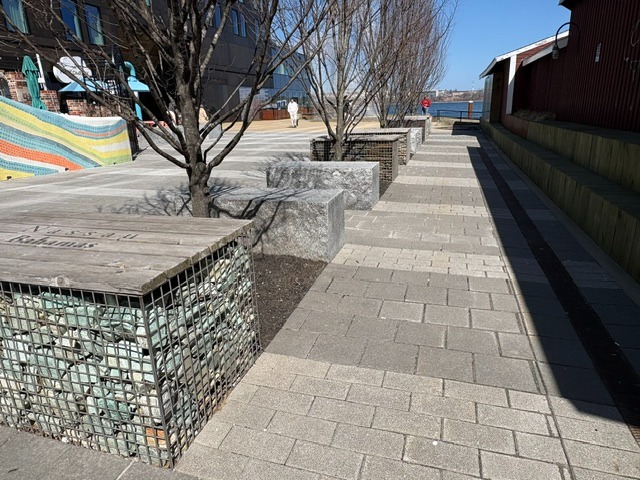
The Ballast Boxes
Along Halifax’s waterfront, stone-filled metal boxes topped with wooden seating recall an essential part of maritime trade. These ballast boxes turn a practical feature of the public landscape into a reminder of the weight that helped sailing ships travel safely across the ocean. A ship needed stability even when its hold carried little or no […]

