Jonathan McCully
A portrait bust in Halifax’s Founders Square commemorates Jonathan McCully, a lawyer, newspaper editor and political leader remembered as one of Canada’s Fathers of Confederation. Born in Cumberland County, Nova Scotia, in 1809, McCully practised law in Amherst before entering provincial politics. Appointed to the Legislative Council in 1848, he later served as solicitor general and government leader in the council.
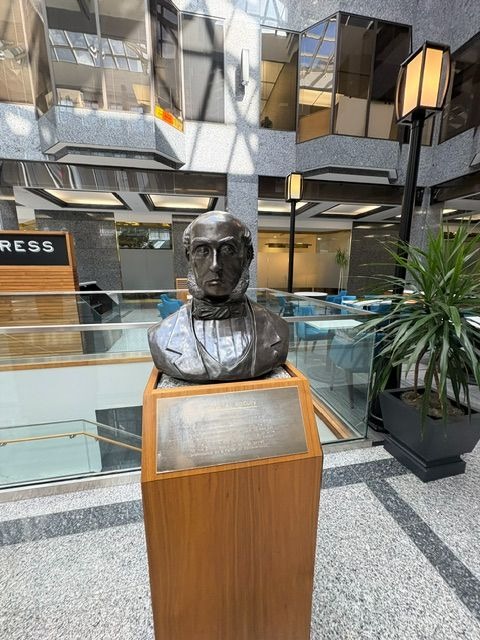
McCully’s influence extended beyond the legislature into the newspaper press. As an editor of the Halifax Morning Chronicle and the Novascotian, he helped shape public discussion of the province’s future. During the Confederation debates, he became a determined advocate for bringing the British North American colonies together. His editorials promoted union at a time when the proposal faced substantial opposition in Nova Scotia.
He also participated directly in the negotiations. McCully attended the Charlottetown and Quebec conferences in 1864 and the subsequent London conference that helped establish the terms of Confederation. His support placed him on the opposite side of the debate from prominent political associates, including Joseph Howe. Creating the new country required persuasion within the provinces as well as agreement among their delegates.
Following Confederation in 1867, McCully entered the Canadian Senate. He resigned in 1870 to become a judge of the Supreme Court of Nova Scotia, serving until his death in Halifax in 1877. His career connected three places where public decisions took shape: the newspaper office, the legislature and the courtroom. The bust preserves the memory of a Nova Scotian whose contribution to Canada’s creation involved both negotiating its foundations and arguing publicly for its future.


Read More From Nancy

Mitchell House
At the corner of Prince and Lower Water Streets, Mitchell House preserves a chapter of Halifax’s history when a merchant’s home and business could share the same building. George Mitchell purchased the property in 1819 and, in the mid-1820s, replaced an earlier wooden house with an ironstone residence and warehouse. The location placed his family […]

The Dockyard Clock
At Chebucto Landing on Halifax’s waterfront, the Dockyard Clock stands above the boardwalk in a blue-shingled tower supported by an open framework. Its public setting is relatively recent, but the timepiece dates to 1767. Made in London, England, it was installed in Halifax’s naval dockyard in 1772, where it served generations of sailors and civilian […]

The Halifax Town Clock
On the eastern slope of Citadel Hill, the Halifax Town Clock overlooks Brunswick Street and the downtown streets below. Its white tower, blue clock faces and copper dome form one of the city’s most recognizable landmarks. The clock began keeping time on October 20, 1803, providing a public reference for both the military garrison and […]

