The Halifax Town Clock
On the eastern slope of Citadel Hill, the Halifax Town Clock overlooks Brunswick Street and the downtown streets below. Its white tower, blue clock faces and copper dome form one of the city’s most recognizable landmarks. The clock began keeping time on October 20, 1803, providing a public reference for both the military garrison and Halifax’s residents.
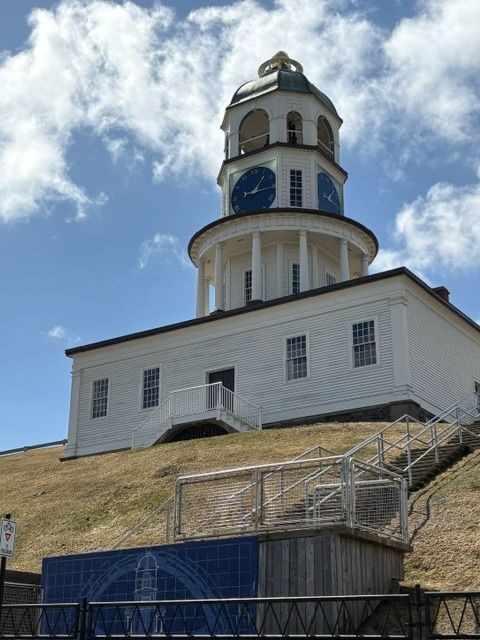
The project originated with Prince Edward, Duke of Kent, who commanded British forces in the region before returning to England in 1800. Concerned with punctuality, he instructed his engineer to prepare plans for a large clock that soldiers and townspeople could consult. The mechanism was made in London by the House of Vulliamy, a family of royal clockmakers, and shipped to Halifax for installation.
The building gave that practical purpose a distinctive architectural form. A symmetrical rectangular base supports a tower arranged in three stages: an open colonnade, an octagonal clock storey and an arcaded upper section beneath the dome. Classical proportions and white wooden cladding create a light appearance, while its elevated position makes the clock visible from the streets below.
Inside, the timepiece works through a system of suspended weights, cables and drums. Winding raises the weights; their gradual descent turns the drums and powers the mechanism. Parks Canada maintains the original clockworks and winds them twice weekly to reduce stress on the machinery. This continuing care preserves a working piece of early nineteenth-century craftsmanship.
The surrounding structure has required substantial renewal. Between 1960 and 1962, it was largely reconstructed to reproduce the earlier building while retaining the historic mechanism. Its heritage value therefore includes both the original timepiece and an important chapter in Halifax’s conservation history. The familiar tower preserves the appearance of the 1803 landmark, while the clock within it continues the task for which it was commissioned.
Read More From Nancy
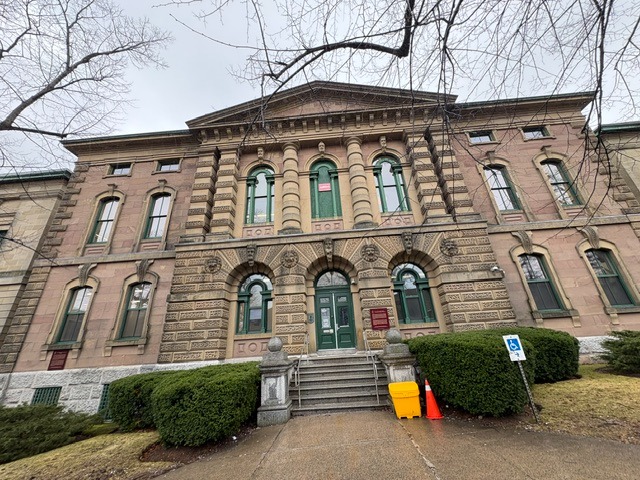
Halifax Court House
On Spring Garden Road in downtown Halifax, the Halifax Court House presents an imposing sandstone façade built to express the dignity and authority of the law. Designed by the Toronto architectural firm of William Thomas and Sons in 1858, the building housed county and provincial courts following its completion in 1863. Its importance to Canada’s […]
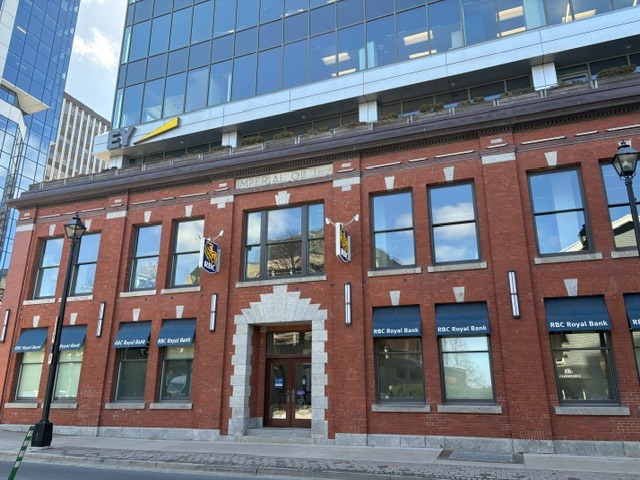
The Imperial Oil Building
At the corner of Duke and Upper Water Streets, the Imperial Oil Building records a twentieth-century chapter in Halifax’s waterfront commerce. Completed in 1926, the two-storey brick building provided office space for Imperial Oil Limited. The company’s name, carved above the central entrance, preserves its original identity. The property’s history reaches further back. It was […]
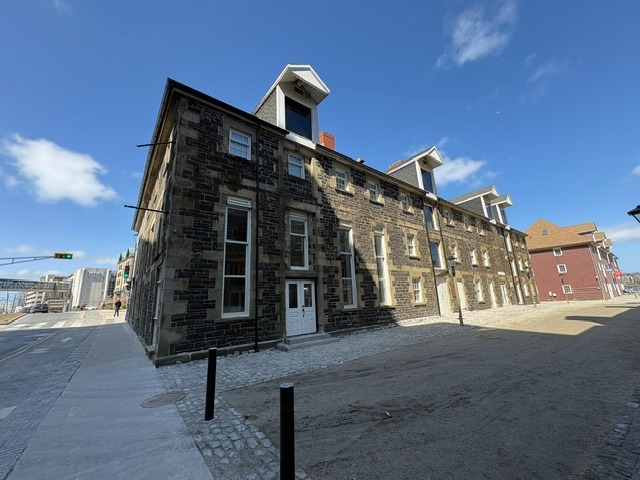
Historic Properties
Along Halifax’s harbour, a closely grouped collection of stone and wooden buildings preserves the character of the city’s nineteenth-century working waterfront. Known as Historic Properties, these former warehouses and commercial premises stood where merchants conducted business and stored goods moving through the port. In 1963, the Halifax Waterfront Buildings were designated a National Historic Site, […]

