Mitchell House
At the corner of Prince and Lower Water Streets, Mitchell House preserves a chapter of Halifax’s history when a merchant’s home and business could share the same building. George Mitchell purchased the property in 1819 and, in the mid-1820s, replaced an earlier wooden house with an ironstone residence and warehouse. The location placed his family and commercial operations close to the harbour on which his livelihood depended.
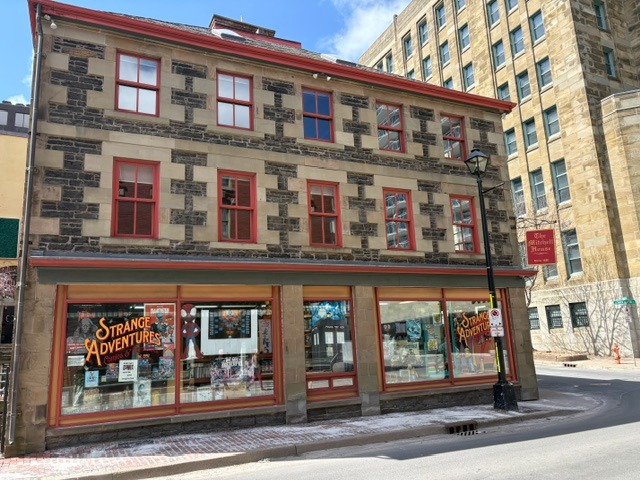
Mitchell was a shipping merchant involved in trade with the West Indies. His house belonged to a waterfront economy shaped by the movement of vessels and goods between Halifax and distant ports. Combining living quarters with storage space brought domestic life and the practical demands of commerce together under one roof.
The building’s Georgian character appears in its restrained proportions and regularly spaced windows. Dark ironstone walls contrast with the lighter stone surrounding the openings and marking the corners. Its substantial masonry and orderly exterior suited a building intended to accommodate both a household and a merchant’s business. The upper storeys retain the appearance of a residence even as the ground floor reflects its long commercial history.
After the Mitchell family moved out, the entire building was adapted for commercial use. Interior features, including trap doors associated with moving goods between floors, provide evidence of its warehouse function. By the twentieth century, it was also known as the Sperry Gyroscope of Canada building, a name recorded in a photograph held by the Nova Scotia Archives.
Recognized as a municipal heritage property in 1981, Mitchell House retains its connection to both family life and waterfront enterprise. Its significance rests in that combination: a surviving merchant’s home whose structure also records the work of storing and handling goods in nineteenth-century Halifax.
Read More From Nancy
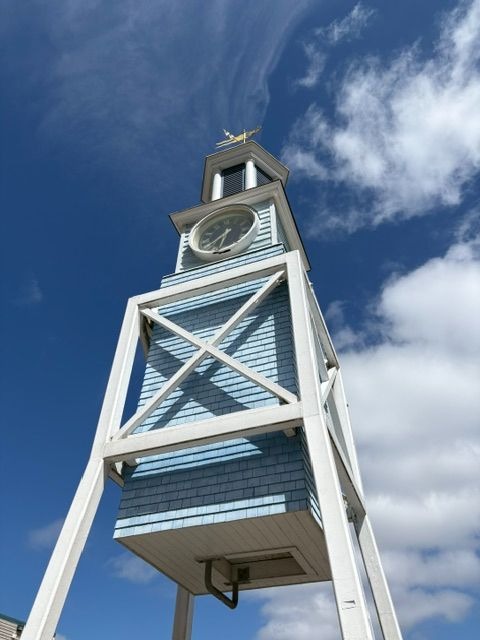
The Dockyard Clock
At Chebucto Landing on Halifax’s waterfront, the Dockyard Clock stands above the boardwalk in a blue-shingled tower supported by an open framework. Its public setting is relatively recent, but the timepiece dates to 1767. Made in London, England, it was installed in Halifax’s naval dockyard in 1772, where it served generations of sailors and civilian […]
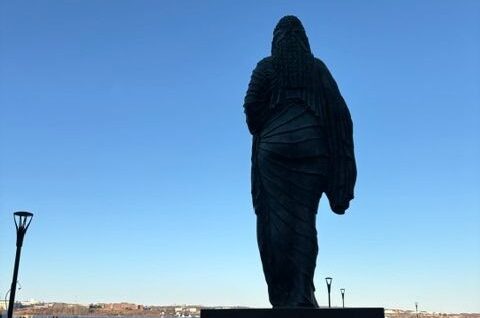
The Sirens’ Calling
At Queen’s Marque on Halifax’s waterfront, four sculpted figures stand on black granite bases, each oriented toward a different point of the compass. Created by Nova Scotia artist John Greer and installed in 2020, The Sirens’ Calling draws on ancient Greek sculpture and mythology to explore departure, return and the harbour’s role as a place […]
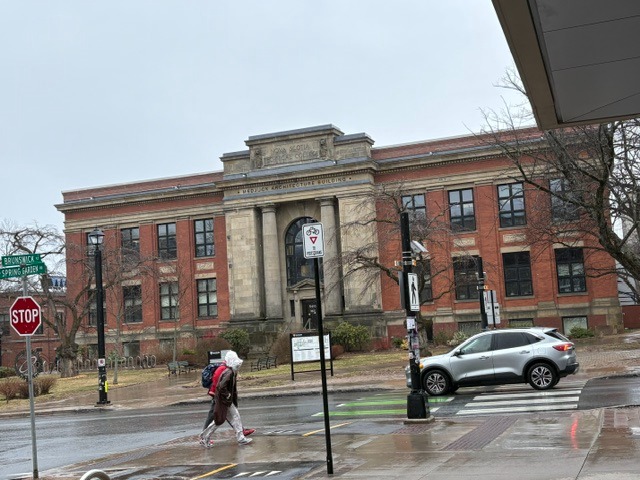
Nova Scotia Technical College
At the corner of Spring Garden Road and Brunswick Street, the former Nova Scotia Technical College preserves an important chapter in the province’s educational history. Designed by Halifax architect Herbert E. Gates and opened in 1909, the building served for many years as the college’s principal academic home. Its red brick walls and formal classical […]

