Halifax Public Gardens
The Halifax Public Gardens preserve a rare example of a Victorian public garden in the heart of a modern city. Across approximately sixteen acres, winding gravel paths connect carefully maintained lawns, ornamental flower beds, mature trees, and water features. The landscape was designed for leisurely walking and close observation, offering opportunities to appreciate both individual plants and the larger patterns of the garden.
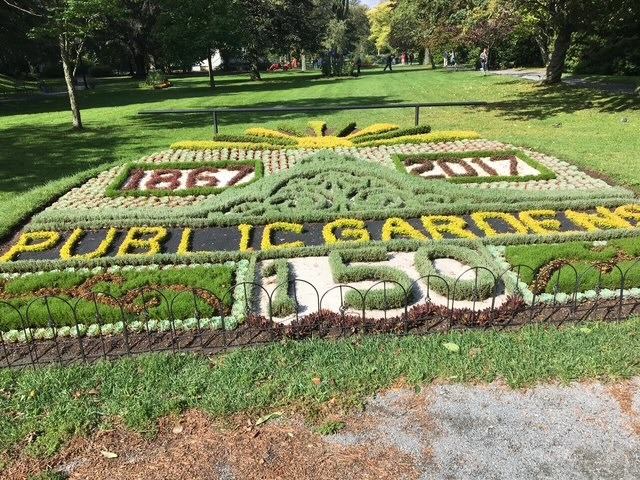
The gardens developed from earlier horticultural and public spaces. The Nova Scotia Horticultural Society established its garden in 1837, and the city later developed an adjoining public garden. Halifax celebrated 1867 as the beginning of its Public Gardens, although the two properties were formally combined in 1874. Over time, a bandstand, fountains, statues, and ornamental gates helped establish the distinctive Victorian character that survives today.
One of the gardens’ most intricate traditions is carpet bedding. Densely arranged, low-growing plants create images, lettering, and geometric patterns through contrasting foliage. Gardeners carefully select, position, and trim the plants so that their leaves form a clear design. These beds combine horticultural knowledge with the precision of decorative artwork.
In 2017, this technique marked two anniversaries: 150 years of Canadian Confederation and the Public Gardens’ own 150th anniversary. One display incorporated Canada’s multicolored anniversary emblem above the dates 1867–2017. Another presented the gardens’ name and anniversary in planted lettering. The commemorative beds brought a Victorian gardening practice into a contemporary celebration of national and local history.

The gardens’ significance rests in the preservation of an entire landscape tradition. Curving paths, carefully framed views, varied plant collections, and elaborate seasonal beds work together to create a public space shaped by nineteenth-century ideas of beauty and recreation. Their continued care allows each growing season to renew a historic setting that generations of Halifax residents and visitors have enjoyed.



Read More From Nancy

Jonathan McCully
A portrait bust in Halifax’s Founders Square commemorates Jonathan McCully, a lawyer, newspaper editor and political leader remembered as one of Canada’s Fathers of Confederation. Born in Cumberland County, Nova Scotia, in 1809, McCully practised law in Amherst before entering provincial politics. Appointed to the Legislative Council in 1848, he later served as solicitor general […]

The Sailors’ Memorial
At Sackville Landing on Halifax’s waterfront, a bronze sailor strides forward with a duffel bag in one hand and a rolled hammock balanced across his shoulder. Created by sculptor Peter Bustin, the figure represents a Canadian sailor of the Second World War era. His belongings give the monument an everyday character: a young man carrying […]

Nova Scotia Technical College
At the corner of Spring Garden Road and Brunswick Street, the former Nova Scotia Technical College preserves an important chapter in the province’s educational history. Designed by Halifax architect Herbert E. Gates and opened in 1909, the building served for many years as the college’s principal academic home. Its red brick walls and formal classical […]

