Veterans Memorial Park
Veterans Memorial Park in North Easton brings military remembrance into a quiet public setting. Granite monuments, American flags, brick paths, and benches surround an open lawn, creating a place where visitors can pause and consider the service of people connected to the town.
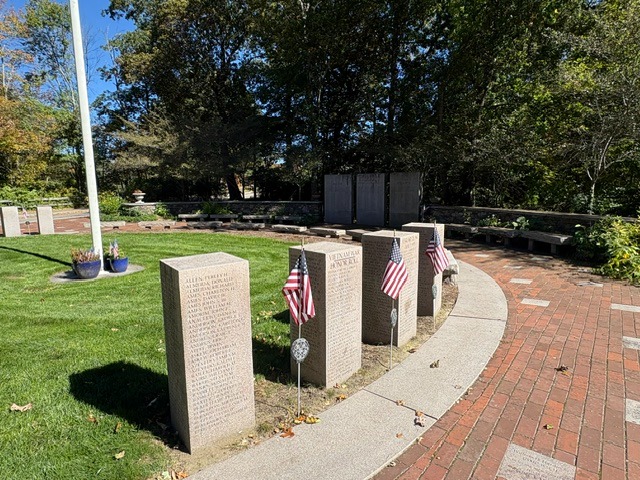
The inscriptions give that remembrance a personal dimension. Rather than referring only to distant battles or national events, the stones record individual names. Each represents a person whose military service became part of Easton’s history, connecting the community with events that unfolded far beyond its boundaries.
The arrangement encourages visitors to approach the monuments closely. A curved walkway follows the line of the granite stones, while small American flags mark the memorial area. Benches along the surrounding wall provide space to sit, and trees and plantings give the park a sheltered character. These features allow the site to accommodate both public observances and individual reflection.
The park also serves as a gathering place for Easton’s commemorative ceremonies. Town announcements document Memorial Day and Veterans Day processions leading to the park, where the community assembles to honor military service and remember those who died. Such observances give continuing meaning to the permanent monuments.
A local veterans memorial preserves a connection between national history and familiar names. At Easton’s Veterans Memorial Park, that connection is expressed through inscriptions, flags, and a space set aside for remembrance. It allows successive generations to encounter the names of those who served and to carry that recognition forward.
Read More From Nancy
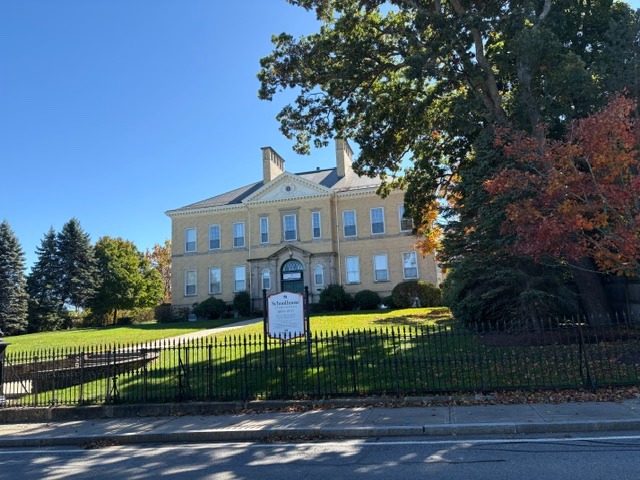
Former Oliver Ames High School
The former Oliver Ames High School represents a lasting investment in public education in Easton. Built in 1895–1896, the school was jointly financed by the town and former Massachusetts governor Oliver Ames. It was dedicated in December 1896, after Ames’s death, and carried his name as a recognition of his contribution to the community. Boston […]
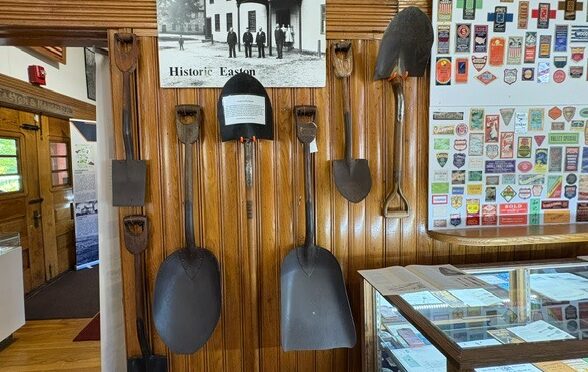
Ames Shovels
Displayed together in the Easton Historical Society Museum, the Ames shovels reveal how much variety can exist within an everyday tool. Some have broad, rounded blades, while others are narrower or nearly rectangular. Long wooden shafts and shorter handles with enclosed grips reflect different ways of lifting, digging, and moving materials. Their shapes invite a […]
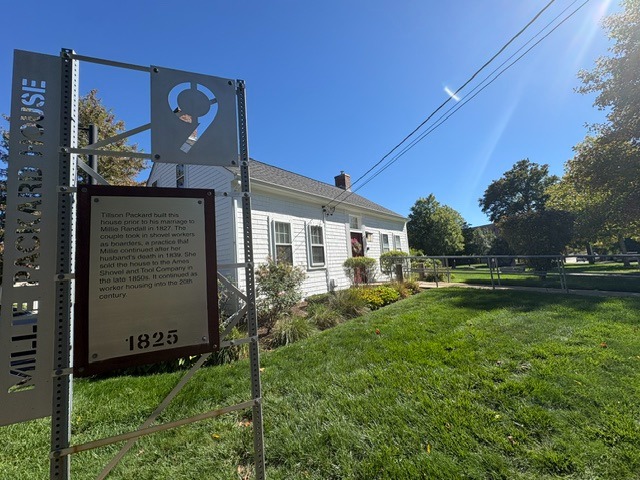
The Millie Packard House
The Millie Packard House preserves a domestic chapter of North Easton’s industrial history. Built in 1825, this modest residence connects the growth of the shovel industry with the people who lived and worked in the village. Its story includes marriage, employment, and the changing relationship between private homes and company-owned housing. Tillson Packard built the […]

