Oakes Ames Memorial Hall
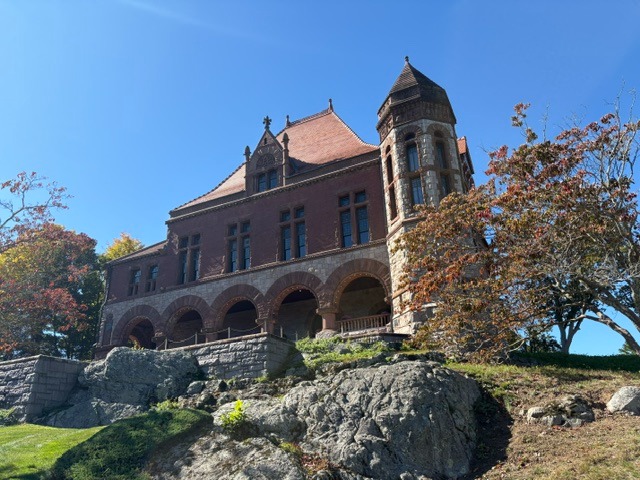
Standing above the street on a rocky hillside, Oakes Ames Memorial Hall is one of North Easton’s most distinctive landmarks. Its broad arches, steep red-tiled roof, and corner tower give it a commanding presence, while the exposed rock beneath it connects the building to the surrounding landscape. Built between 1879 and 1881, the hall was commissioned by the children of Oakes Ames to honor their father and provide a gathering place for the community.
Oakes Ames was a manufacturer, congressman, and an important investor in the Union Pacific Railroad. The Ames family’s industrial success helped shape Easton, and their railroad investments extended their influence far beyond Massachusetts. His national legacy, however, included controversy. In February 1873, the House of Representatives censured Ames for his involvement in the Crédit Mobilier scandal, in which discounted shares were sold to members of Congress to gain political support for railroad interests. The memorial hall therefore honors a man whose career combined substantial contributions to American industry with a serious breach of public trust.
To design the memorial, the family selected Henry Hobson Richardson, one of the leading American architects of the nineteenth century. Richardson developed a distinctive interpretation of Romanesque architecture, using substantial masonry, rounded arches, dramatic rooflines, and carefully arranged building masses. At the hall, a stone arcade stretches across the lower level beneath brick upper walls. The tower creates an asymmetrical silhouette, while carved details give the heavy masonry a finer decorative character. These features exemplify the style that became known as Richardsonian Romanesque.
The building was dedicated on November 17, 1881. Although intended to serve as Easton’s town hall, it was never accepted for that purpose because of opposition from other sections of town. Instead, it became a place for meetings and gatherings, fulfilling its broader community purpose even though it did not become the center of municipal government. That distinction is part of its history: an impressive civic gift could still encounter disagreements over how a town should organize its public life.
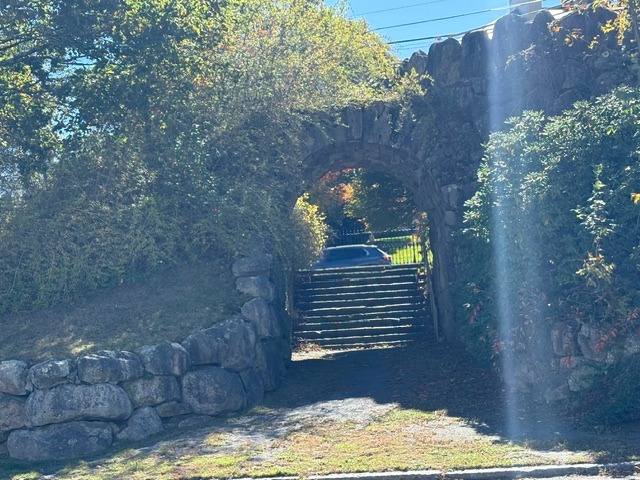
The setting received further attention from landscape architect Frederick Law Olmsted, who designed the surrounding grounds in 1887. Stone stairs, terraces, and planting helped connect the hall to its elevated site. Rather than concealing the hillside’s rugged character, the landscape incorporated it, creating an approach in which natural rock and constructed stonework complement one another. The building and its grounds demonstrate the relationship between Richardson’s architecture and Olmsted’s landscape design.
For more than a century, Oakes Ames Memorial Hall has provided a setting for community gatherings, celebrations, and private events. Its continued use carries forward the family’s original intention to create a place that would benefit the people of Easton. Preserving the hall allows successive generations to experience its architecture while keeping it active in the life of the town.
The hall brings together several chapters of Easton’s history: the influence of the Ames family, the ambitions of nineteenth-century philanthropy, and the work of Richardson and Olmsted. Its stone arches, brick walls, and carefully shaped grounds give lasting physical form to those connections. A memorial conceived to honor one man has become a place with a history shared by the community.
Read More
Read More From Nancy
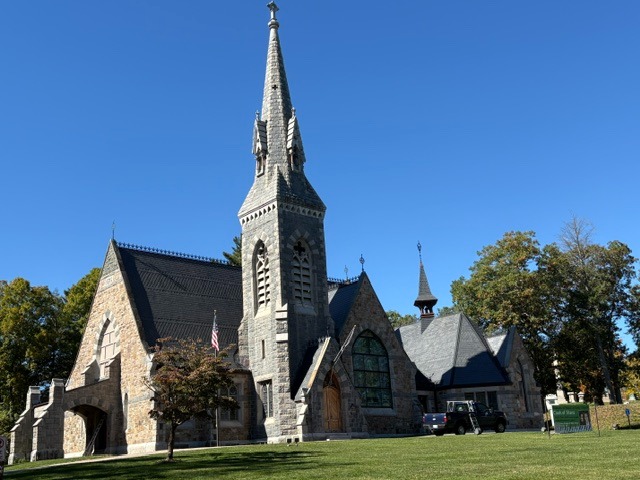
Unity Church
Unity Church rises above its lawn in North Easton with a slender stone spire, steep roofs, and pointed windows. Built in 1875, it was a gift from Oliver Ames II to the Unitarian Society of North Easton. The church reflects both the religious life of the community and the Ames family’s investment in craftsmanship, architecture, […]
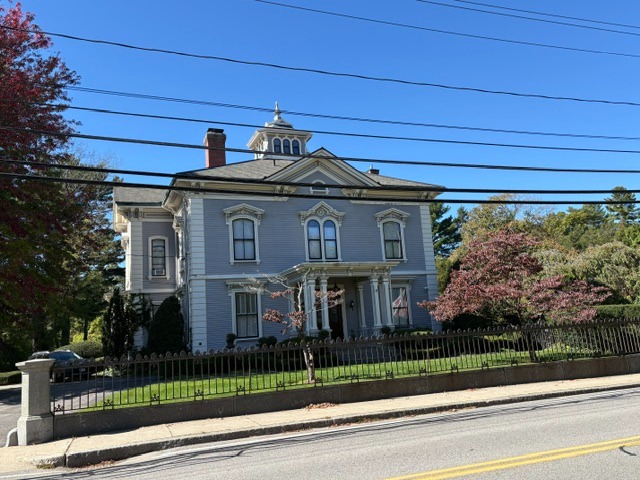
Unity Close
Unity Close, at 23 Main Street, was built in 1862 for Oliver Ames Jr. and his wife, Sarah Lothrop Ames. Designed by Boston architect George Snell, the house reflects the prosperity of the Ames family during the expansion of its shovel manufacturing business. Its location near the company’s operations kept the family home closely connected […]
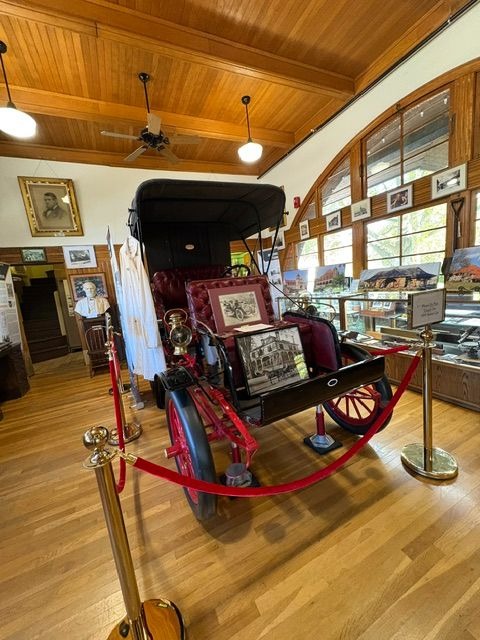
The Morse Runabout
With its tall wheels, upholstered seat, and overhead canopy, the Morse Runabout recalls a time when automobiles still resembled the horse-drawn vehicles they were beginning to replace. Preserved in the Easton Historical Society Museum, the car introduces a less familiar chapter of the town’s industrial history: its connection to early automobile manufacturing. The museum identifies […]

