USS Constitution: Old Ironsides
Looking across the harbor during our walk through Boston’s North End, we could see the tall masts of USS Constitution at the Charlestown Navy Yard. From this distance, the ship connects the modern waterfront with the era when wooden sailing vessels carried the nation’s commerce and defended its interests at sea.
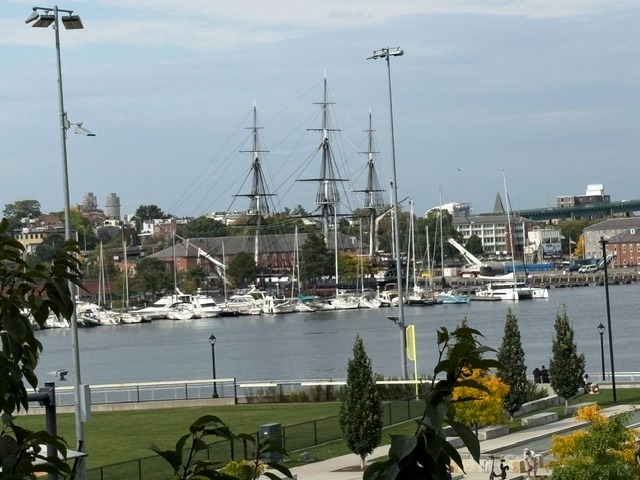
Constitution was launched on October 21, 1797, at Edmund Hartt’s shipyard in Boston’s North End. Designed by Joshua Humphreys, it was one of the six frigates authorized to establish the young United States Navy. Protecting American merchant shipping was central to their purpose.
The ship served during the Quasi-War with France and the First Barbary War, but its most famous encounter came during the War of 1812. On August 19, 1812, Captain Isaac Hull and his crew engaged the British frigate HMS Guerriere. Constitution defeated the British vessel, delivering an important victory for a nation confronting the much larger Royal Navy.
That battle also gave Constitution its enduring nickname. Some British cannonballs struck the thick wooden hull without penetrating it, leading to the name “Old Ironsides.” Its strength came from timber, including dense southern live oak, rather than iron armor. The ship’s construction helped turn a battlefield observation into a lasting national symbol.
Preserving that symbol required repeated intervention. In 1830, reports that the aging ship might be dismantled prompted Oliver Wendell Holmes to write his poem “Old Ironsides.” The poem helped stir public support for its preservation, and reconstruction began in Boston in 1833. Later generations continued the work of repairing and maintaining the vessel.
Constitution remains a commissioned United States Navy warship, the oldest afloat in the world. Its survival depends upon the sailors and skilled craftspeople who care for it at the Charlestown Navy Yard. In 1997, marking its two-hundredth anniversary, it sailed under its own power for the first time in 116 years.
Seeing its masts across the water brings this history into the present-day city. Built on one side of the harbor and preserved on the other, Old Ironsides remains part of Boston’s waterfront and its long relationship with the sea.
Read More From Nancy
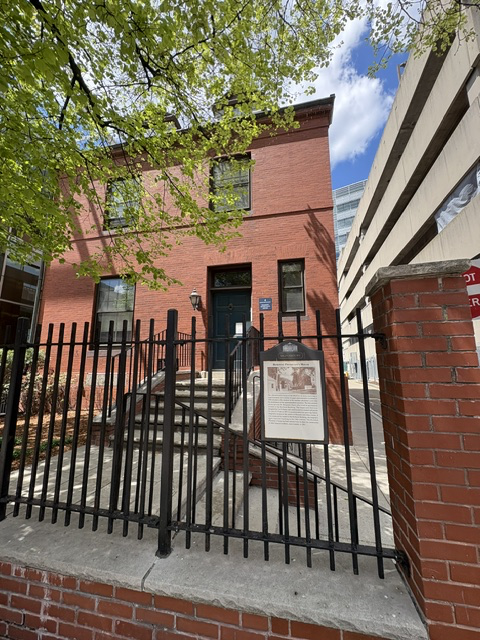
The Resident Physician’s House
History is all around us in Boston, and sometimes Marty and I discover it simply by walking without a particular destination. Near Massachusetts General Hospital, we came across this modest red-brick house. Surrounded today by the enormous modern buildings of MGH, it would be easy to walk past without realizing that it represents an important […]
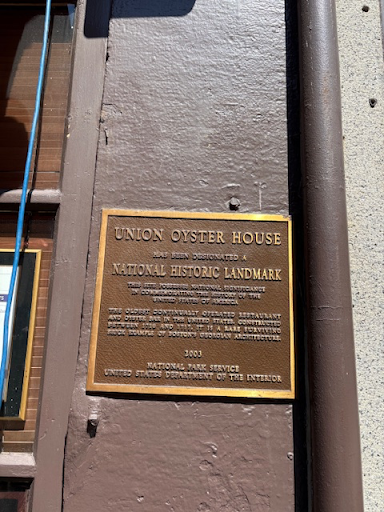
Union Oyster House
Walking along the Freedom Trail in Boston, it is easy to miss the plaque outside the Union Oyster House. But if you pass it by, you are missing not only a good meal, but an extraordinary chapter in American history. The Union Oyster House is the oldest continuously operating restaurant in the United States, serving diners […]
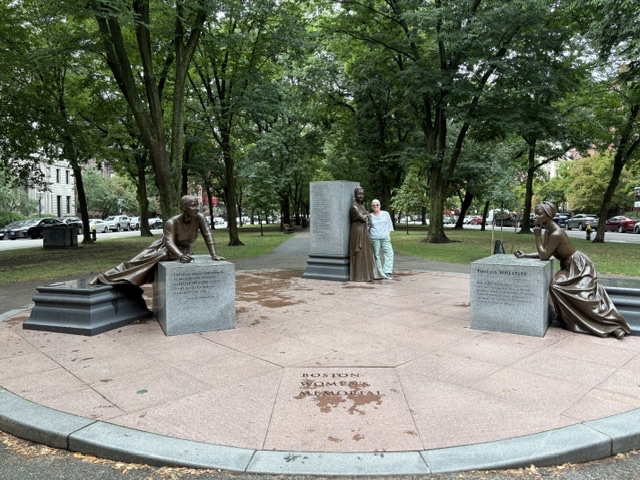
Boston Women’s Memorial
Located on the Commonwealth Avenue Mall, the Boston Women’s Memorial honors Abigail Adams, Lucy Stone and Phillis Wheatley, three women whose words challenged the political, social and intellectual boundaries of their times. Created by sculptor Meredith Bergmann, the bronze-and-granite memorial was dedicated by the City of Boston on October 25, 2003. The idea for the […]

