Apollo at La Fragata
Below the Church of Sant Bartomeu i Santa Tecla, a small classical figure stands in the gardens of La Fragata. With one arm raised above his head and drapery falling across his body, Apollo occupies a quiet patch of green between the historic town and its waterfront. His presence adds another layer to Sitges, where art is encountered outdoors as well as inside its museums.
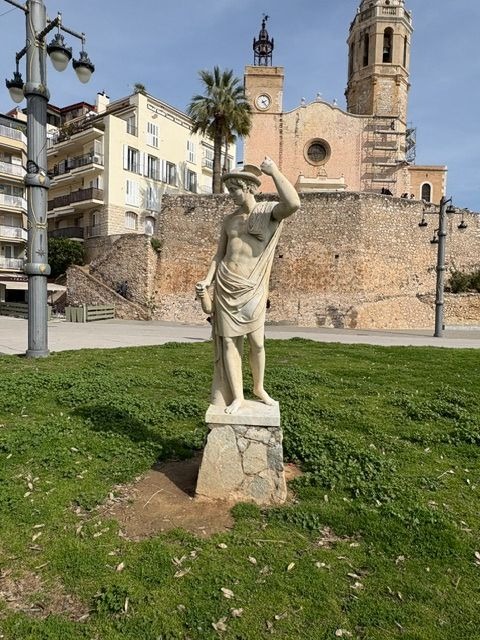
In classical mythology, Apollo was associated with music, poetry, prophecy, and healing. Here, the ancient subject became part of the town’s public landscape through the generosity of Dr. Jesús Pérez-Rosales, a physician and art collector. He donated three sculptures, Apollo, Mercury, and Diana, which were installed at La Fragata in 1977. That date marks their installation; Apollo’s sculptor and original date of creation remain undocumented.
The statue’s recent history includes a serious episode of damage and a careful recovery. During Carnival in 2019, vandalism broke off its head and one arm. Both pieces were recovered, allowing conservator Mònica Roca Luján to restore the figure rather than replace the missing parts.
The restoration also addressed deterioration caused by years outdoors. Dirt, biological growth, cracks, and changes to the surface had affected the figure and its pedestal. After cleaning, the broken sections were reattached and strengthened with internal fiberglass rods. Cracks were sealed to reduce water penetration, and the statue was secured to its base before returning to the gardens in December 2019.
Apollo is one of the works included in Sitges’ public sculpture route, which brings together monuments and artworks scattered through streets, squares, and waterfront spaces. Some commemorate people connected with the town; others, like this figure, introduce subjects from a much older artistic tradition. Together, they make a walk through Sitges an opportunity to discover art beyond the museum doorway.
With the church rising behind him and the Mediterranean nearby, Apollo forms part of a setting where architecture, sculpture, and daily life share the same space. His story also reveals the work involved in keeping public art there: a collector’s gift, the recovery of broken pieces, and the patient care that allowed a familiar figure to return to the waterfront.
Read More From Nancy
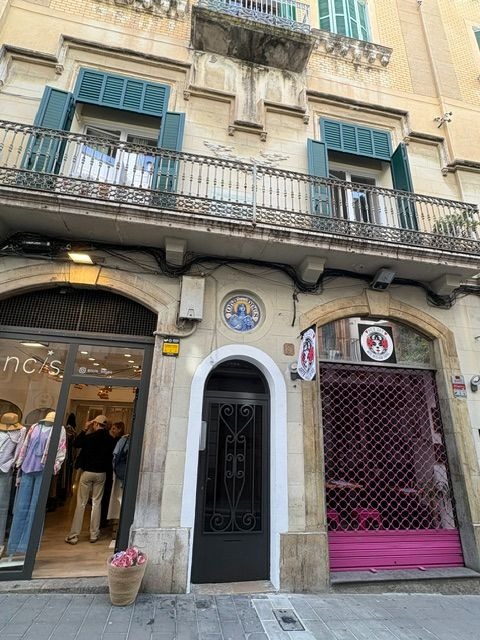
A House and the Virgin of Vinyet
Above a doorway in Sitges, a small ceramic image brings a religious tradition into the life of the street. The depiction appears to be the Mare de Déu del Vinyet, the Virgin of Vinyet, whose connection with the town reaches back centuries. Set between shops and beneath a balcony, it gives a familiar domestic entrance […]
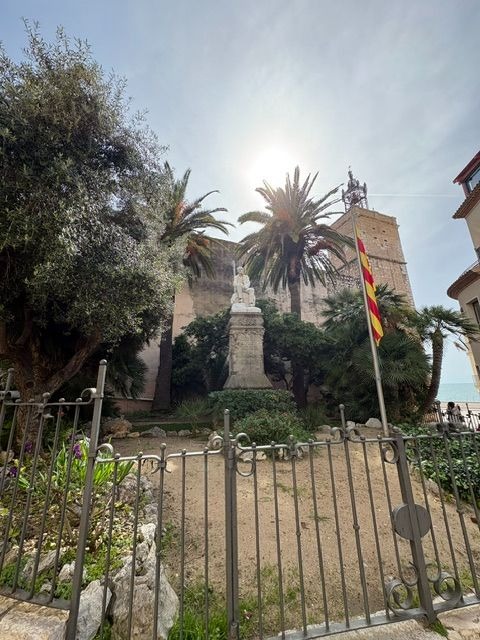
Monument to Dr. Bartomeu Robert
In a small garden near Sitges’s town hall, a seated stone figure honours a man remembered for both medicine and public service. The monument depicts Dr. Bartomeu Robert i Yarzábal, whose career took him to Barcelona but whose family connections and early education tied him to Sitges. Sculptor Josep Reynés created the work, which was […]
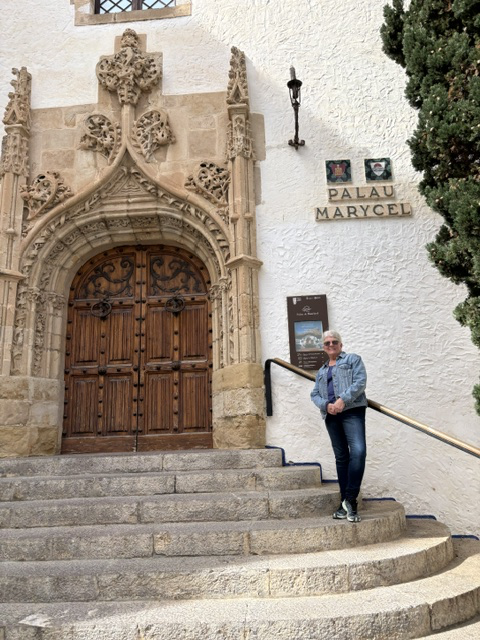
Palau Maricel
Walking through the historic streets of Sitges, Spain, we came upon one of the town’s architectural treasures: Palau Maricel. Standing before its beautifully carved Gothic doorway, it is easy to imagine that this is a medieval palace. It is the product of an extraordinary vision that brought together centuries of Spanish architectural traditions to create […]

