The Sailor in Stone
Walking through Barcelona, I noticed a carved stone panel beside a storefront entrance. A sailor stood next to a large anchor, with the outline of a ship rising behind him and a star above. The relief was incorporated into the building itself, an architectural detail that could easily be overlooked while passing the shop windows.
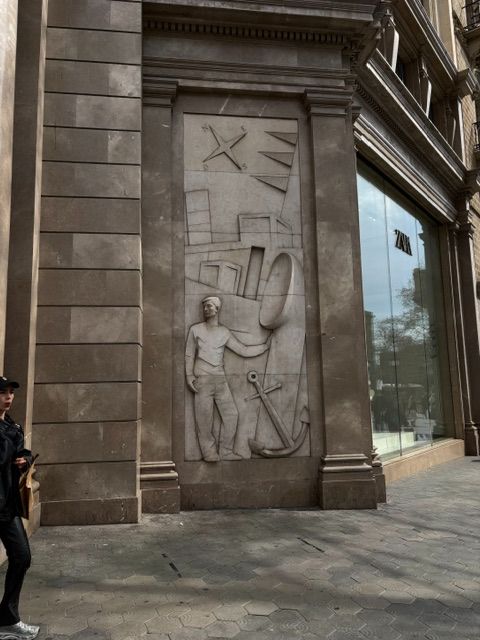
The panel is identified as a 1961 work by Catalan sculptor Eudald Serra. It decorated the entrance of the former Banco Rural y Mediterráneo building at Passeig de Gràcia and Gran Via. By the time of our visit, the storefront carried the Zara name, but the sailor remained beside its entrance, preserving a detail from the building’s earlier commercial life.
Serra arranged the composition within a tall, narrow rectangle. The sailor occupies the lower portion, while the vessel and star fill the space above. His figure is simplified, with little unnecessary detail. The anchor is immediately recognizable, and the ship is suggested through geometric shapes rather than a fully modeled scene. Together, these elements allow the subject to be understood quickly, even from the sidewalk.
The carving also uses different depths to create contrast. The sailor projects from the surface, while parts of the ship appear as outlines cut into the stone. Light and shadow help distinguish the figure from the surrounding forms. Seen closely, the panel becomes an exercise in how a sculptor can communicate a scene within the shallow space of a building’s wall.
What interested me most was its survival through a change of use. A sculpture commissioned for one business had become part of the entrance to another. The shop sign identified the present occupant, while the stonework retained a connection to the past.
Discoveries like this encourage me to examine the spaces around doorways as well as the buildings above them. Here, an ordinary shopping street held a small work of sculpture whose story began decades before the storefront we encountered. The sailor remained at his post, quietly carrying that earlier chapter into the life of the modern city.
Read More
Read More From Nancy
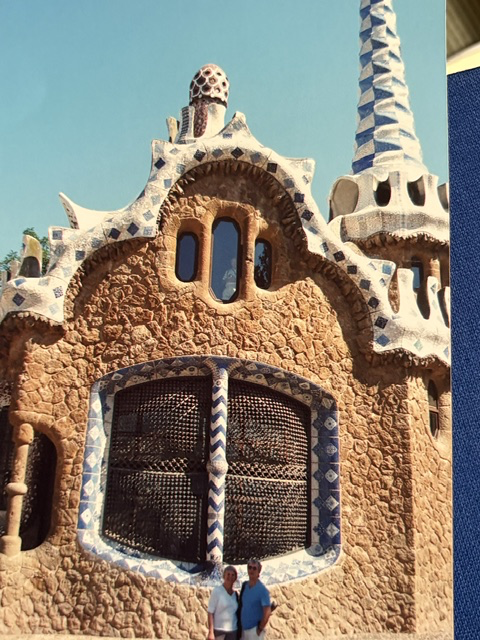
Park Guell
Standing in front of this building was like stepping into another world. The flowing curves, textured stonework, colorful mosaics and dreamlike architecture reveal that this is the work of the visionary architect Antoni Gaudi. Visiting Park Guell is where the line between architecture, sculpture and fantasy blur. Located in the hills overlooking the city of Barcelona, Park Guell was envisioned in […]
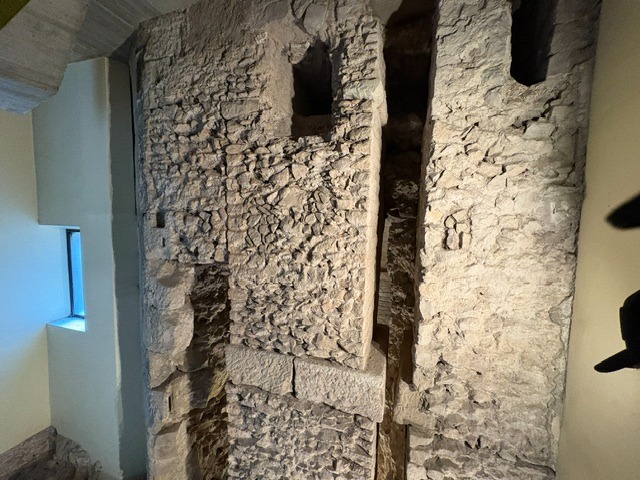
The Roman Aqueduct
Inside Casa de l’Ardiaca, near Barcelona’s cathedral, surviving water channels reveal part of the engineering that supported the ancient Roman city of Barcino. Built into a site later occupied by a medieval residence, these remains preserve evidence of an essential urban service: bringing fresh water from beyond the city walls. The Romans established Barcino near […]
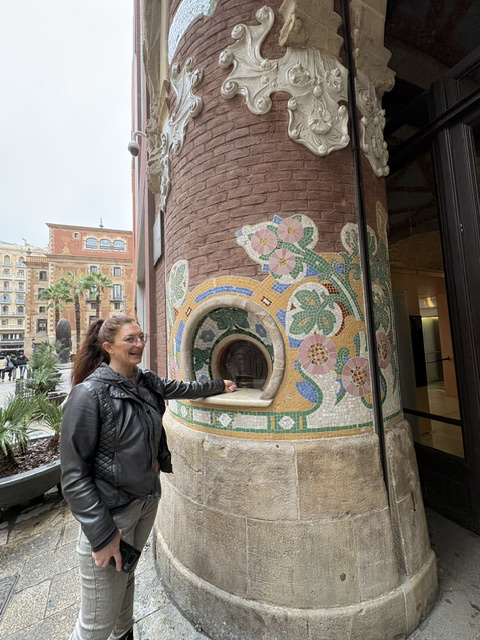
The Original Ticket Windows
Built between 1905 and 1908, the Palau de la Música Catalana was designed by architect Lluís Domènech i Montaner as the home of the Orfeó Català choral society. Its original entrance was formed by two large arches opening directly from the narrow street into the vestibule. Between them stood a substantial brick column containing two […]

