The Monument to Francesc Soler i Rovirosa
Along Barcelona’s Gran Via, we came across a reclining marble woman holding a rose. Her relaxed pose and quiet expression contrasted with the traffic moving past the surrounding gardens. On the pedestal beneath her was a portrait medallion and a name: Francesc Soler i Rovirosa. The monument honors an artist whose work helped audiences enter imaginary worlds inside Barcelona’s theaters.
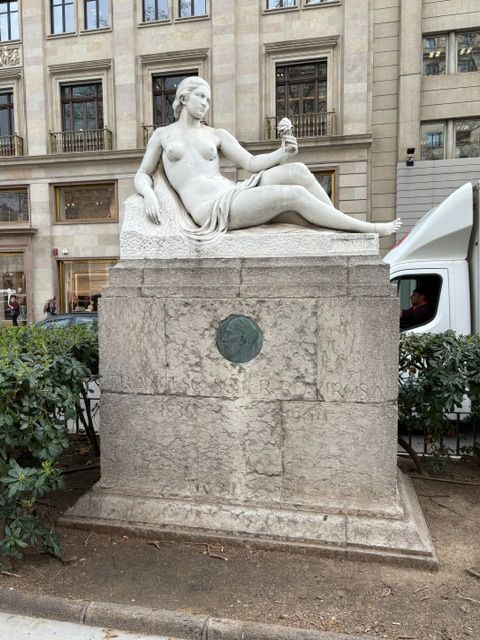
Soler i Rovirosa, who lived from 1836 to 1900, was a painter and theatrical set designer. His contribution lay in creating the settings in which performances unfolded, the landscapes, buildings, and interiors that helped establish a story’s place and atmosphere. He became a leading figure in the Catalan school of stage design, working for theaters throughout Barcelona.
His training took him to Paris, where he worked in the studio of the renowned scenic artists Charles-Antoine Cambon and Joseph Thierry. There, his skill earned him responsibility for drawing and perspective. These were essential tools for theatrical illusion: painted surfaces could suggest deep rooms, distant streets, or expansive landscapes within the limited space of a stage.
Returning to Barcelona, he helped introduce new approaches to realistic scenery. His work belonged to an era when theatrical settings were carefully painted and constructed to draw audiences into the performance. The scenery did more than fill the space behind the actors. It helped make the world of the play or opera convincing, giving the audience visual clues about its location, mood, and historical period. His influence continued through the designers who followed him.
That makes this an especially interesting person to commemorate outdoors. Much of a scenic artist’s work is temporary, created for a production and experienced during a performance. Audiences may remember the spectacle without knowing who designed it. This monument gives a lasting public presence to someone whose artistry usually supported the people appearing onstage.
Sculptor Frederic Marès created the memorial in 1930, thirty years after Soler i Rovirosa’s death. Rather than placing a standing portrait of the designer above the pedestal, he chose a reclining female figure in white marble, holding a symbolic rose. Soler’s likeness appears in the medallion below. The composition combines personal remembrance with an allegorical tribute.
The sculpture reflects Noucentisme, a Catalan cultural movement associated with classical order, proportion, and restraint. Here, those qualities appear in the figure’s gently modeled form and composed expression. The memorial is regarded as an important achievement in Marès’s career, and its quiet character rewards a closer look.
Our stop began with a sculpture that caught my attention and led to an artist I had not known. Learning about Soler i Rovirosa added another dimension to Barcelona’s cultural history: behind its theaters and celebrated performances were craftspeople who built the illusion. This small garden monument remembers one of the artists who helped make that transformation possible.
Read More From Nancy
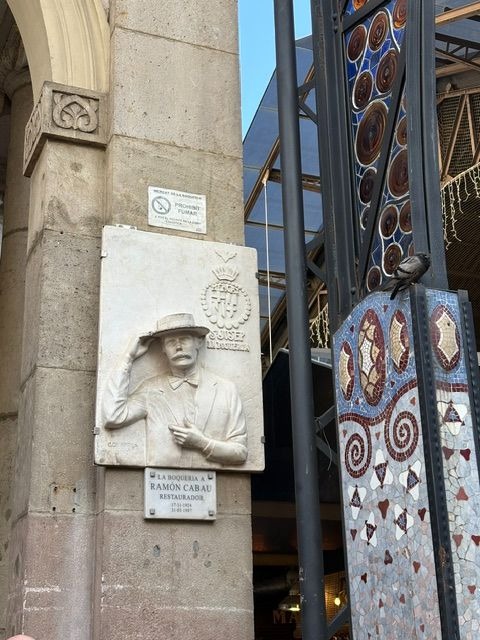
Ramon Cabau
At an entrance to Barcelona’s La Boqueria market, a sculpted relief depicts a man lifting his straw hat in greeting. The inscription identifies Ramon Cabau, a restaurateur whose close relationship with the market made him one of its memorable personalities. Born in 1924, Cabau became known through Agut d’Avinyó, a restaurant in Barcelona’s old city. […]
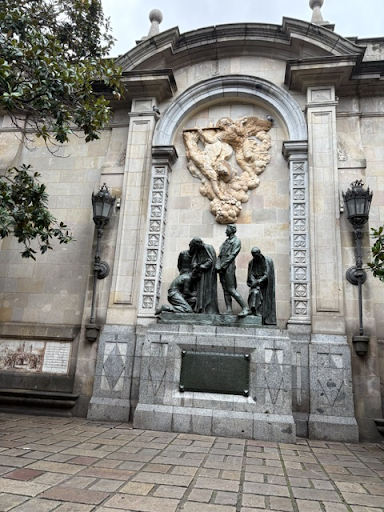
The Martyrs of 1809
While exploring the area around Barcelona Cathedral, I came upon this moving monument tucked into a quiet square beside the cathedral walls. Like so many monuments I encounter while traveling, it encouraged me to stop and learn the story behind it. This memorial honors the Martyrs of 1809, a group of Catalan patriots who were […]
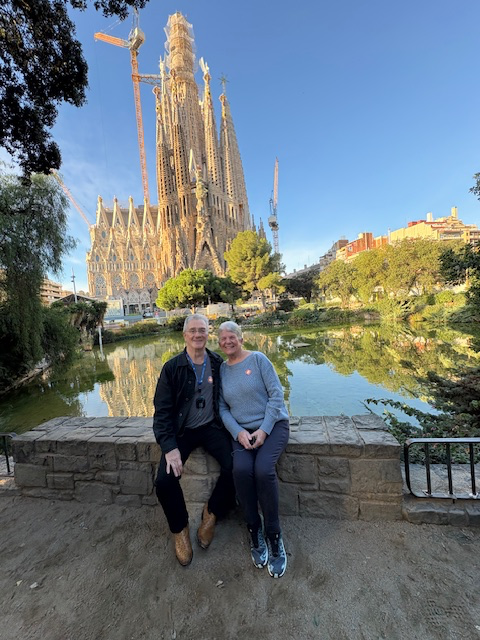
Sagrada Familia
We visited the Sagrada Familia in Barcelona again in 2025, the year they projected to have the cathedral completed. Over the years of visiting the city, we have watched this magnificent cathedral grow from the vision of Antoni Gaudi. What makes this experience unique is that it is not a finished monument, but a living […]

