Guglielmo Marconi
Guglielmo Marconi was born in Bologna, Italy, in 1874. As a young man, he became convinced that recently discovered electromagnetic waves could be used to send messages without wires. Working with simple equipment on his family’s property, he began experimenting with the transmission of wireless signals.
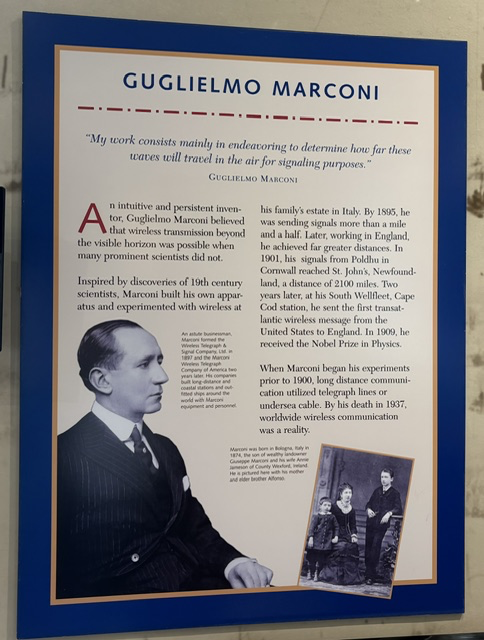
By 1895, Marconi had succeeded in sending a signal more than a mile and over a hill, demonstrating that wireless waves could travel beyond an unobstructed line of sight. He later moved his work to England, where he received support for further experimentation and continued increasing the distance over which messages could be sent.
In December 1901, Marconi received signals at St. John’s, Newfoundland, that had been transmitted from Poldhu in Cornwall, England. The successful experiment demonstrated that wireless signals could cross the Atlantic Ocean.
Marconi then developed a wireless station in South Wellfleet on Cape Cod. In January 1903, the station transmitted a message from President Theodore Roosevelt to Britain’s King Edward VII, establishing the first two-way wireless communication between the United States and Europe.
Marconi shared the 1909 Nobel Prize in Physics for his contributions to wireless telegraphy. By the time of his death in 1937, the technology that began with his early experiments had developed into a worldwide communications network. His work also led to the construction of the wireless receiving station in Chatham in 1914. The station later became Chatham Radio/WCC, connecting ships and people throughout the world for much of the 20th century.

Read More From Nancy
Life Savers and the Rise of American Board Games
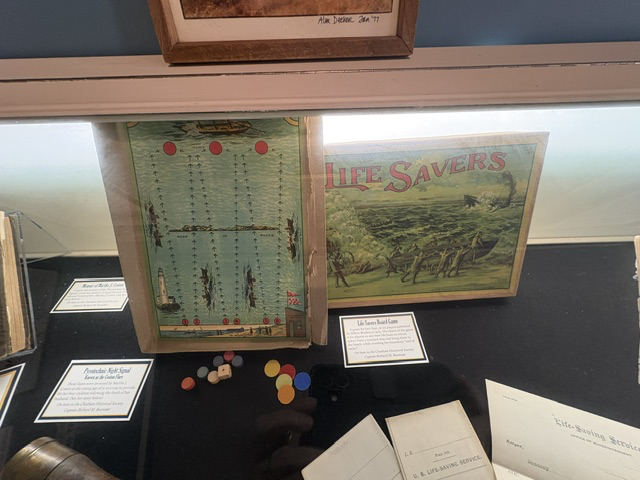
The game Life Savers transformed the dangers of a shipwreck into a contest of rescue. Produced by the Milton Bradley Company near the turn of the twentieth century, the game challenged players to send lifeboats to a wrecked vessel, rescue its sailors, and return them safely to shore. Its illustrated cover, playing board, spinner, and colored pieces […]
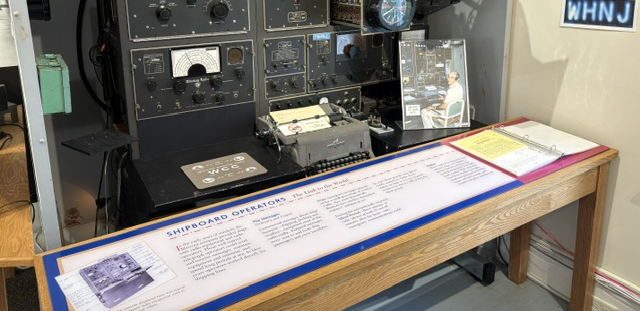
SS HOPE Shipboard Radio
The shipboard radio station from the SS HOPE, preserved at the Marconi-RCA Wireless Museum, represents the vital communications link between a ship at sea and the world on shore. The vessel began its service as the USS Consolation, a United States Navy hospital ship commissioned in 1945. It treated wounded service members during the Korean War and […]
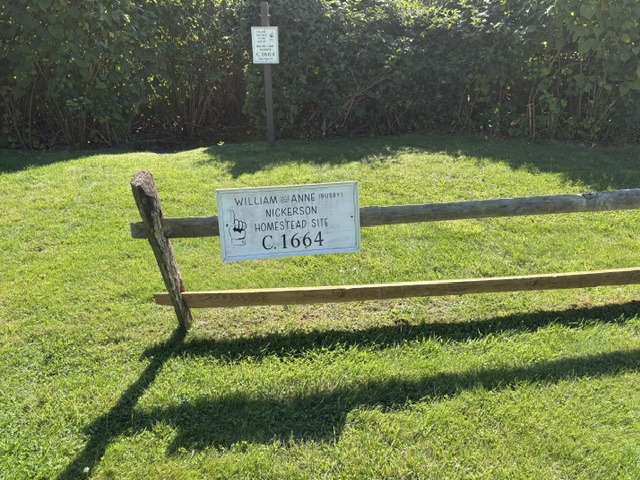
Rediscovering the William and Anne Nickerson Homestead
For centuries, records indicated that William and Anne Busby Nickerson had established their Chatham homestead near Ryder’s Cove around 1664. The general location was known, but the house itself had disappeared. No complete description survived, and little was understood about its size, construction or the daily lives of the people who occupied it. That began […]

