The 1492 Edict of Expulsion
This document records the order that brought Girona’s centuries-old Jewish community to an end. Issued by Ferdinand and Isabella on March 31, 1492, the Edict of Expulsion required practicing Jews to leave the kingdoms under their rule unless they accepted baptism and converted to Christianity.
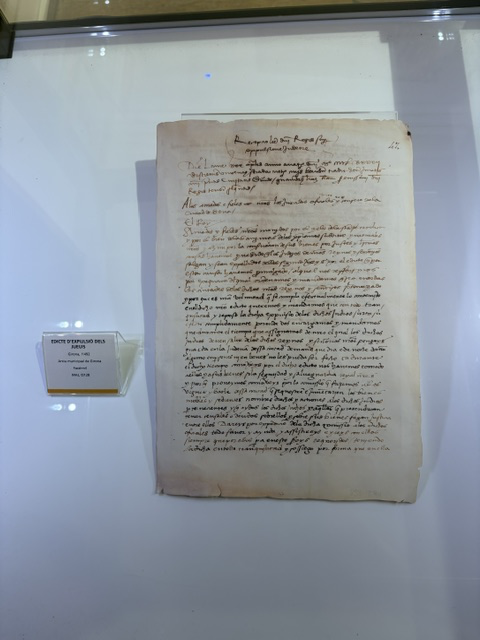
The edict was closely connected to the Spanish Inquisition and its scrutiny of conversos—Jews who had converted to Christianity. Church and royal authorities claimed that the presence of practicing Jews might encourage converts to retain or return to Jewish beliefs and customs. Their solution was to remove the remaining openly Jewish population.
Jews were given only a few months to settle their affairs and leave. They were forced to sell homes, businesses and possessions within a limited period, often under unfavorable conditions. They could take some belongings with them, but restrictions prevented the removal of gold, silver, coined money, weapons and horses.
By 1492, Girona’s Jewish community had already been greatly reduced by decades of violence, forced conversions and increasing restrictions. The attacks of 1391 had resulted in deaths, conversions and departures, while those who remained were gradually confined to a smaller section of the Call.
Some of Girona’s remaining Jews converted rather than abandon the city. Others left, joining the wider Sephardic diaspora that established new communities in North Africa, the Ottoman Empire, Italy and other parts of Europe and the Mediterranean.
Girona’s final synagogue was sold in July 1492, shortly before the deadline for departure. Homes changed ownership, religious objects were removed and the Jewish Quarter ceased to function as a living Jewish community.
The document displayed in the Museum of Jewish History preserves the official language behind that transformation. Its handwritten lines represent more than a royal decree: they mark the legal ending of more than six centuries of documented Jewish life in Girona.
Read More From Nancy
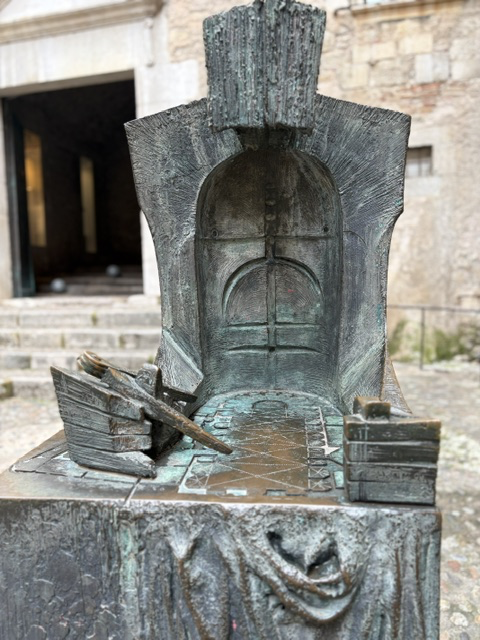
Studio of Modest Urgell
A bronze sculpture outside this stone building recreates the intimate world of an artist’s studio. Within its small architectural setting are the tools and furnishings associated with creative work, inviting passersby to look more closely. A plaque on the nearby wall explains the reason for its placement: Catalan painter and writer Modest Urgell i Inglada […]
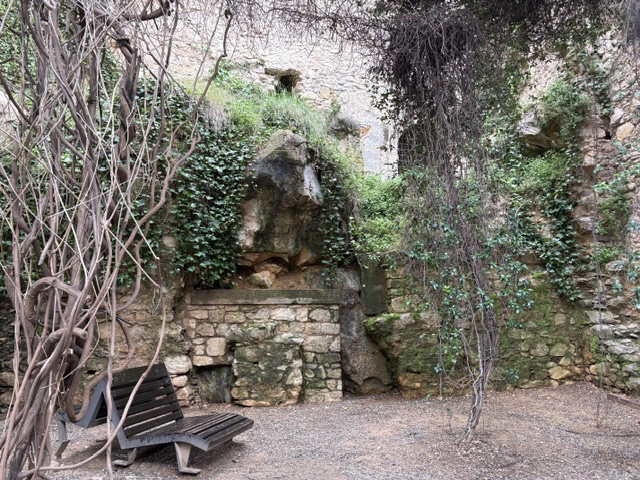
War of the Spanish Succession
Within a quiet, overgrown corner of Girona, an informational panel recalls a conflict that once placed the city at the center of a struggle for the Spanish throne. The War of the Spanish Succession began after King Charles II died without an heir in 1700. European powers divided their support between two claimants: Philip of […]
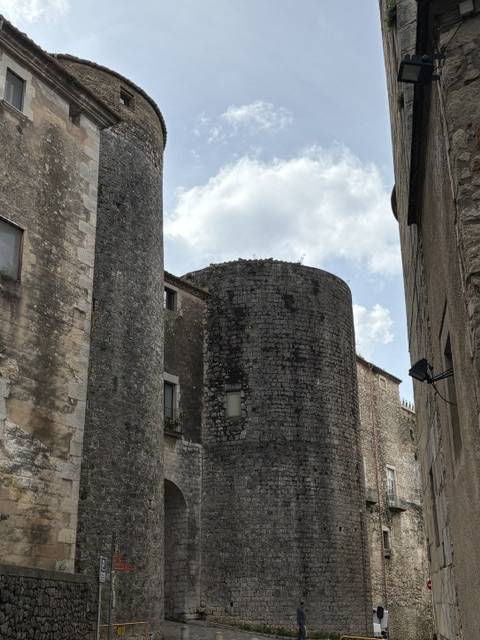
The Portal de Sobreportes
As we walked through Girona’s old quarter, two enormous circular towers rose above the narrow cobblestone street. Their height, thickness and close position immediately suggested that this was once more than an ordinary passageway. These towers guarded the Portal de Sobreportes, one of the principal entrances into the historic city. The gateway originated as the […]

