The Old Stone Mill
Beside the Chepachet River, the Old Stone Mill preserves a substantial remnant of the village’s early textile industry. Also known as the Lawton Owen Mill, the building bears the date 1814 above its entrance. Its stone walls stand close to both the river and Putnam Pike, placing it within the landscape of waterpower, transportation and commerce that shaped Chepachet.
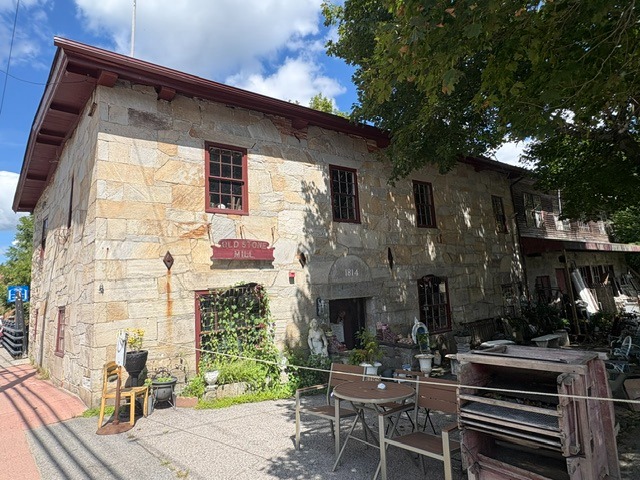
The mill began as a cotton-yarn manufacturing enterprise. An early history of Glocester identifies it with the Chepachet Manufacturing Company, while later historical accounts associate its construction with Lawton Owen. The operation subsequently processed wool, reflecting changes in the village’s textile businesses over time.
Textile manufacturing expanded an economy already supported by gristmills, sawmills, a tannery and an oil mill. These earlier enterprises served agricultural and commercial needs; textile factories brought a larger concentration of machinery and production. The stone mill belonged to the period when Chepachet developed into a busy rural manufacturing center.
The surviving building was once part of a more extensive industrial complex associated with the White textile operations. Much of that complex disappeared, leaving the original stone block and a wooden boiler building among its principal survivors. Preservation also involved substantial reconstruction inside the stone mill, where floors and framing were replaced after the interior had been gutted.
Its later use as an antiques shop continued the building’s working life. The mill’s significance remains closely tied to its location: the river that supplied industrial power still passes beside walls built for manufacturing more than two centuries ago. It provides a direct connection between Chepachet’s present-day village center and the textile economy that helped shape it.
Read More From Nancy
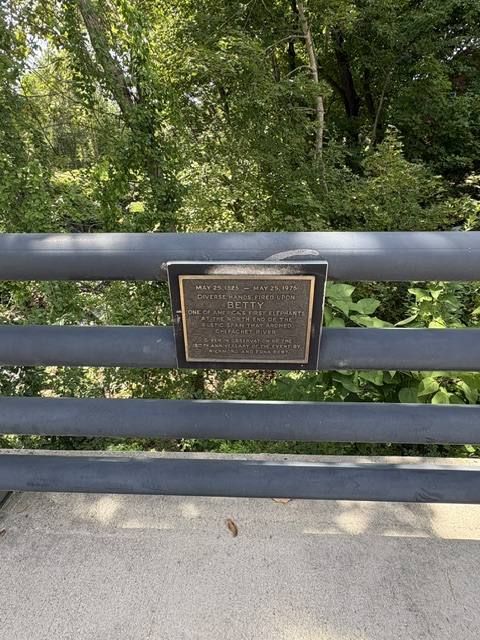
Betty the Learned Elephant
A small bronze plaque attached to the bridge over the Chepachet River preserves one of the saddest and most unusual stories in the history of Chepachet. Its old-fashioned inscription states that “divers hands fired upon Betty,” meaning that several people were responsible for shooting an elephant that had come to the village as part of […]
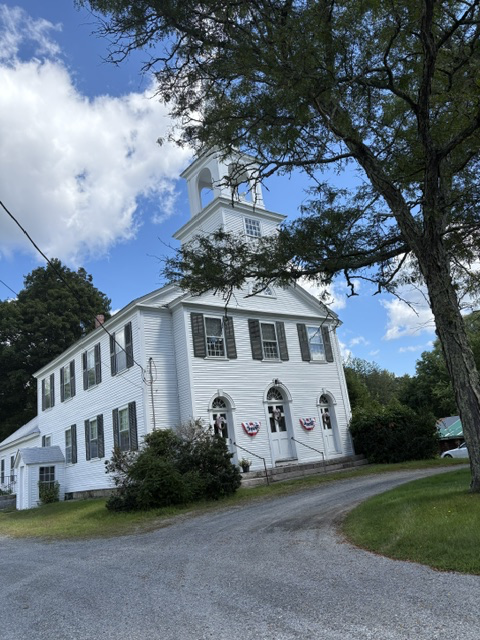
The Chepachet Meeting House
The Chepachet Meeting House has stood along Putnam Pike for more than two centuries. Constructed in 1821, it was built before the Chepachet Baptist Church itself was formally organized. A group of 36 residents known as the Proprietors of the Chepachet Meeting House initially pledged $1,135.50 toward the creation of “an house for the publick […]
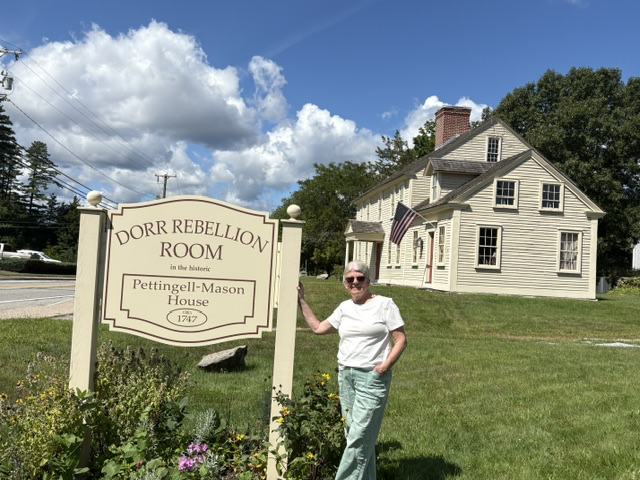
The Pettingill-Mason House and the Dorr Rebellion Room
Traditionally dated to 1747, the Pettingill-Mason House is a substantial colonial home standing at the foot of Acote’s Hill. Constructed with a heavy post-and-beam frame, the house was organized around a large central chimney with four fireplaces. Its hand-hewn timbers, wide-plank floors, narrow stairways, and stone foundation preserve the character of an eighteenth-century Rhode Island […]

