Abigail Adams: Wife of a President, Mother of Another
On Boston’s Commonwealth Avenue Mall, Abigail Adams stands beside a granite pedestal, her arms folded and her expression resolute. Part of the Boston Women’s Memorial, her figure honors a woman whose life connected the American Revolution with two generations of presidential leadership. She was the wife of John Adams, the second president of the United States, and the mother of John Quincy Adams, the sixth. Her own contributions reached into the family’s finances, her children’s education, and the political debates of a new nation.
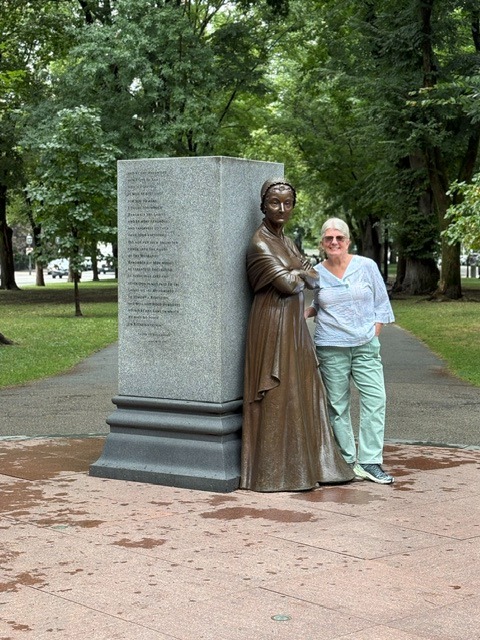
Born Abigail Smith in Weymouth, Massachusetts, in 1744, she grew up in a household that valued religion, reading, and public responsibility. Although she received no formal schooling, she developed an inquisitive mind and a lasting interest in ideas. In 1764, she married John Adams, a young lawyer from nearby Braintree. Their marriage became an enduring intellectual and emotional partnership, sustained through frequent separations by letters that mixed affection, family news, political observations, and candid advice. More than 1,100 letters between them survive.
The responsibilities behind that partnership were substantial. While John traveled for his legal work, attended the Continental Congress, and served overseas, Abigail raised and educated their children, managed the farm, and oversaw household finances and investments. Wartime shortages and uncertainty made these tasks increasingly difficult. Her letters reveal both her resourcefulness and the loneliness of carrying so much responsibility while her husband was away. Their family also experienced profound losses: of their six children, only four reached adulthood.
Abigail followed the Revolution closely and formed her own judgments about its promises. On March 31, 1776, she urged John to “Remember the Ladies” when considering the laws of the emerging nation. She challenged the unchecked authority husbands held over wives and argued for greater protection for women. She also championed women’s education, recognizing that mothers were expected to prepare future citizens while being denied many opportunities to develop their own abilities. Her appeal did not bring the changes she sought, but it preserved a powerful question about who would share in America’s new freedoms.
In 1784, Abigail crossed the Atlantic to join John, entering diplomatic society in France and Britain. When he became president in 1797, she brought years of political knowledge and practical experience to her role. She received guests, maintained important relationships, and offered advice that John actively sought. Her political convictions could also be controversial: she supported the Alien and Sedition Acts, including restrictions directed at hostile newspapers. Her involvement placed her within the arguments and divisions of the early republic. In November 1800, she became the first president’s wife to live in the building now known as the White House.
As a mother, Abigail placed great importance on John Quincy’s education, character, and sense of duty. When he traveled abroad with his father, she continued guiding him through letters, encouraging him to use his opportunities responsibly. She lived to see him become a diplomat, United States senator, and secretary of state. She died on October 28, 1818, seven years before he became president in 1825. Although she never witnessed his inauguration, she had helped shape the person who would take that oath.
Abigail and John’s marriage lasted fifty-four years. Across those decades, she sustained a household through war, participated in an extraordinary political partnership, and guided children whose lives would become part of the nation’s history. Her correspondence preserves the daily work and personal costs behind public achievement. At the Boston memorial, her presence gives recognition to that life, and to a woman whose words remain part of the American conversation.
Read More From Nancy
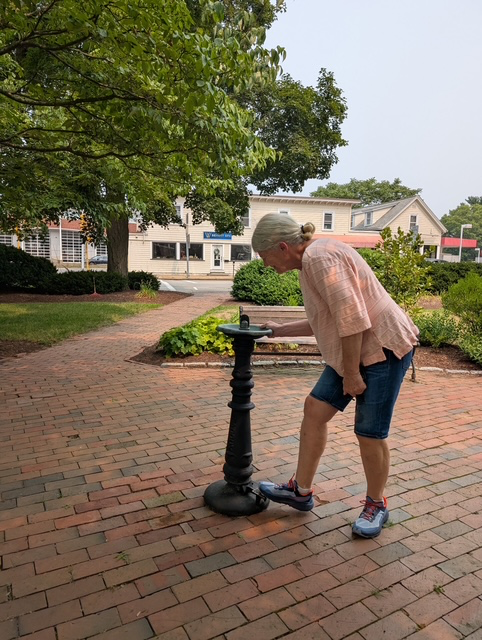
Water Fountain in Wellesley
Though I have walked the parks and paths of Wellesley, Massachusetts for years, I had not paused at this water fountain before. Growing up, I often drank from fountains because they were everywhere. The label on the base read: Murdock Manufacturing, Cincinnati, OH, a company founded in 1853. I learned that Murdock became one of […]
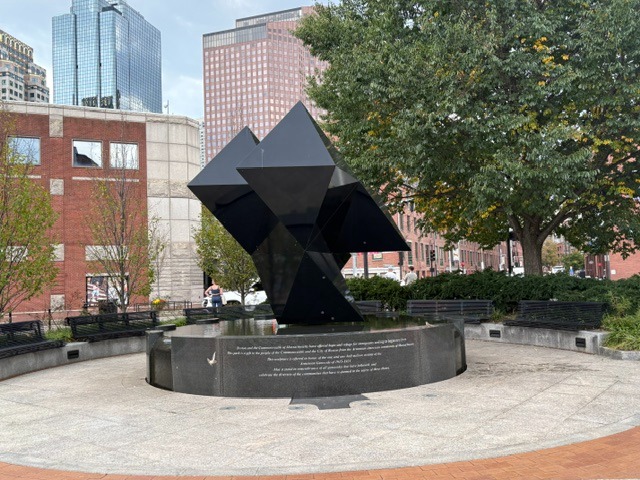
Armenian Heritage Park
During our walk around Boston, we stopped at Armenian Heritage Park on the Rose Kennedy Greenway. Its angular sculpture offers a different kind of memorial: one whose form changes while its purpose remains rooted in remembrance. The sculpture honors the lives lost during the Armenian Genocide of 1915–1923 and the genocides that followed. The park […]
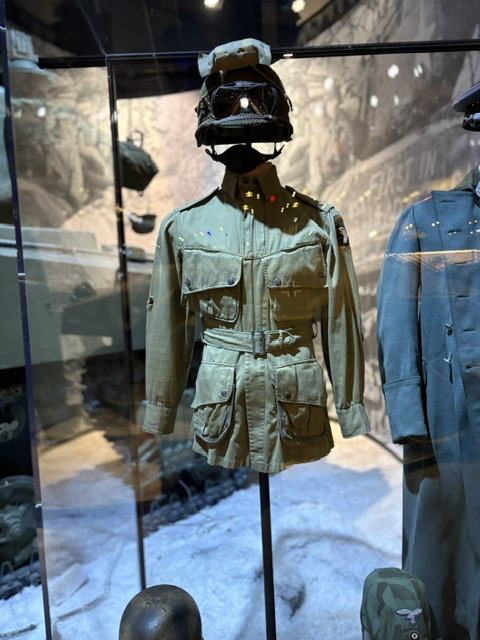
M42 Jump Jacket
While visiting the American Heritage Museum in Hudson, one exhibit drew my attention because it represented more than a uniform. It represented the courage of the young men who volunteered for one of the most dangerous assignments of World War II. Displayed behind glass is an M42 jump jacket worn by Private Duane Tedrick of […]

