The Face Behind the Vision
As I walked through the Bancroft Memorial Library, I found myself drawn to this portrait of Adin Ballou. After spending the day exploring his home, his desk, his traveling trunk, and the places where his vision took root, it was meaningful to finally discover and investigate the man behind the story.
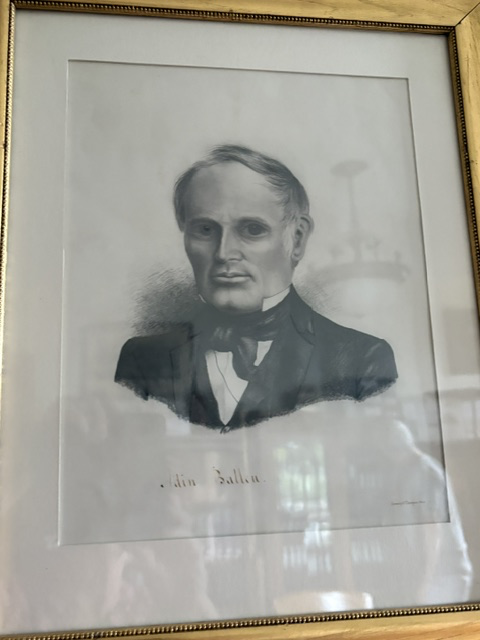
Adin Ballou was born on April 23, 1803, on his family’s farm in Cumberland, Rhode Island. The seventh of eight children, he grew up in a hardworking New England family. His father, Ariel Ballou, was a Revolutionary War veteran, farmer, mill owner, and church deacon who expected his children to contribute to the family’s work from an early age. Those years on the farm instilled in Ballou the discipline, perseverance, and humility that would define the rest of his life.
Although Ballou possessed a keen intellect and a deep desire to learn, his formal education was limited. He dreamed of attending Brown University, but his father believed his future belonged on the farm and could not justify the expense of a college education. Rather than allowing that disappointment to define him, Ballou embarked on a lifelong course of self-education. He immersed himself in theology, philosophy, history, literature, and the Bible, reading tirelessly and teaching himself through discipline and determination. It is one of the great ironies of his life that a man with so little formal schooling would become one of the nineteenth century’s most respected religious writers and social reformers.
At the age of twelve, Ballou joined the Christian Connexion Church, and by eighteen he believed he had been called to the ministry. Without attending a seminary, he began preaching in local churches, relying upon his own study and convictions rather than formal theological training. Over the years his beliefs evolved, eventually leading him to embrace Universalism and later Unitarianism, but throughout his life he remained
His personal life was marked by both joy and profound loss. In 1822, he married Abigail Sayles. Their happiness was short-lived. Abigail died in 1829 shortly after giving birth to their daughter, Abbie, the only one of Ballou’s children to survive to adulthood. Grief and illness nearly claimed Ballou’s own life. During his recovery he was cared for by Lucy Hunt, whom he later married. Lucy became his lifelong partner and an essential supporter of his work. Together they experienced the heartbreak of losing several children, including their gifted son, Adin Augustus Ballou, who died of typhoid fever at only eighteen years of age. These personal tragedies deepened Ballou’s compassion and strengthened his conviction that faith must provide hope even in life’s darkest moments.
In 1842, Ballou founded the Hopedale Community, believing it was possible to create a society built upon Practical Christianity. The community embraced cooperation, equality, education, temperance, abolition, and Christian nonresistance. Although the experiment lasted only a little more than a decade, its influence extended far beyond the boundaries of this small Massachusetts village.
From his modest home and simple writing desk, Ballou produced dozens of books, hundreds of sermons, countless newspaper articles, and an extensive correspondence that reached readers throughout the United States and abroad. His writings on Christian nonresistance eventually found their way to the Russian author Leo Tolstoy. Tolstoy’s writings later influenced Mahatma Gandhi, whose philosophy of nonviolent resistance inspired Dr. Martin Luther King Jr. It is remarkable to think that ideas first developed in this quiet New England town became part of movements that changed the course of world history.
Walking through Hopedale, I came to realize that Adin Ballou’s greatest accomplishment was not simply founding a utopian community. His enduring legacy lies in demonstrating that one person’s ideas, faithfully lived and patiently shared, can reach far beyond the place where they began. The mills rose and fell, industries changed, and buildings came and went, but the principles Ballou championed, peace, justice, cooperation, compassion, and service to others, continue to define the story of Hopedale.
Read More From Nancy
Community House
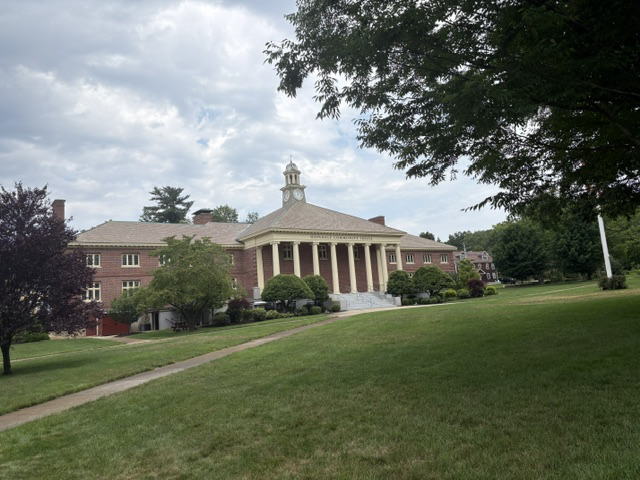
Every town has a place where people naturally gather. In Hopedale, that place is the Community House. Standing prominently along the town green, this impressive Georgian Revival building is impossible to miss. Its stately columns and clock tower project a sense of permanence, but its true significance lies not in its architecture, but in what […]
Hopedale Fountain
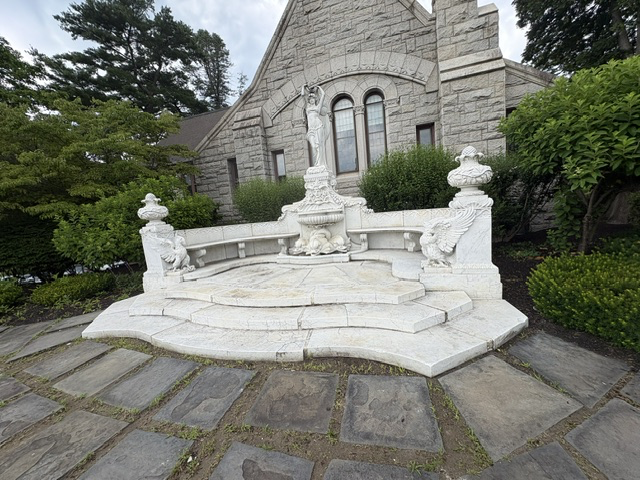
Some communities preserve their history in books or museums. Hopedale preserves its history in stone. Standing in front of the Bancroft Memorial Library is the Statue of Hope Fountain, one of the town’s most treasured landmarks. More than a beautiful work of art, it is a symbol of the ideals upon which Hopedale was founded. […]
A tribute from those who knew him
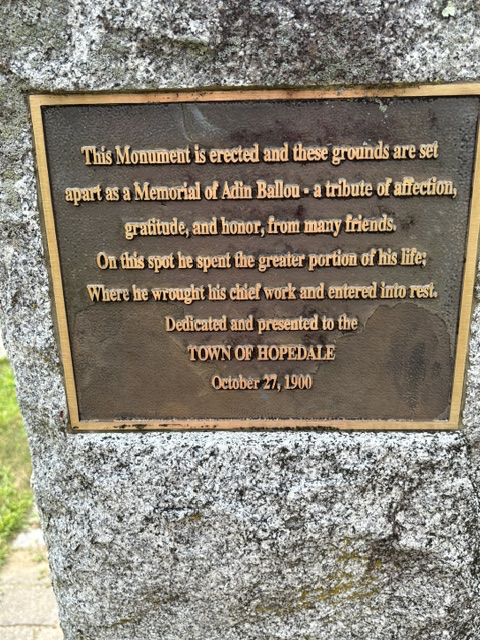
Many monuments are erected decades or even centuries after a person’s death. This one was different. Dedicated to the Town of Hopedale on October 27, 1900, only ten years after Ballou’s death, it was presented not by government officials but by friends and admirers. The inscription describes it as “a tribute of affection, gratitude, and […]

