Hopedale Fountain
Some communities preserve their history in books or museums. Hopedale preserves its history in stone.
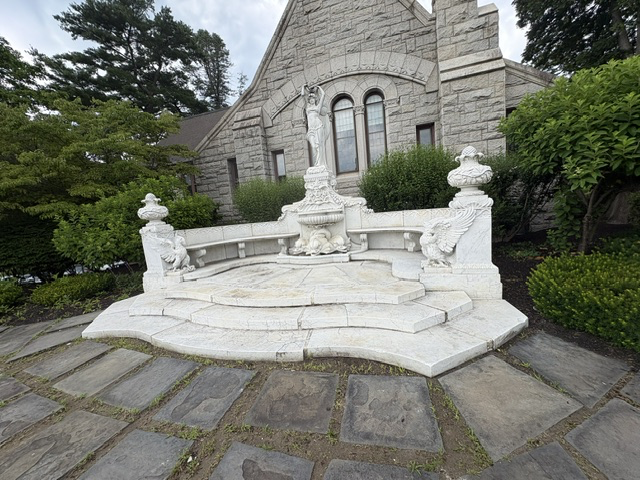
Standing in front of the Bancroft Memorial Library is the Statue of Hope Fountain, one of the town’s most treasured landmarks. More than a beautiful work of art, it is a symbol of the ideals upon which Hopedale was founded.
The fountain traces its origins to the Hopedale Community, the utopian settlement established in 1842 by minister and social reformer Adin Ballou. Ballou believed that people could build a society founded on Christian principles of peace, equality, cooperation, and mutual responsibility. “Hope” became an appropriate symbol for that vision, a reminder that a better community could be created through shared values and common purpose.
Dedicated in 1870, the fountain was carved from magnificent Carrara marble, the same stone favored by many of the world’s greatest sculptors. At the time of its installation, it was considered the finest fountain in the United States, an extraordinary distinction for a small Massachusetts town. It also earned another place in history as the first public statue erected in Massachusetts and one of the earliest pieces of public sculpture in America.
The fountain’s surrounding landscape was designed by Henry Holland Richardson, adding another layer of artistic significance to the site. Together, the sculpture and its setting reflected the community’s belief that beauty, education, and civic life should be woven into everyday living.
As Hopedale evolved from a utopian experiment into one of America’s leading industrial communities through the success of the Draper family and the Hopedale Machine Company, the Statue of Hope remained. It became a bridge between two chapters of the town’s history, reminding future generations that before there were factories and international business success, there was an extraordinary social experiment built on faith and optimism.
Standing before the fountain today, it is easy to admire its craftsmanship, but its true importance lies in what it represents. The people who founded Hopedale believed that communities could be shaped by ideals as much as by economics. More than 150 years after the fountain was dedicated, the Statue of Hope continues to remind visitors that Hopedale’s greatest legacy is not simply what it manufactured, but the vision that inspired its beginning.
Read More
Read More From Nancy
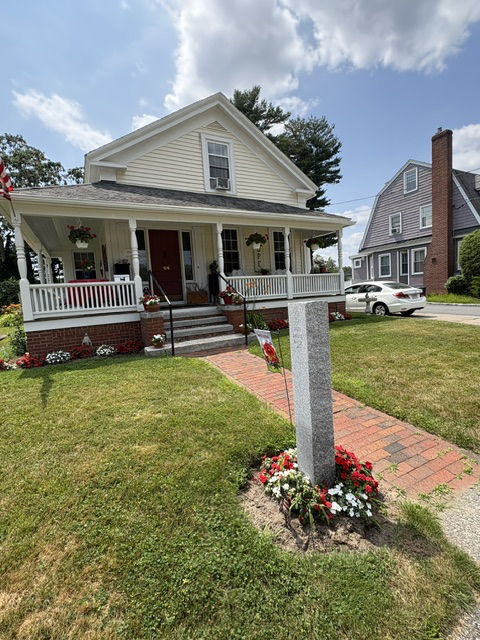
The Adin Ballou House
Every town has a founder. Few can still point to the home of the person whose ideas shaped its very identity. This modest house on Dutcher Street was the home of Reverend Adin Ballou, the visionary minister who founded the Hopedale Community in 1842. Although the house stands in a different location today, it originally […]
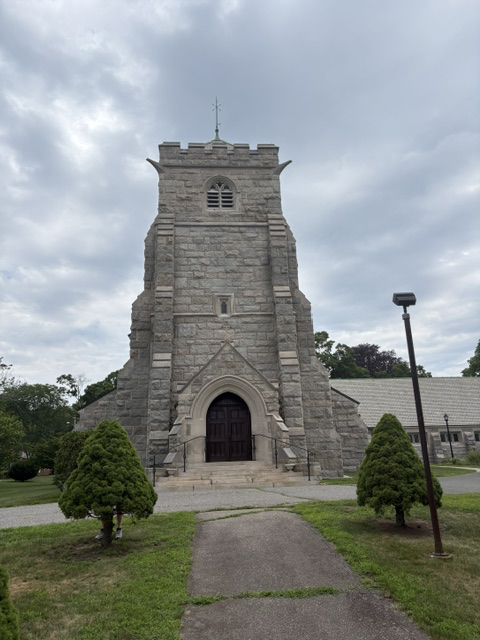
Unitarian Parish Church
Constructed between 1898 and 1901, the Unitarian Parish Church was a gift from brothers George A. and Eben S. Draper in memory of their parents, George and Hannah Draper. Built of locally quarried granite in the Romanesque Revival style, its imposing tower and solid stone walls were designed to reflect both strength and permanence. Yet […]
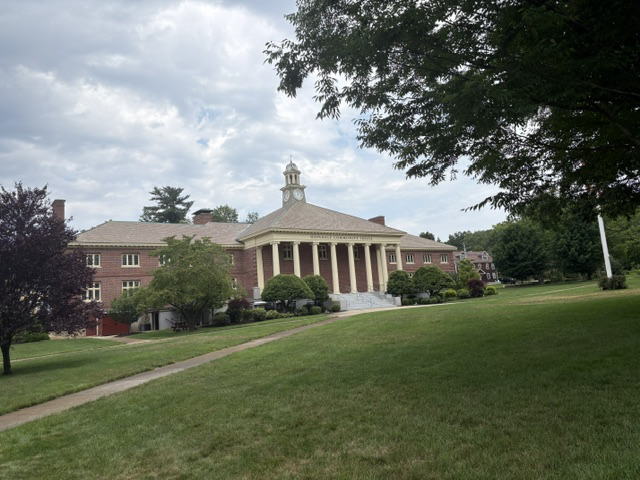
Community House
Every town has a place where people naturally gather. In Hopedale, that place is the Community House. Standing prominently along the town green, this impressive Georgian Revival building is impossible to miss. Its stately columns and clock tower project a sense of permanence, but its true significance lies not in its architecture, but in what […]

