The Church at Auvers-sur-Oise
Erin stands outside the church at Auvers-sur-Oise, beside a reproduction of the painting Vincent van Gogh made of it in 1890. The building and its painted interpretation share the same setting, offering an opportunity to compare the place with the artist’s vision.
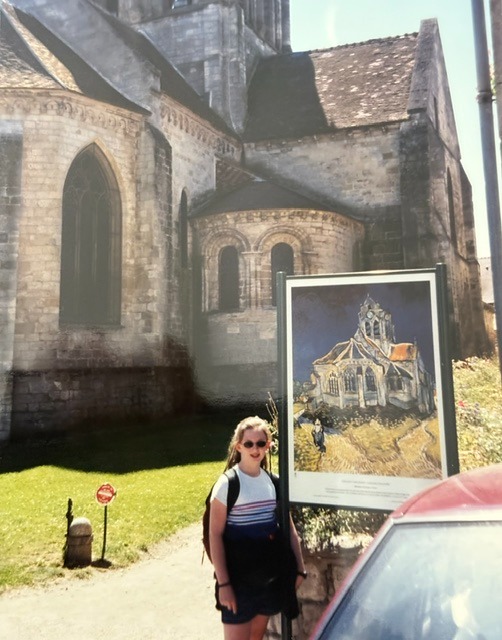
Van Gogh painted the church in June 1890, shortly after settling in the village. He had come north following his stay at the psychiatric hospital in Saint-Rémy-de-Provence. In Auvers, the buildings, people and surrounding countryside supplied subjects for an intensely productive final period of his life.
His painting presents the church as something more unsettled than a conventional architectural view. The walls appear to bend, the rooflines shift, and the windows become deep patches of blue. A dark sky rises above the building, while sunlight illuminates the grass and paths below. A woman walks along one of the paths, giving the scene a small human presence beside the imposing structure.
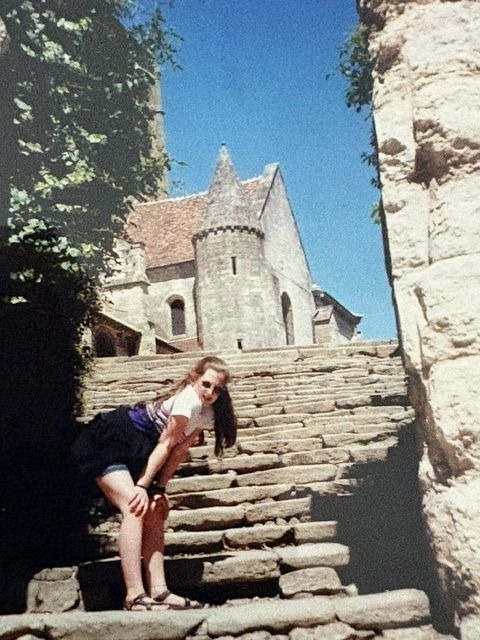
The church itself offers a different encounter. Its stonework, windows and projecting sections can be examined as parts of a physical building. Comparing those features with the painting makes Van Gogh’s choices easier to recognize: he retained an identifiable place while changing its colors, contours and atmosphere.
The original painting now belongs to the Musée d’Orsay in Paris. In Auvers-sur-Oise, the building remains part of the village that inspired it.
For our family, visiting the church connected a familiar work of art with an actual place. Erin’s presence beside it carries that connection into our own history, a moment when an artist’s view of a French village became part of our experience of it.
Read More From Nancy
Eiffel Tower
There are certain landmarks across the world that have become instantly recognizable. Once you see them, you know exactly what they are and often where they stand. That is certainly true for the Eiffel Tower. The first time we visited Paris, of course we did what first-time visitors do: we took the ride up the […]
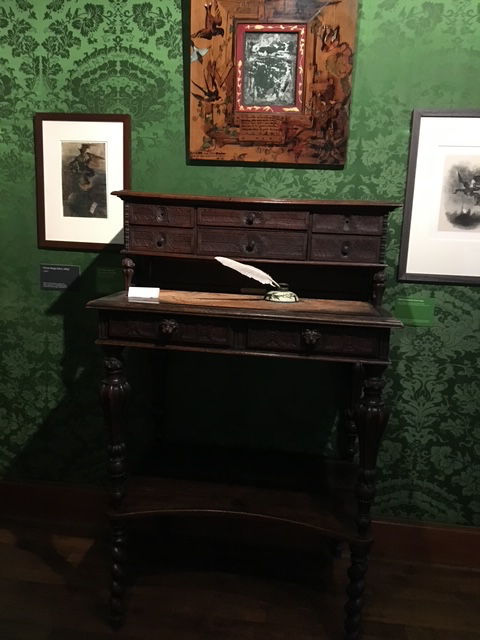
Victor Hugo’s Standing Desk
Victor Hugo was known for writing while standing, and this desk was arranged to accommodate that lifelong habit. Rather than being made as a single piece, it was assembled from existing furniture: a small secretary with drawers was placed upon a narrow table or shelf, raising the writing surface to the height Hugo required. The […]
Musée Picasso
In the Marais district of Paris, the Musée national Picasso-Paris occupies a mansion whose history began more than three centuries before it became a museum. Known as the Hôtel Salé, the building brings together the legacy of a seventeenth-century fortune and the work of one of the twentieth century’s most influential artists. The mansion was […]

