St. John’s Anglican Church
With its white wooden walls, red roof, and slender corner spire, St. John’s Anglican Church stands above the rocky landscape of Peggy’s Cove. The building’s Gothic Revival design gives it a distinctive presence within the small fishing community. Its history reaches beyond the present structure to the residents who worked together to establish a place of worship in the mid-nineteenth century.
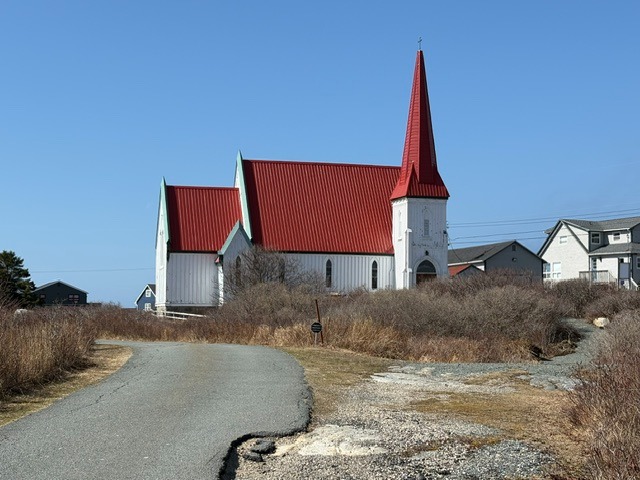
The first entry in the congregation’s minute book dates to December 1847, when plans were discussed for building a church. That effort produced a chapel consecrated in 1850. The present church followed in the early 1880s, with the parish recording its completion in 1883. Timber was brought across the bay, and a builder from Mahone Bay helped carry out the work. The church became a centre for the community’s baptisms, marriages, worship and remembrance.
Its architecture adapts Gothic forms to wooden construction. Vertical board-and-batten siding emphasizes the height of the walls, while narrow pointed windows and a steeply pitched roof draw the eye upward. The tower occupies a corner rather than the centre of the entrance façade, giving the building an asymmetrical outline. Buttressed tower corners and small projecting sections add detail without overwhelming its modest scale.
Inside, two paintings donated by William deGarthe in 1963 connect religious imagery with the experiences of people who earned their living at sea. One depicts fishermen facing storm and turbulence; the other portrays Christ bringing calm to the waters. DeGarthe, a Finnish-born artist who made Peggy’s Cove a central subject of his work, understood the sea as both a source of livelihood and a force beyond human control. The paired paintings bring those concerns into the church’s sanctuary.
St. John’s and its grounds were municipally designated as a heritage property in 1993. That recognition protects a building whose importance lies in both its distinctive wooden architecture and its long association with the families of Peggy’s Cove.


Read More From Nancy
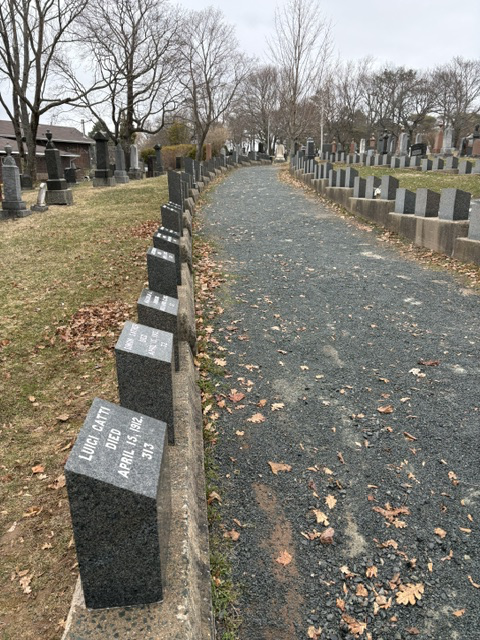
Fairview Lawn Cemetery
Some places become part of history not because events happened there, but because they answered history’s call when tragedy struck. Fairview Lawn Cemetery in Halifax, Nova Scotia, is one of those places. When RMS Titanic struck an iceberg and sank shortly before midnight on April 14–15, 1912, more than 1,500 people lost their lives in the icy […]
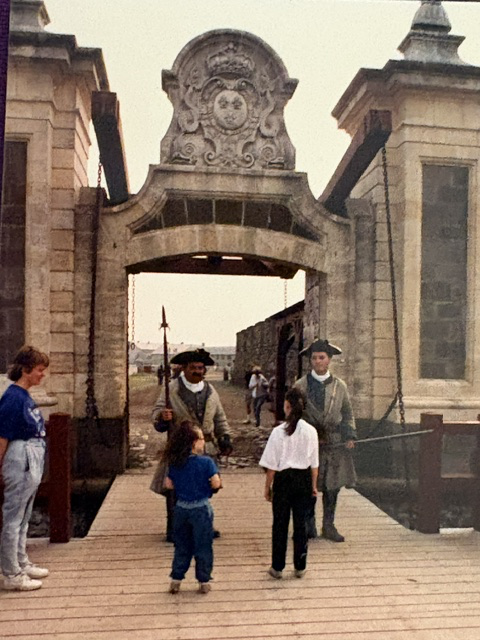
Fortress of Louisbourg National Historic Site
One of the highlights of our drive around Cape Breton Island was visiting the Fortress of Louisbourg National Historic Site. As we crossed the wooden drawbridge and passed through the King’s Gate, it felt as though we were leaving the twenty-first century behind and stepping into the world of eighteenth-century French North America. The Fortress […]

William E. DeGarthe Memorial Monument
Every trip to Nova Scotia, I have carved out some time to visit Peggy’s Cove – it is simply that beautiful. The combination of the Atlantic Ocean, weathered granite rocks, fishing village and lighthouse never loses its charm. This photograph was taken in 2026 during a weekend we were teaching in Halifax, and once again we found ourselves […]

