Fortress of Louisbourg National Historic Site
One of the highlights of our drive around Cape Breton Island was visiting the Fortress of Louisbourg National Historic Site. As we crossed the wooden drawbridge and passed through the King’s Gate, it felt as though we were leaving the twenty-first century behind and stepping into the world of eighteenth-century French North America.
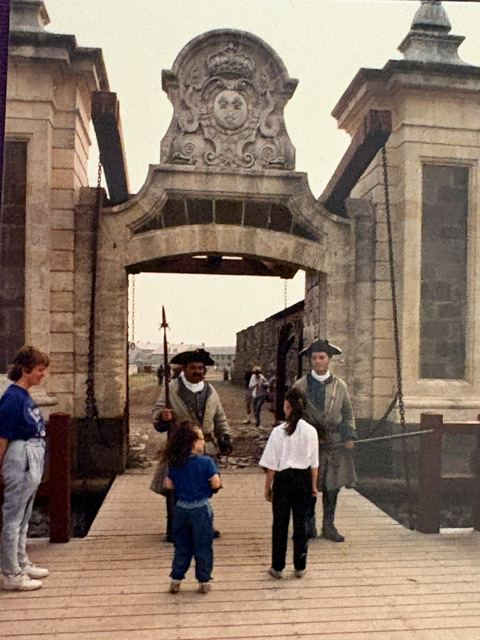
The Fortress of Louisbourg was established by France in the early 1700s to protect the entrance to the Gulf of St. Lawrence, the vital waterway leading to Quebec and the interior of New France. Rich fishing grounds, expanding trade, and military strategy all made Louisbourg one of the most important settlements in North America. Surrounded by massive stone walls, guarded by cannons, and defended by thousands of soldiers, it became known as the “Gibraltar of North America”.
The King’s Gate was the principal entrance into the fortified town. Everyone who entered the fortress, soldiers, merchants, fishermen, government officials, and visiting dignitaries, passed beneath the royal coat of arms of France displayed above the gateway. Crossing the drawbridge was more than simply entering a town; it was entering one of the most heavily fortified communities on the continent.
Although the British captured Louisbourg twice, first in 1745 and permanently in 1758 during the French and Indian War, the fortress remained so important that much of it was deliberately dismantled to prevent France from ever using it again. For nearly two centuries the site lay in ruins before Canada undertook one of the largest historical reconstruction projects ever attempted. Today, about one-quarter of the original town has been painstakingly rebuilt using archaeological evidence, historical records, and traditional eighteenth-century building techniques.
Travel has always been one of our family’s greatest classrooms. Whether we were exploring Cape Breton, walking through a centuries-old fortress, or wandering a small local museum, we were constantly discovering stories we had never heard before. Looking back, I realize that these journeys were about much more than the destinations. They nurtured curiosity, encouraged questions, and gave us memories that have lasted far longer than the miles we traveled. That may be the greatest gift of family travel—not simply seeing new places but discovering them together.


Read More From Nancy

Founders Square
Along Hollis and Prince Streets in downtown Halifax, Founders Square preserves a row of nineteenth-century commercial façades within a development completed in 1986. The historic buildings associated with the complex date from 1816 to 1865, spanning decades when Halifax’s business district grew around the harbour and the provincial seat of government. Their surviving street fronts […]

Peggy’s Cove
A trip to Nova Scotia would not be complete without driving to Peggy’s Cove. We have made this drive every time we have visited this province, and each time it feels just as special. The road itself begins to set the tone. As we leave the city behind, the landscape opens up and the air shifts. […]

The Halifax Town Clock
On the eastern slope of Citadel Hill, the Halifax Town Clock overlooks Brunswick Street and the downtown streets below. Its white tower, blue clock faces and copper dome form one of the city’s most recognizable landmarks. The clock began keeping time on October 20, 1803, providing a public reference for both the military garrison and […]

