Sir Winston Churchill
It was one rainy Halifax afternoon when this familiar figure appeared through the mist. Standing outside the former Halifax Memorial Library is a bronze statue of Sir Winston Churchill, his hands clasped behind his back, his head slightly lowered, as though he is deep in thought. It is a fitting pose for a man whose leadership helped shape the course of the twentieth century.
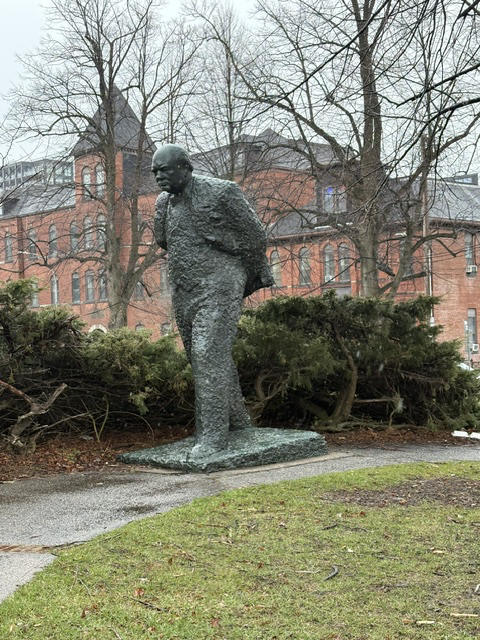
The ten-foot bronze statue was sculpted by the renowned artist Oscar Nemon, one of Churchill’s favorite sculptors. It was unveiled on January 20, 1980, after a community fundraising effort led by former Halifax mayor Leonard Kitz. Rather than portraying Churchill delivering one of his famous speeches, Nemon chose a quieter, reflective stance based on a photograph taken during Churchill’s visit to Halifax in 1943.
Churchill’s connection to Halifax was forged during the Second World War. At the time, Halifax was one of the most important ports in the Allied war effort. Merchant ships from across North America gathered in Halifax Harbour before forming convoys that crossed the dangerous North Atlantic to Britain. These convoys carried food, fuel, weapons, vehicles, and troops; supplies that were essential to Britain’s survival. Without Halifax and the Canadian ports, maintaining those supply lines would have been far more difficult.
Churchill visited Halifax in August 1943 while traveling to the Quebec Conference, where he met with President Franklin D. Roosevelt to discuss Allied strategy for the remainder of the war. Although the visit was intended to be secret, news quickly spread throughout the city, and crowds gathered to welcome Britain’s wartime Prime Minister. He returned in 1944, receiving another warm reception from the people of Halifax. Those visits strengthened the bond between Churchill and a city that had become one of the Allied world’s most important wartime gateways.
The statue’s location is also significant. It originally stood in front of the Halifax Memorial Library, itself conceived as a living memorial to the men and women of Halifax County who lost their lives in the World Wars. Together, the library and the statue created a place of remembrance dedicated not only to military service but also to the ideals of freedom, learning, and democracy that Churchill so often spoke about. Standing there in the rain, I was reminded that Churchill’s legacy extends far beyond Britain.
Halifax was one of the vital links that connected North America with Europe during the war, and Churchill understood the city’s strategic importance. This monument is more than a tribute to a remarkable leader. It is also a recognition of Halifax’s own contribution to the Allied victory and a reminder that history is often shaped not only by the people who lead nations, but also by the communities that quietly support them from behind the front lines.


Read More From Nancy
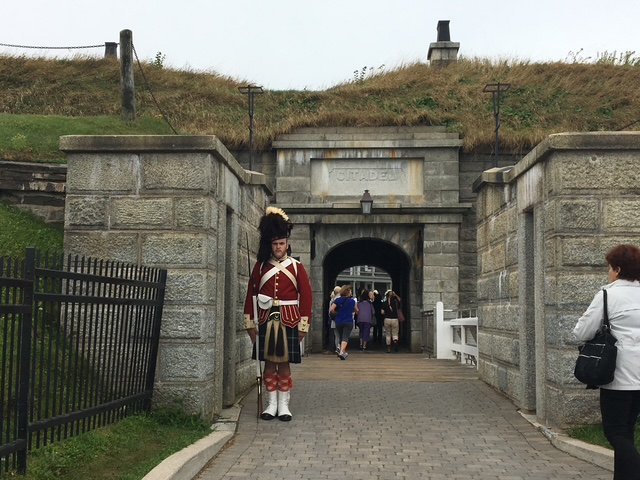
Halifax Citadel National Historic Site
We will be visiting Halifax again this month, and as I look back through my photos, I am reminded of how much I enjoy this town and the province that surrounds it. Sitting at the top of the city is the Halifax Citadel National Historic Site, a place that quietly watches over everything below. From […]
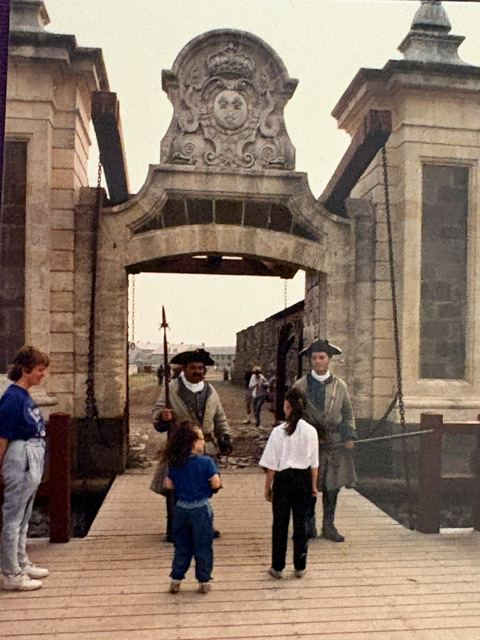
Fortress of Louisbourg National Historic Site
One of the highlights of our drive around Cape Breton Island was visiting the Fortress of Louisbourg National Historic Site. As we crossed the wooden drawbridge and passed through the King’s Gate, it felt as though we were leaving the twenty-first century behind and stepping into the world of eighteenth-century French North America. The Fortress […]

The Ballast Boxes
Along Halifax’s waterfront, stone-filled metal boxes topped with wooden seating recall an essential part of maritime trade. These ballast boxes turn a practical feature of the public landscape into a reminder of the weight that helped sailing ships travel safely across the ocean. A ship needed stability even when its hold carried little or no […]

