Dexter’s Grist Mill
Standing beside Lower Shawme Pond, Dexter’s Grist Mill preserves the story of one of the earliest and most essential industries in Sandwich. Thomas Dexter began developing a mill at this location soon after the town was settled in 1637. The mill seen here began operating around 1654, using the flowing water from Shawme Pond to power its wooden gears and grinding stones.
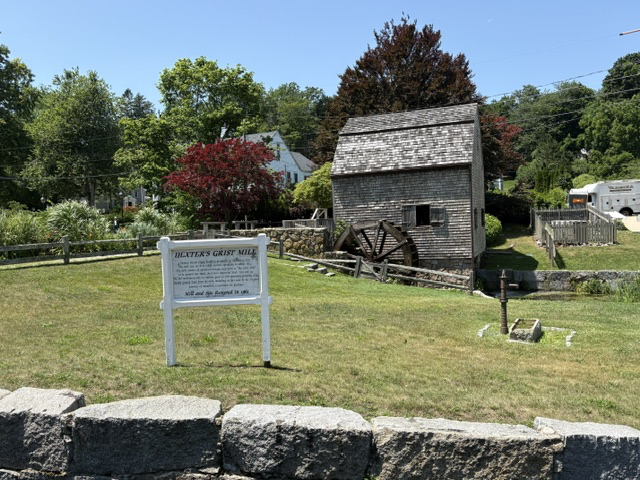
For the families of early Sandwich, a gristmill was not simply a convenience. Cornmeal was one of their most important foods, and grinding enough corn by hand to feed a household required considerable time and labor. Families brought their harvested grain to the mill, where the miller ground it into meal in exchange for a “toll” – a portion of the grain retained as payment.
Because nearly every household depended upon this service, the miller occupied an important and powerful position within the community. By 1665, however, town officials had become dissatisfied with Thomas Dexter Jr., who was then operating the mill. They believed he was keeping too large a share of each customer’s grain as his toll. With only one gristmill available, the people of Sandwich had little choice but to accept his terms.
Rather than simply continuing to argue with Dexter, the town decided to encourage competition. It offered land to anyone willing to establish another gristmill. Benjamin Nye accepted the opportunity and received 12 acres near a stream flowing from Nye Pond in East Sandwich. His water-powered mill was operating by 1669, giving the town a second place where families could have their grain ground.
The Nye mill was therefore not merely another early industrial site. It was established partly to challenge Dexter’s control over an essential community service. It also provided a more convenient mill for families living in the eastern portion of the growing settlement. Nye later expanded his operation by adding a fulling mill, where homespun woolen cloth could be cleaned, thickened, and finished.
Together, the Dexter and Nye mills tell a larger story about life in seventeenth-century Sandwich. They reveal how dependent residents were upon shared resources, how much authority could be held by the person controlling those resources, and how the town used competition to protect its citizens from excessive charges. Long before modern discussions about monopolies and consumer choice, the people of Sandwich were confronting those same concerns on a local level.
Dexter’s Grist Mill was restored in 1961 and returned to working condition. Visitors can still see its wooden machinery in operation and purchase cornmeal ground at the mill. What survives beside Shawme Pond is therefore more than a picturesque colonial building. It represents the labor that fed the town, the power created by controlling an essential service, and the community’s determination to ensure that one miller did not have the final word.
Read More From Nancy
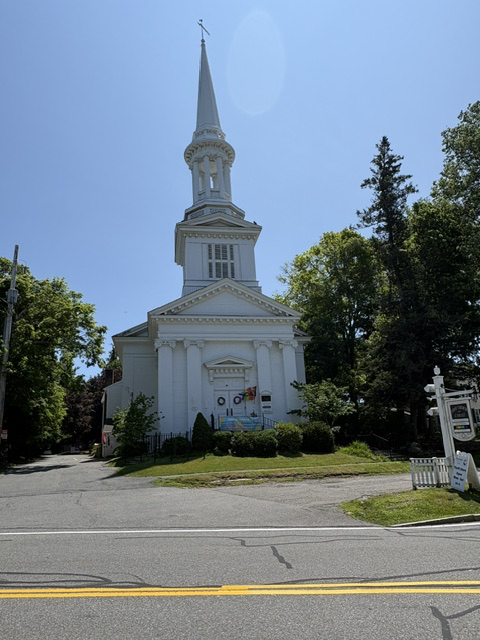
First Church of Christ
Standing prominently in the center of Sandwich is the First Church of Christ, its tall white steeple visible above the surrounding village. The building I photographed dates to 1848, but the Congregational tradition it represents reaches much further back into the earliest history of Sandwich. The first English settlers arrived in Sandwich in 1637, and […]

Sandwich Glass
Inside the Sandwich Glass Museum, the shelves display the remarkable variety of glass that gave this Cape Cod town an international reputation. Deep cobalt blue, turquoise, amethyst, emerald green, ruby, and clear glass were formed into candlesticks, lamps, vases, dishes, goblets, compotes, and countless decorative objects. Together, these pieces reveal that “Sandwich glass” was never […]
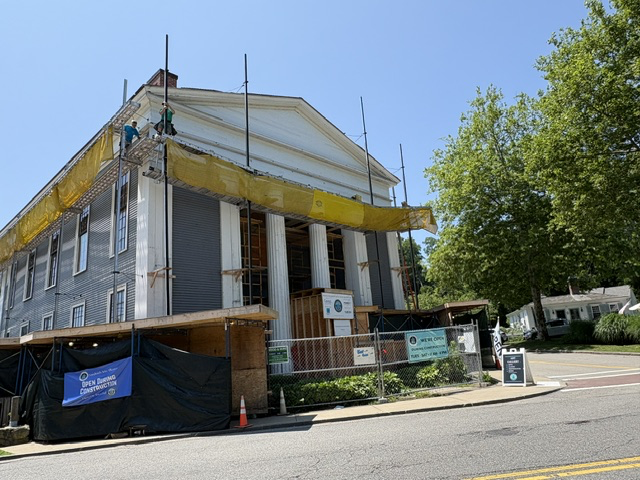
Sandwich Town Hall
Standing prominently in the center of Sandwich, the Town Hall represents an important change in the relationship between religion and government in Massachusetts. Before it was constructed, Sandwich conducted its civic business in the Congregational meetinghouse, where religious services and town meetings took place beneath the same roof. This arrangement had been common throughout colonial […]

