Letting Children Step into the Story
When our daughters were young, we didn’t want their education to exist only in books and classrooms. We wanted them to experience the things they were learning about. To walk through historic places, hear the stories, touch what they were allowed to touch, ask questions, and interact with the people bringing the past to life.
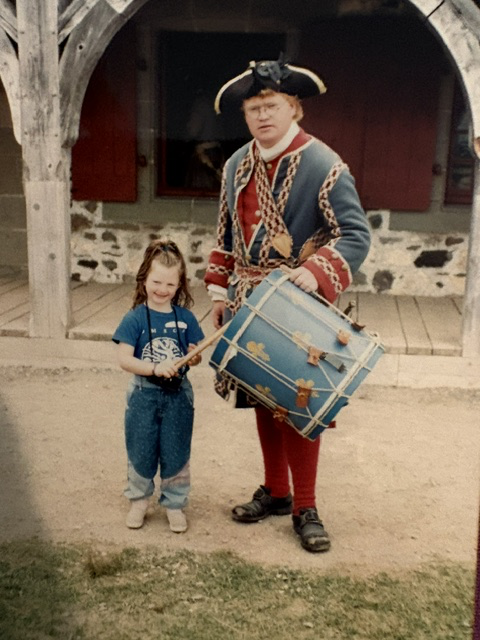
This photograph of Erin at the Fortress of Louisbourg in Nova Scotia captures that idea beautifully. Instead of simply learning that military drummers were once an important part of life in an 18th-century fortress, she was standing next to one. She could see his clothing, hear the drum, hold a drumstick, and participate.
From a neurological perspective, experiences like this matter. A child’s developing brain is continually organizing information received through the senses. Seeing, hearing, touching, moving, interacting, and responding create a very different learning experience than simply being told a fact. The more meaningful and multisensory the experience, the more connections the brain has available to associate with what is being learned.
At Louisbourg, Erin wasn’t memorizing a lesson about colonial history. She was experiencing a small piece of it. The drummer could explain that drumbeats once communicated information throughout a military garrison, calling soldiers together, signaling duties, marking parts of the day, and accompanying ceremonies. Suddenly, an abstract fact had a sound, a face, a place, and an experience attached to it.
This was one of the reasons we took our daughters to historic houses, forts, museums, battlefields, national parks, and living-history sites. We weren’t simply trying to teach them more facts. We were giving their developing brains more experiences from which to build an understanding of the world.
The brain grows and develops through stimulation and experience. Give children opportunities to explore, participate, question, and discover, and learning becomes something they experience rather than simply something they are taught.
Read More From Nancy
Preparing for Birth: From Perfection to Perspective
I often think about the preparation that goes into a first pregnancy. Some of us begin even before we conceive, while most of us dive in during those nine months of anticipation. This was certainly true for me. In my first pregnancy, preparation was an exploration — through books, conversations with elders who could guide […]
My Second Child
I made so many preparations for the birth of my first child, doing everything I could in the hope of being the best parent possible. But as every parent learns, no amount of planning prepares us for the responsibility and learning that come with welcoming a firstborn. When Emmy, my first, arrived, I remember carrying […]
Flexibility in Parenting
Becoming as prepared as possible for pregnancy and parenthood is something many of us strive for. Gaining knowledge, exploring different options, and understanding what’s available is an important first step. It helps build confidence and provides a foundation for decision-making as your child grows. But one of the most essential qualities in parenting is flexibility. No matter how much […]

