Washington Tower
One of the places Marty and I especially wanted to see at Mount Auburn Cemetery was Washington Tower. We climbed the spiral staircase to the top, and when we stepped outside, we were rewarded with this remarkable view across Cambridge toward the Boston skyline. Surrounded by the brilliant colors of autumn, it was easy to understand why a tower had been planned for this hill almost from the moment Mount Auburn was created.
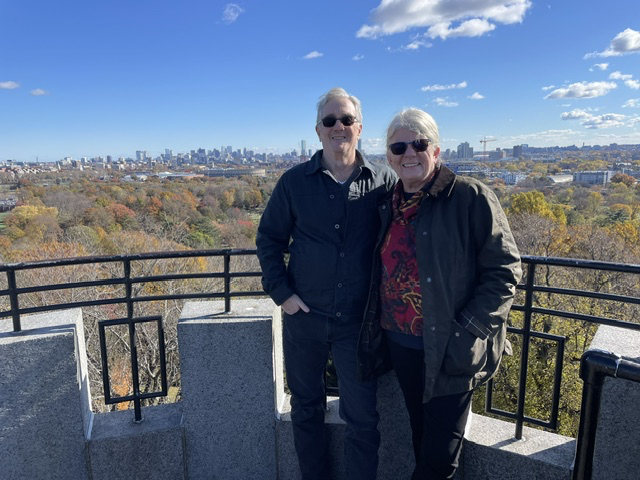
The idea for a tower actually dates to the cemetery’s founding in 1831. Mount Auburn’s founders recognized that its highest point, 125 feet above the Charles River, offered an extraordinary panoramic view. They envisioned placing a tower there that would serve two purposes: it would be an observation point for visitors and a landmark that could be seen from a great distance.
But the tower was intended to mean something more. Henry A. S. Dearborn, one of Mount Auburn’s founders, proposed that it become a cenotaph to George Washington, a monument honoring him even though he was buried elsewhere. This was still a young nation, only a few generations removed from the Revolution, and Americans were beginning to think seriously about how the people and events of the country’s founding would be remembered. Large national monuments to the Founders that seem so familiar to us today were still relatively uncommon. Washington Tower became one of these early expressions of national remembrance.
The tower did not appear immediately. More than twenty years passed before Mount Auburn’s trustees approved its construction in 1852. Dr. Jacob Bigelow, one of the cemetery’s founders and its second president, worked with Boston architect Gridley J. F. Bryant on the design. Constructed from massive blocks of Quincy granite, the tower was completed in 1854 at a height of 62 feet.
Its appearance was deliberately reminiscent of an old European tower. Bigelow described it as based upon the round towers of the feudal era, complete with battlements, Gothic windows, galleries and an interior stone spiral staircase. Placed on Mount Auburn’s highest summit, the 62-foot tower reached an overall elevation of about 187 feet. When completed, it was one of the tallest structures in the Boston area.
The view was an essential part of the design. Visitors climbed the spiral staircase to outdoor galleries where they could look across the cemetery, the Charles River and the surrounding countryside toward Boston. In the mid-19th century, the landscape would have looked dramatically different from what we saw. Cambridge and the surrounding communities had not yet developed into the dense metropolitan area we know today, so the tower offered long views across fields, villages and waterways toward Boston and even the distant ocean.
Our photograph from the top records how that view has changed. Instead of a largely rural landscape, Boston’s modern skyline now rises in the distance. Yet between us and the city remains an extraordinary canopy of trees. From this height, Mount Auburn’s 175-acre landscape seems almost like an island of green surrounded by metropolitan Boston. The original purpose of the tower remains intact. It is still an observation tower, still a landmark within Mount Auburn, and still a memorial to George Washington.
Read More From Nancy
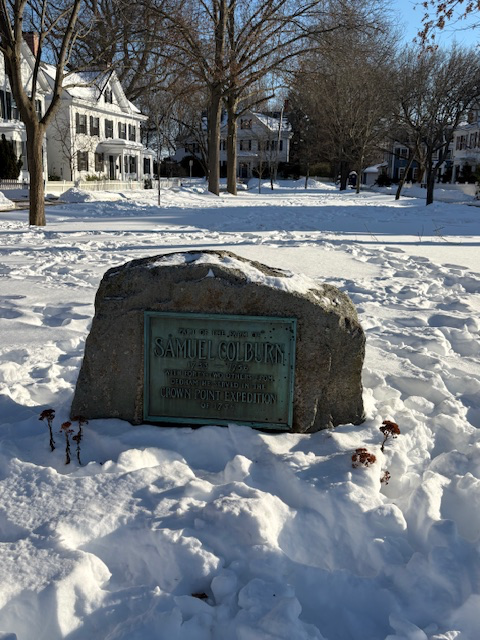
Samuel Colburn
As I was walking through downtown Dedham, I came across a simple rock monument honoring Samuel Colburn. I must admit I was not aware of the Crown Point Expedition. That unfamiliar name immediately caught my attention. I was excited to take a photo and look up more information later. There is something satisfying about discovering a small marker and realizing it opens […]
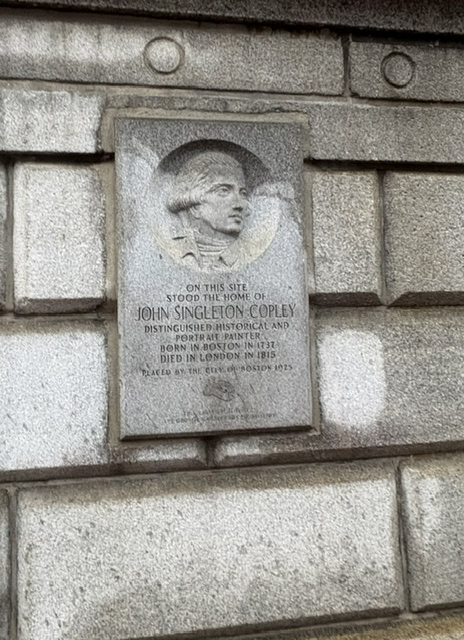
John Singleton Copley
Walking through Boston, I came across this plaque marking the site where the home of John Singleton Copley once stood. The house itself is gone, but the plaque preserves the connection between this location and one of the most important artists of colonial America. Copley was born in Boston in 1738, although the plaque gives […]
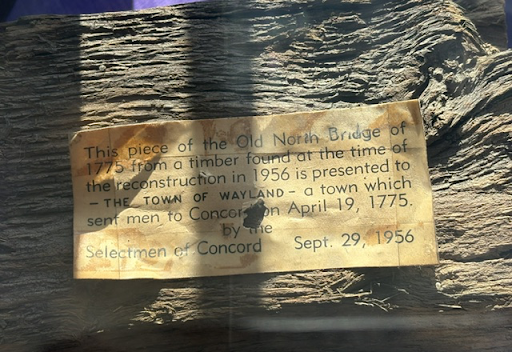
A Piece of the Old North Bridge
While visiting the Wayland Historical Society, I was surprised to find a small fragment of wood displayed in a simple case. At first glance, it appeared to be little more than an old, weathered timber. Yet this was no ordinary piece of wood. It was a remnant of the original Old North Bridge, the bridge […]

