Christmas 1941 — St. Vincent’s Home, Saginaw, Michigan
Among my father’s papers are several Christmas cards that help document a period of his life that I know only in pieces. In the weeks before Christmas 1941, he was living at St. Vincent’s Home at 800 Howard Street in Saginaw, Michigan. The envelopes themselves establish this address, while the postmarks and Christmas greetings place him there during December 1941.
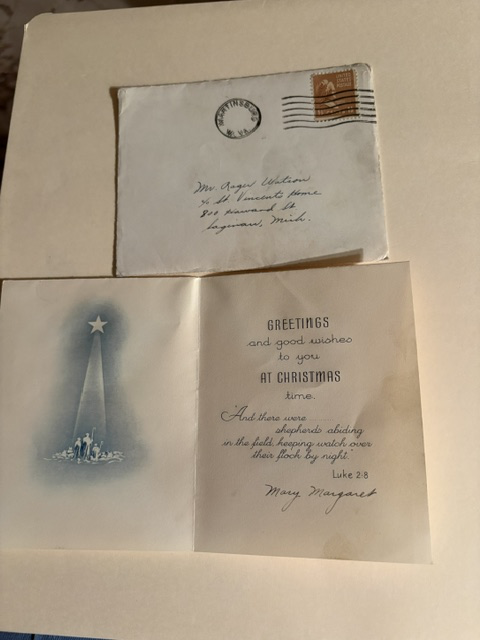
St. Vincent’s had a long history in Saginaw. It originated in the nineteenth century as St. Vincent’s Orphan Home, a Catholic institution caring for children, with the Daughters of Charity assuming responsibility for the home in 1875. By the twentieth century it was known as St. Vincent’s Home for Children. Exactly what residential arrangements existed there for adults in 1941 remains unclear.
That makes my father’s presence particularly interesting. He was 21 years old and had traveled a considerable distance from his hometown of Martinsburg, West Virginia. He obviously was not at St. Vincent’s as one of the children for whom the institution had originally been created. I remember that he was in Michigan for some type of training, although I have not yet been able to identify the program. It seems possible that St. Vincent’s provided him with a place to stay while he was receiving training elsewhere in Saginaw, but at this point that remains a possibility rather than something I can document.
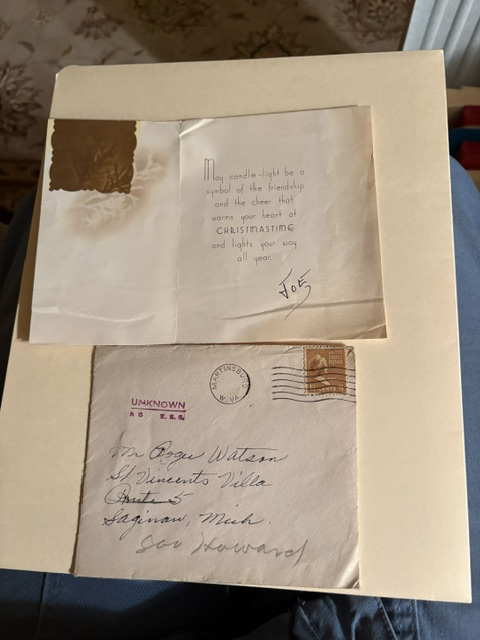
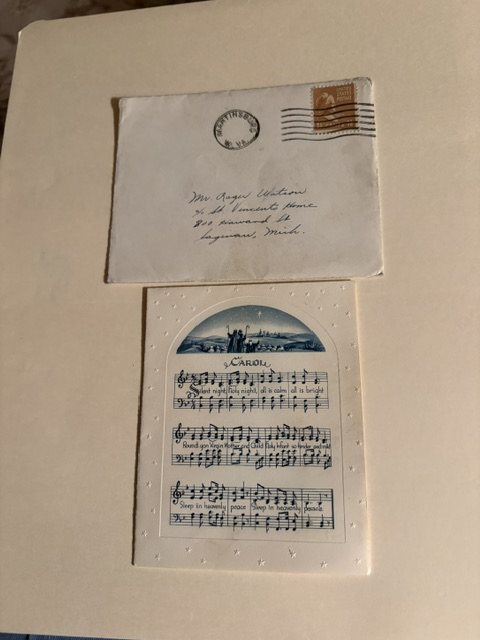
The cards tell another part of the story. They were sent to him from people back home in Martinsburg. One is signed “Mary Margaret”, another “Joe”. Their messages are simple Christmas greetings, offering friendship, good wishes and thoughts of peace. One contains the passage from Luke describing the shepherds “abiding in the field, keeping watch over their flock by night”. They are the kinds of cards thousands of people exchanged at Christmas, but the circumstances in which my father received them were anything but ordinary.
On December 7, 1941, while he was in Michigan, the Japanese attacked Pearl Harbor. The following day the United States declared war on Japan, and within days America was at war with Germany and Italy as well. My father had gone to Saginaw before Christmas in one world and suddenly found himself living in another. For a 21-year-old man, the implications of America’s entry into the war must have been impossible to ignore.
Saginaw itself was also being transformed by the war. It was an important manufacturing center, and its factories would become part of the enormous industrial effort required to supply the American military. If my father was indeed receiving some type of vocational or industrial training there, his presence in Saginaw would fit into the larger story of young Americans acquiring skills as the country prepared for and then entered the war.
What we do know is preserved in these small pieces of paper. In December 1941, my father was far from home, living at St. Vincent’s Home in Saginaw. Friends and family in Martinsburg knew where to reach him and sent their Christmas greetings there. He received those cards during one of the most consequential weeks in American history and for some reason, he kept them for the rest of his life.

Read More From Nancy
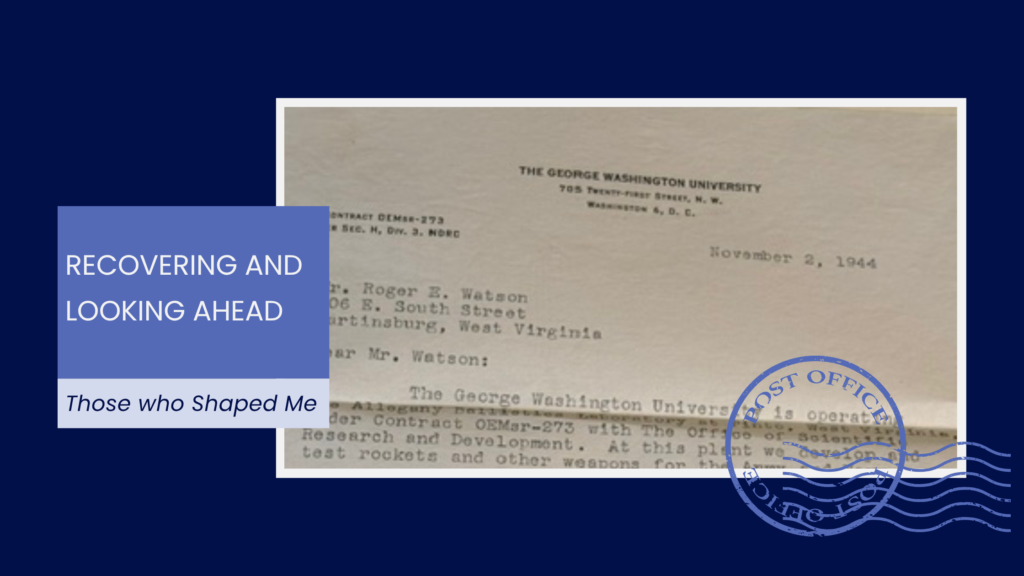
Recovering and Looking Ahead
Among my father’s papers is this letter from November 2, 1944, written during a transitional period in his life. Only a few months earlier, he had received an honorable discharge from military service. Although my parents had married in May 1944 while he was home on leave, they were temporarily living apart. My mother had […]
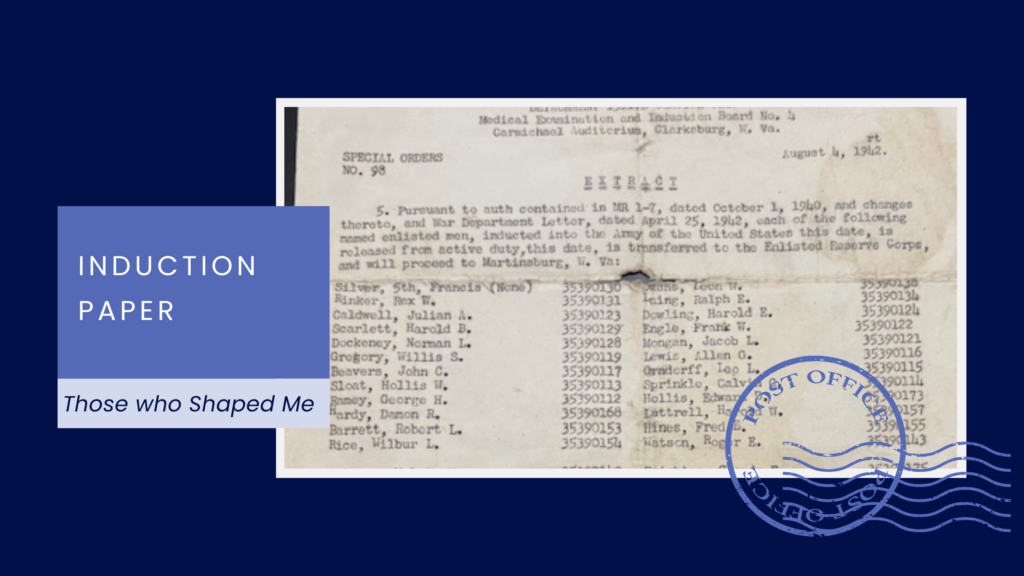
Induction Paper
What this document records is a clearly defined sequence in my father’s entry into military service during World War II, set within the structured and highly organized process of Army induction in 1942. On August 4, 1942, my father, Roger E. Watson, was among a group of men processed through the induction center in Clarksburg, West Virginia. […]
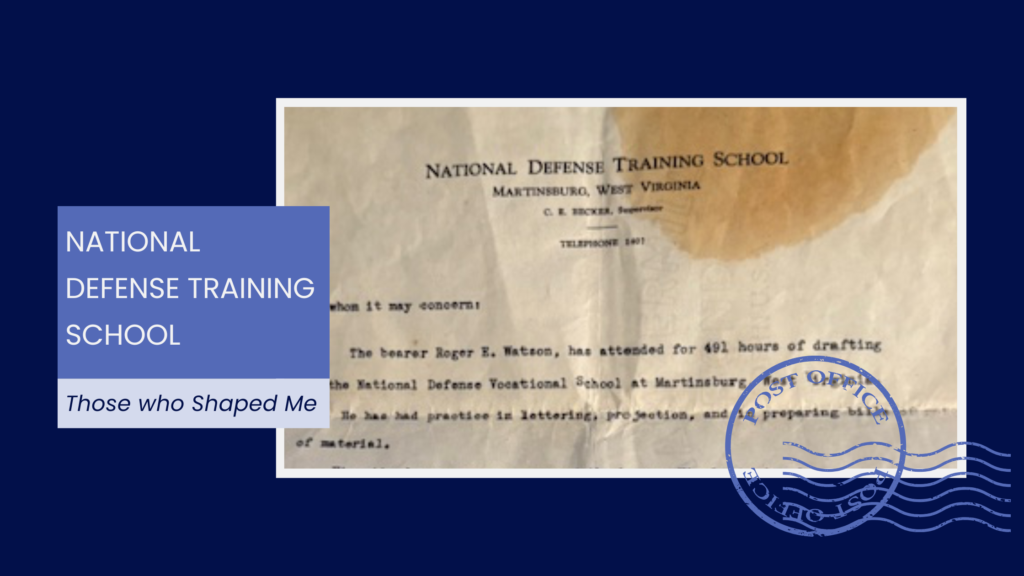
National Defense Training School
Among my parents’ papers that have survived the years is this simple letter from the National Defense Training School in Martinsburg, West Virginia. Although modest in appearance, the document provides a valuable glimpse into my father, Roger E. Watson, as a young man before military service and his marriage to my mother. The letter certifies that […]

