Searching for His Next Chapter
As I continue sorting through the papers my parents left behind, I am discovering that many of them are more than old documents. They are snapshots of lives in transition. They capture moments when the future was uncertain, when important decisions had not yet been made, and when my parents could not possibly have known where life would eventually lead.
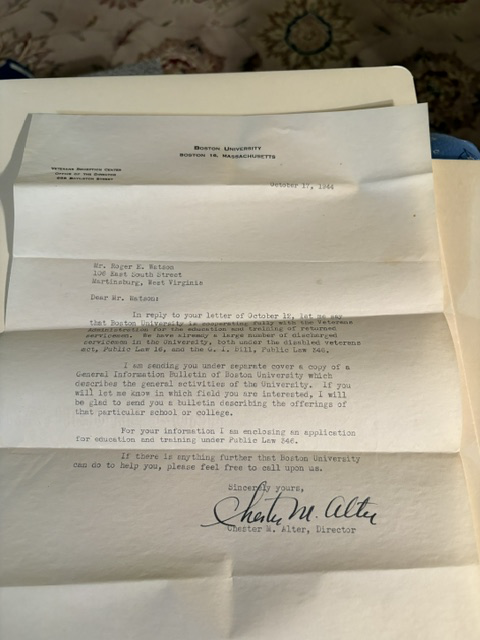
This letter from Boston University is one of those moments. The date is October 17, 1944, only two months after my father, Roger E. Watson, received his honorable discharge from military service in August 1944. The war had changed the course of his life, and now, like millions of other returning veterans, he faced a question that every serviceman eventually confronted: What comes next?
At the time, he was living in Martinsburg, West Virginia, with his mother. His wife remained in New Hampshire, and his life was very much in transition. Rather than settling immediately into a career, he began exploring his options. This letter is one of several I have found from colleges and universities responding to his inquiries about continuing his education through the G.I. Bill.
The letter itself is routine. Boston University explains that, as a veteran, he would be eligible for admission under the educational benefits provided by Public Law 346. Enclosed were a university bulletin, information about academic programs, and an application for admission. But what makes this letter meaningful is not what Boston University wrote. It is what the letter reveals about my father.
It tells me that he was thinking about his future. He was considering returning to school, exploring possibilities, and trying to determine what direction his life should take after military service. Standing where I do today, I know how his story unfolded. I know the career he eventually chose, the family he built, and the life he lived. He did not.
That is what makes these papers so fascinating to me. They allow me to step into a moment when the future was still unknown. Each letter represents another path he considered, another opportunity that might have changed everything. They remind me that the lives we now see as complete were once filled with uncertainty and unanswered questions.
As I work through my parents’ papers, I find that I am no longer simply collecting family documents. I am rediscovering their journeys. These letters reveal not just where my father ended up, but how he searched for his place in the world after the war. They remind me that every life is shaped not only by the decisions we make, but by the possibilities we consider along the way.
Today, this seventy-year-old letter is more than a piece of correspondence from Boston University. It is a reminder that before my father became the man I knew, he was a young veteran trying to imagine what the next chapter of his life might become.
Read More From Nancy
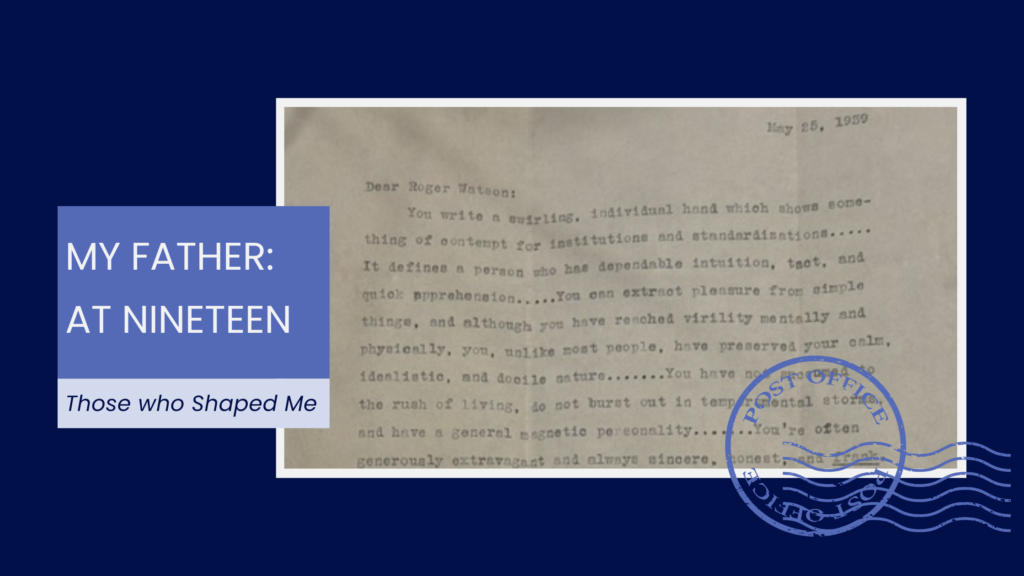
My Father: At Nineteen
Among my father’s papers was this personality assessment, written when he was nineteen years old. He had likely just finished high school and, like many young adults, was trying to determine what direction his life would take. During this period, he explored a variety of interests through correspondence courses in subjects such as cartooning, commercial […]
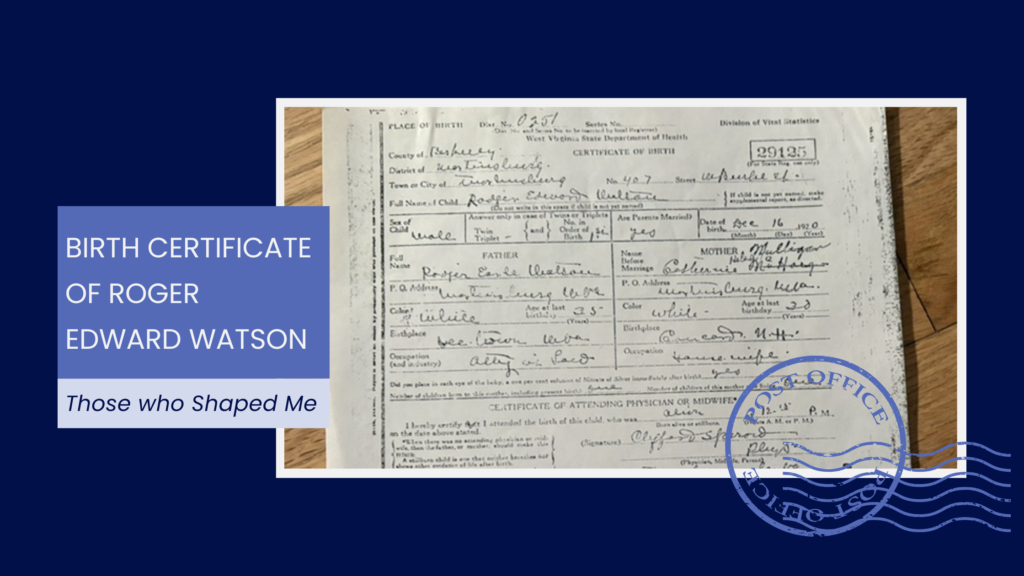
Birth Certificate of Roger Edward Watson
Every birth certificate marks the beginning of a life, but this one also tells the story of two families whose histories had already begun to intertwine. My father, Roger Edward Watson, was born on December 16, 1920, in Martinsburg, West Virginia. His father, Roger Edward Watson, was a West Virginian and an attorney. His mother, […]
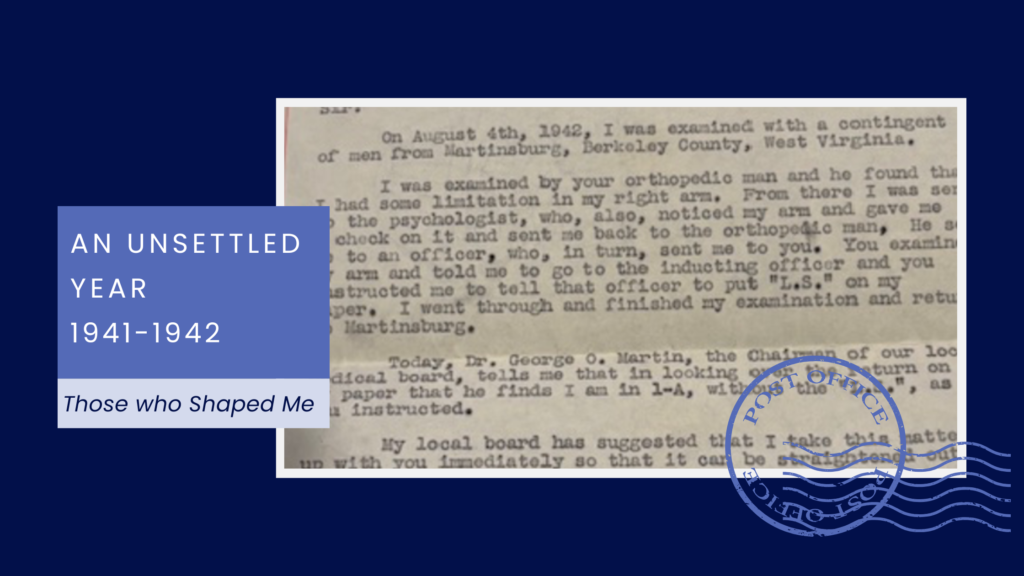
An Unsettled Year – 1941-1942
There is a year of my father’s life that I am slowly piecing together: 1941. He is twenty years old, and his life looks unsettled and scattered across a map. Through my grandmother’s letters, I can trace him from Concord, NH in December of 1940, to Martinsburg, WV in the summer of 1941 and then to […]

