Sant Pau Art Nouveau Site
Standing in front of the Hospital de Sant Pau in Barcelona, it is difficult at first to believe that this extraordinary building was created as part of a working hospital. With its towers, elaborate brickwork, mosaics, sculptures, arched windows and decorative details, it looks more like a palace or cathedral than a place designed for medical care. The building in my photograph is the Administration Pavilion, the monumental entrance to what became one of the most remarkable hospital complexes in Europe. Behind it was an entirely different vision of what a hospital could be.
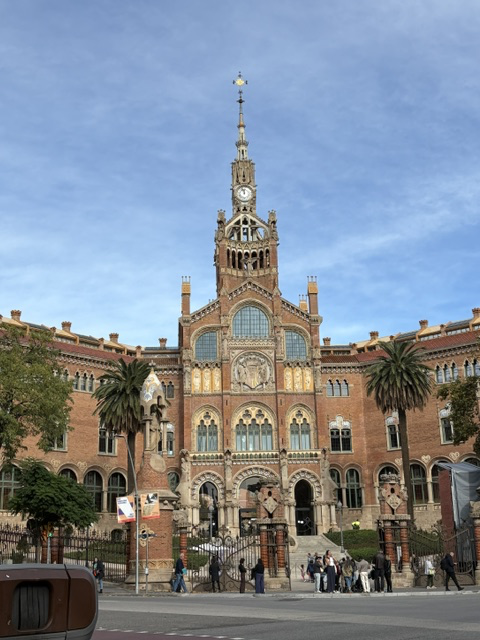
The history of Sant Pau reaches back much further than these buildings. In 1401, six smaller medieval hospitals in Barcelona were brought together to create the Hospital de la Santa Creu. For centuries it served the people of the city, but by the late 1800s Barcelona was expanding rapidly and the old hospital could no longer meet its needs. A large bequest from Catalan banker Pau Gil helped make construction of a new hospital possible. Architect LluísDomènech i Montaner, one of the great figures of Catalan Modernisme, was chosen to design it. Construction began in 1902, and instead of creating one enormous institutional building, he imagined something much more ambitious—a hospital that would function almost as a small city.
The Administration Pavilion formed the grand entrance, but beyond it were individual pavilions devoted to different areas of medical care. These buildings were surrounded by gardens and connected by an underground network of tunnels that allowed patients, staff and supplies to move between them without disrupting the peaceful spaces above.
Domènech i Montaner believed that the environment surrounding a patient mattered. Natural light and fresh air were incorporated into the buildings. Gardens provided open spaces between the pavilions. Windows offered views of trees and sky. Colorful ceramic tiles, stained glass, mosaics, sculpture and decorative stonework appeared throughout the hospital.
Even the Administration Pavilion in my photograph expresses that idea. Every portion of the façade seems to have been considered artistically. Religious and historical imagery, sculpture, ceramics and architectural ornamentation were incorporated into a building that also had a very practical purpose. Patients and families entering the hospital were not greeted by a cold institutional façade but by something intended to inspire.
The hospital continued to function here for much of the 20th century. Medicine changed, however, and eventually the historic pavilions could no longer accommodate the technological and practical requirements of a modern hospital. Medical services were transferred to a newer hospital complex nearby, allowing these remarkable buildings to be preserved and restored.
In 1997, UNESCO designated the Hospital de Sant Pau, together with Domènech i Montaner’s Palau de la Música Catalana, a World Heritage Site. The former hospital complex is now known as the Sant Pau Art Nouveau Site. More than a century ago, architects and physicians were considering how light, air, gardens, color and beauty could influence the experience of people who were sick and recovering. The result was a hospital that treated its surroundings as part of the environment of care.
Read More From Nancy
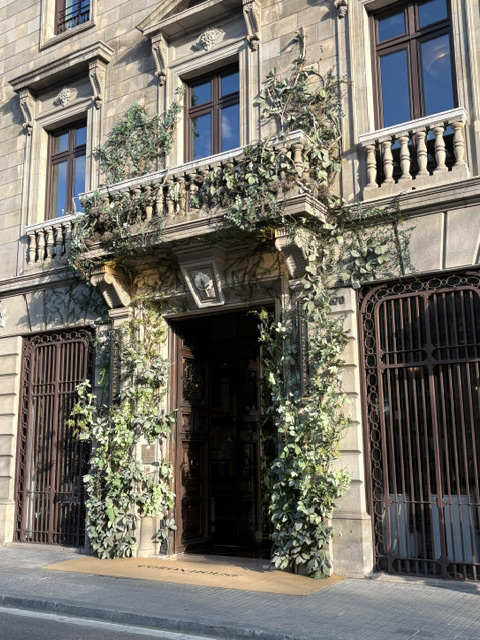
Cotton House Hotel
Whenever we travel, we enjoy staying in places that have a history of their own. A historic hotel often becomes more than a place to spend the night; it becomes another way of understanding the city we have come to explore. That was certainly true during our stay at the Cotton House Hotel in Barcelona. […]
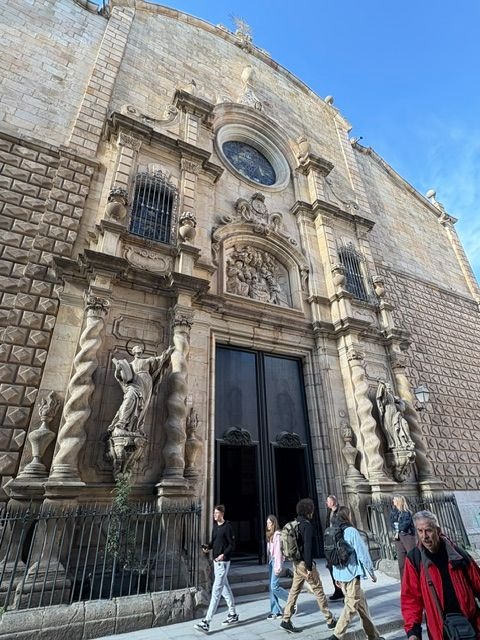
Church of Mare de Déu de Betlem
At the corner of La Rambla and Carrer del Carme, the Church of Mare de Déu de Betlem preserves an elaborate Baroque entrance amid one of Barcelona’s busiest areas. Twisting stone columns, sculpted saints, and a relief of the Nativity identify a church whose history includes two destructive fires and the expulsion of the religious […]
Teatre Romea
On Carrer de l’Hospital in Barcelona’s Raval district, the Teatre Romea preserves a history closely connected with the development of Catalan theater. Behind its columned façade, generations of actors and playwrights helped establish Catalan as a language of popular entertainment and serious dramatic expression. The theater opened on November 18, 1863, in premises previously occupied […]

