The Lyndon Baines Johnson Presidential Library and Museum
Our exploration of presidential libraries took us to Austin, Texas, and the Lyndon Baines Johnson Presidential Library and Museum, located on the campus of the University of Texas at Austin.
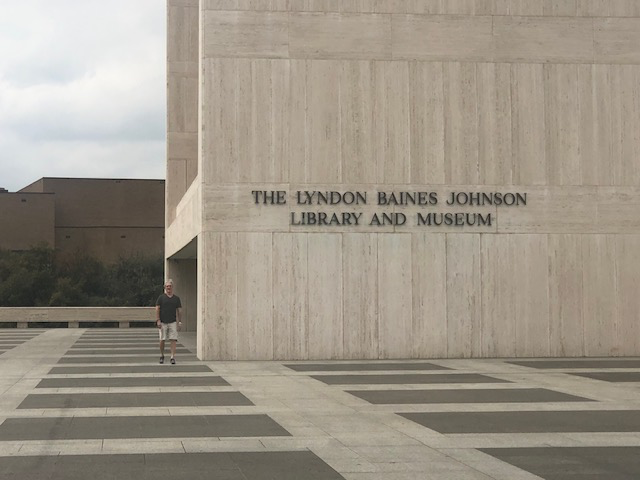
The LBJ Library opened on May 22, 1971, with Johnson himself attending the dedication alongside President Richard Nixon. It was the first presidential library to be located on a university campus. Johnson had deep connections to Texas, and placing the library at the state’s flagship public university reflected his lifelong commitment to education. The location also allowed his presidential papers to become part of an active academic environment where scholars and students could study the events and decisions of his administration.
Johnson’s is a particularly fascinating presidency to explore because it encompasses two very different stories in American history. At home, he presided over one of the most consequential periods of social legislation of the 20th century. Abroad, his presidency became increasingly consumed by the Vietnam War.
Johnson became president under extraordinary circumstances. Following the assassination of John F. Kennedy in Dallas on November 22, 1963, Johnson took the oath of office aboard Air Force One and inherited both the presidency and a nation in shock.
Over the next several years, he used his remarkable understanding of Congress and political power to advance an ambitious domestic program he called the Great Society. During his administration came the Civil Rights Act of 1964, the Voting Rights Act of 1965, Medicare and Medicaid, expanded federal support for education, and programs addressing poverty, housing, conservation and the arts.
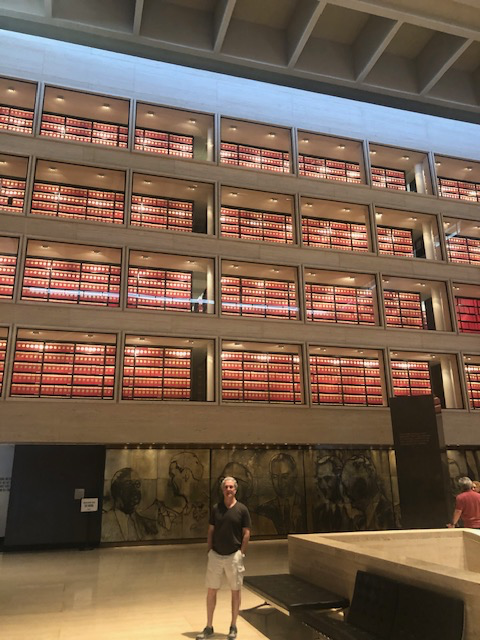
One of the most impressive sights inside is the enormous glass-enclosed archive rising several stories above the Great Hall. Rows of red archival boxes fill the space. They are a wonderful visual reminder that this is more than a museum. The library preserves millions of pages of historical records documenting Johnson’s political career and presidency, allowing historians to continue examining this transformative period in American history.
One of the exhibits introduces visitors to what became known as the “Johnson Treatment”. Johnson was famous for using his imposing physical presence and extraordinary powers of persuasion to get people to support his positions. At about six feet four inches tall, he would move remarkably close to the person he was speaking with leaning over them, gesturing, arguing, flattering and sometimes intimidating until he made his point.
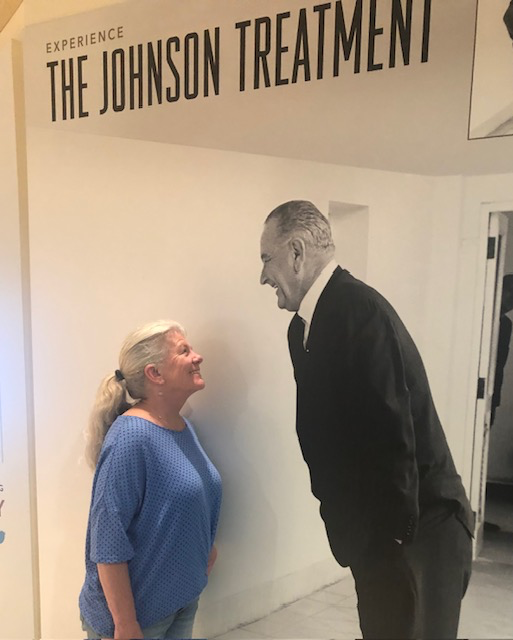
Standing face-to-face with the life-size image of Johnson gave me a rather amusing opportunity to experience what that might have felt like. It is easy to understand why the “Johnson Treatment” became legendary in Washington.
But no exploration of his presidency can avoid Vietnam. American involvement in the war expanded dramatically during Johnson’s years in office. As casualties mounted and opposition grew, Vietnam increasingly overshadowed his domestic achievements and divided the country. In March 1968, Johnson surprised the nation by announcing that he would not seek another term as president.
Walking through it allows us to encounter both the enormous ambitions and the enormous controversies of the 1960s and to better understand the complicated man who occupied the White House during some of the most consequential years in modern American history.