The Texas School Book Depository
When I visited Dallas, one of the places I particularly wanted to see was the Texas School Book Depository at Dealey Plaza. I had seen this red-brick building countless times in photographs and television documentaries, but standing in front of it and later walking through its upper floors gave me an entirely different perspective on a place that has become part of American history.
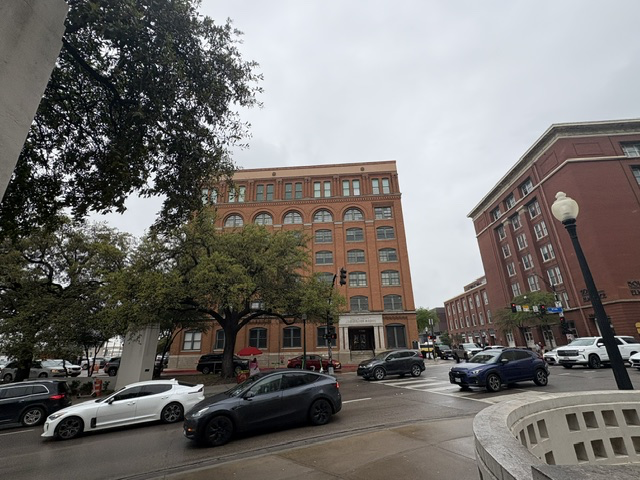
The building’s story actually began decades before it became a book depository. A five-story building was constructed on this site in 1898 for the Southern Rock Island Plow Company, which used it for agricultural equipment. After that building was destroyed by fire following a lightning strike in 1901, the present seven-story structure was erected on the original foundation. Its heavy brick construction and rounded arches reflect the commercial Romanesque Revival architecture popular at the time.
Over the following decades, the building served a succession of very ordinary commercial purposes. In 1937 it became known as the Perfection-Aire Building when an air-conditioning company leased it. From 1941 until 1961, it was the southwestern distribution center for John Sexton & Company, a Chicago-based wholesale grocery business. Then, in 1963, the Texas School Book Depository Company leased the building as a warehouse and distribution center for school textbooks. Regional textbook publishers also maintained offices there.
Everything about the building’s place in history changed on November 22, 1963.
President John F. Kennedy’s motorcade was passing through Dealey Plaza when shots were fired at approximately 12:30 in the afternoon. Investigators soon focused their attention on the Texas School Book Depository. On the sixth floor, near the southeast corner windows overlooking the motorcade route, they discovered three spent cartridge cases. A rifle was subsequently discovered elsewhere on the sixth floor. Depository employee Lee Harvey Oswald was arrested later that afternoon and accused of assassinating the president.
Touring the building was particularly powerful for me because the Sixth Floor Museum allows you to experience the history in the place where it actually occurred. The principal exhibition occupies the sixth floor and follows Kennedy’s presidency, his trip to Texas, the assassination, the investigations that followed and his continuing legacy. Photographs, films, television and radio broadcasts, documents and artifacts reconstruct those days in remarkable detail.
The part I remember most was reaching the southeast corner of the sixth floor. The area identified as the sniper’s perch has been reconstructed using crime-scene photographs, with cardboard book cartons positioned around the windows much as they were found after the assassination. The corner itself is enclosed and preserved, but standing nearby and looking out toward Dealey Plaza makes the geography of that day suddenly understandable. The streets, the height of the window and the distances that seem abstract in photographs become real when you are standing there.
The museum also explores what happened afterward with the search for Oswald, his arrest, his murder by Jack Ruby, the Warren Commission investigation and the enormous body of evidence that has been examined and reexamined ever since. It also considers the controversies and conspiracy theories that grew out of the assassination, allowing visitors to understand why questions about November 22, 1963, have persisted for generations.
The building itself almost became another casualty of the assassination. After the Texas School Book Depository Company moved out in 1970, there were serious efforts to demolish it. Dallas struggled with what to do with a building associated with such a painful event in the city’s history. Eventually Dallas County acquired it, restored the exterior to its 1901 appearance and converted the lower floors for government use. The Sixth-Floor exhibition finally opened in 1989 after years of debate about how the site should be preserved and interpreted.
That history makes my photograph more meaningful to me. This was never constructed as a monument or a museum. It began as a warehouse for farm equipment, later held groceries and eventually became a warehouse filled with schoolbooks. Then, during a few minutes on an ordinary Friday afternoon in 1963, this otherwise unremarkable commercial building became one of the most recognizable buildings in America.
Touring the Texas School Book Depository allowed me to move beyond the photographs I had seen throughout my life. I could stand inside the building, look from its upper floors across Dealey Plaza, and understand the physical setting in which the assassination occurred. The museum preserves not only the events of that day, but also the questions, investigations and debates that have kept Americans returning to this building and its history for more than sixty years.